Serenade after Plato’s “Symposium” – Leonard Bernstein

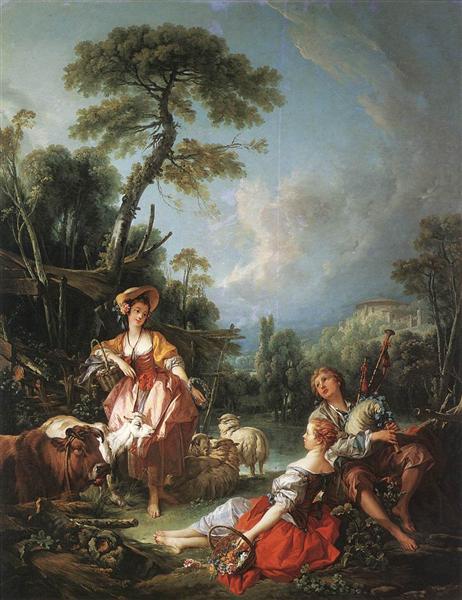
“Summer Pastoral“ (1749)
__________
on my way to my metaphorical
Eiffel Tower, Beethoven’s Piano
Sonata no 15, the “Pastorale”,
his first to impress me, his
Opus 28, despite the notoriety
of the earlier “Pathétique”,
Opus 13, and of the “Moonlight”,
his Opus 27, no 2, splashy
showpieces, those last two, to
my mind, rather than revelatory,
I knew I was going to stop at the
Arche de Triomphe, if you’ll
allow me the developing allegory,
to visit the other “Pastorale”, the
6th, and my favourite, Symphony,
one of the few works which he
named, but where he also gives,
apart from tempo, in the usual
Italian, descriptive headings in
German, the culture that had
taken over the arts, essentially,
from the Italians, during the
18th Century
Erwachen heiterer Empfindungen
bei der Ankunft auf dem Lande,
he, for instance, instructs, or
Awakening of cheerful feelings on
arrival in the countryside, then
Scene by the brook, Merry
gathering of country folk, Thunder.
Storm, and finally Shepherd’s song.
Cheerful and thankful feelings after
the storm – five, unconventionally
already, movements, instead of the
usual three, or four, with headings
that look a lot like stage settings,
cues for a play, chapters in a story
it’s evident that music has explicitly
become, here, literature, movements
have been given a specific thrust,
a particular direction to follow, not
dance, but emotive, appealing to the
vocabulary of the senses, the
grammar of the heart, music as
graphic description, later we’ll even
get tone poems
sure, Vivaldi had written his “Four
Seasons“, 1723, but never, ever,
as precisely rendered as here,
Beethoven brings to life an actual
storm, bing, bang, pow, you hear,
as thunder cracks, rumbles,
crashes, not to mention the virtual
call, chirp, twitter of the various
birds he elicits bristling in the
rustling leaves, you’ll even hear
in the recovering countryside a
rainbow if you listen
music has become a language, a
medium of direct intelligent
communication, enough, indeed,
to verily inspire a century, indeed,
as well, beyond
you’ll also fall in love with Leonard
Bernstein here, who shows why
Leonard Bernstein remains ever,
indisputably, Leonard Bernstein,
beautiful, angelic, inspired
R ! chard
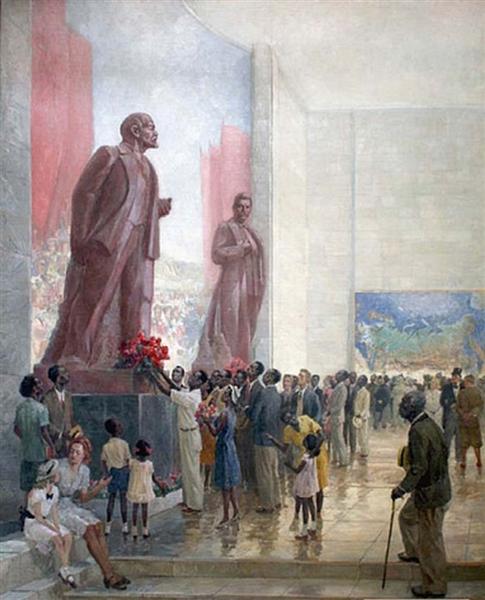
“Great Expectations. USSR pavilion at 1939 New York World’s Fair“ (1947)
________
it’s become evident that Shostakovich’s
symphonies require context, a backstory,
it’s otherwise like listening to a film score
without the movie, though often even
pleasant, it lacks the poignancy that a
story would deliver to the music
accompanying it
not that that’s impossible, John Williams
has delivered, irrespective of if you’ve
seen the relevant film, his “Shindler’s
List“ for example, listen
and I used to fall asleep to Alex North‘s
soundtrack for “Who’s Afraid of Virginia
Woolf”, a film that changed, or rather
defined, my life, much as Somerset
Maugham’s “Of Human Bondage“, the
book, had done a decade earlier,
these would be, I’d intuited,
my destiny
but for specifically political reasons,
the symphonies of Shostakovich,
apart from a few exceptions, the
Fifth, the Eighth, though only
somewhat that one, for instance,
without the accompanying history,
don’t hold, the emotional connection
is too abstruse, foreign, to catch
the Ninth was written in 1945, World
War ll had been won, by the Soviet
Union as well as the Western Allies
Stalin was still in command, Russians
were returning to their oppressive,
indeed murderous, regime
Shostakovich had been expected to
bring glory to the Soviet system, he
delivered instead a joke, in musical
terms, a scherzo, if you can listen to
the language, a wry joke, instead of
a paean to the glory of Stalin, he
delivered not at all a full on hour-long
special as he’d been doing before,
but a short, his shortest, symphony,
full of exaggerated, which is to say,
hypocritical, fanfare
piccolos and flutes cheer, mimicking
flags and banners, trombones boast
an only uncertain victory, deflating
even, in the third movement
decisively, though, I found,
prolongedly, with winds sounding
exhausted, but not succumbing to
standing down, while violins portray
the population in a frenzy, their
military industrial complex having
whipped them into feverish
servitude
Stalin was not amused, the piece
was banned until after the autocrat’s
demise, for its “ideological weakness”
nor was the world then, for that matter,
impressed, who thought the Soviet
superstar’s response to victory was
unusually trivial
but Shostakovich had been unable
to applaud the tyrant, a politically
required duty, if not even officially
commissioned, he could only put
up surreptitiously a pantomime, if
he was to remain true to his
principles
which he did
his work was a call to arms for the
beleaguered denizens of his
oppressed society, spoken in a
locally decipherable musical code
as such it is a historical document
listen to Leonard Bernstein give
further invaluable information on
the subject
R ! chard
“Great Expectations. USSR pavilion on 1939 New York World’s Fair“ (1939)
____________
“I hope that these few preparatory words
can give you an insight that may permit
you to experience this strangely
heterogeneous work as a single entity,
a flashpoint in musical history”, says
Leonard Bernstein, somewhat,
admittedly, grandiloquently, in an indeed
thrilling introduction to Shostakovich’s
Sixth Symphony in B minor, opus 54
that he reiterates several of the points
that I earlier brought up does me no
disservice, coming especially from a
person of such high quality, pedigree,
in the musical world, I’m abashed,
bashful, indeed blushing, that my
humble insights have been so
eminently corroborated
but I cannot second his enthusiasm
for Shostakovich’s Sixth Symphony,
a failed, to my mind, entity, a long
introductory lament that lingered
long after its “best before” date,
followed by indifferent, though
perhaps energetic, yet unrelated,
final movements, the instrumentation
might be, admittedly, brilliant, the
Shostakovichian precise array of
sounds, but the sum is less than the
parts, I think, I took home only
confusion, as did the crowd,
apparently, at its first presentation,
Leningrad, November 21, 1939,
Mravinsky conducting, wow, an
even more convincing argument,
maybe, than Bernstein’s, however
rousing, interpretation
for your information, I’ve included
Tchaikovsky’s Sixth, according to
Bernstein intimately related, he
explains, to Shostakovich’s Sixth
you’ll note how different, however,
these two symphonies are compared
to how similar in so many respects
Beethoven’s and Shostakovich’s
Fifths are, Tchaikovsky’s Sixth is
manifestly more Romantic than
Revolutionary
but imagine Tchaikovsky starting and
ending with an adagio, how audacious,
daring, though not particularly efficient,
I think, not especially successful, the
adagio lamentoso seems to me
anticlimactic after the vigorous allegro
molto vivace, which receives a
thunderous applause, the last
movement, the lamentoso, however
lovely, doesn’t rise to the heights of a
proper finale for this forerunner’s
contagious ebullience, sounds rather
like an encore, melodramatic and a bit
pretentious
or maybe I’m just getting cranky
sooner or later though, the conundrum
of adagio bookends will be resolved,
someone inevitably will do it, like
finding the square on the hypotenuse,
unearthing warped space, discovering
a way to recapture carbon dioxide and
make it work for us, as trees would do
if we let them, someone always exceeds,
miraculously, our expectations, watch
for it, dare I say, here
R ! chard

“Colors For A Large Wall“ (1951)
__________
talking about walls, isn’t it only a few
years ago we were tearing one down
here is Roger Waters and several
other outstanding guest artists, in
very Berlin, July 21, 1990, celebrating
its demise
a little earlier, C***mas, 1989, only
moments after East Germans had
been allowed to visit West Germany,
essentially giving way to the
dissolution of the barrier, Leonard
Bernstein conducted Beethoven’s
Ninth Symphony, changing the
word “joy” from the title of Schiller’s
poem, appropriated by Beethoven
for his great fourth choral movement,
to “freedom”, giving new meaning,
and new life, and new inspiration,
to Beethoven’s always resounding
nevertheless masterpiece
how soon we’ve forgotten
Richard
psst: let’s paint the wall
“May Day in Freedom“ (1958)
__________
two events took place after the fall
of the Berlin Wall, which have
remained cultural landmarks since,
nothing much comes close to their
historical significance, music to
declare a new world order
on December 25, 1989, Leonard
Bernstein conducts Beethoven’s
Ninth Symphony at the
Schauspielhaus in the former
East Berlin, it is remembered as
the “Freedom Concert” for having
replaced the word “Joy” in
Schiller’s poem during the “Ode
to Joy”, the vocal novelty of the
Ninth, also its triumph, with the
word “Freedom”, a whim of the
conductor, not inappropriately
on July 21, 1990, Roger Waters
puts on “The Wall“, Pink Floyd’s
20th-Century counterpart for the
Beethoven, the clarion call to do
away with barriers, fences, it’s
hard to dismiss its prescience
when the piece had been written
eight years earlier, seven years
before the fall of the Wall, as
though Pink Floyd had been
prophetic
like Beethoven had been, not
at all coincidentally here, in
his own day
both concerts are beyond
description, extraordinary
watch for unexpected guest
appearances in either of,
everywhere, the very highest
quality
Richard
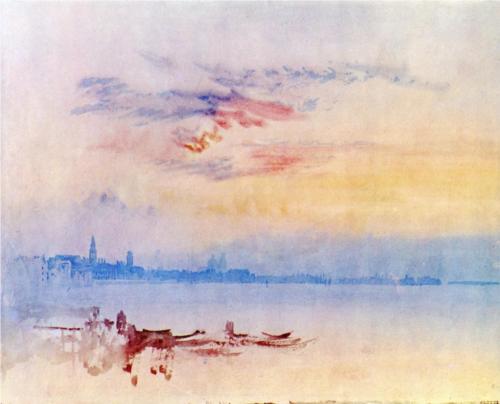
“Venice Looking East from the Guidecca, Sunrise“ (1819)
_______
“Death in Venice“ is perhaps the most
beautiful film I’ve ever seen, just click
Visconti suffuses his masterpiece with
all the colours and textures of Monet,
Renoir, Seurat, Toulouse-Lautrec, and
a host of other Impressionists, and
settles them all upon, nearly inevitably,
the splendours of a Canaletto Venice
Dirk Bogarde has never been better,
his von Aschenbach is definitive,
Silvana Mangano is every single inch
an aristocrat, the epitome of poise,
elegance and propriety, Tadzio is
throughout the very incarnation of a
Botticelli
all is given stately motion by the art
of film and made thereby into another
equal and haunting form of poetry
enjoy, marvel
Richard
psst: Visconti even makes Mahler sound
profound
as does Leonard Bernstein, incidentally,
in the accompanying clip, who is
manifestly transported throughout his
evidently otherworldly experience,
just as you might even be, just click
so that you may enjoy these masterpieces at your leisure, I’ve
compiled, for an online musical library you might easily store
among your “Folders”, the best I could find of Beethoven’s five
piano concertos on the Internet, all of them of course complete,
which is to say with all of their unabridged individual sections,
for what is a concerto by definition without its integral
movements, its parts, in Beethoven these fast, slow, fast, in
that order, fast first to draw in your attention, slow then to
signal the composer’s, the interpreters’ varied musical abilities,
versatility, then last fast again to send you off on your merry
way a happy, even exhilarated, camper, these are the
traditional, Classical, structural arrangements, this will change
there are better performances than the clutch of five here first
presented, a collaboration several years ago between a somewhat
celebrated, though inpressively able, performer, Krystian
Zimmerman – an especially European fame, which is of course not
surprising it being their very own music, which resounds for
them more than for us culturally, who only sporadically retained
some vestiges of it generally in our psyches across the pond,
we were busy building countries – and the illustrious, legendary
Leonard Bernstein, who died before finishing this august project
so that Zimerman had to continue on his own, he conducts from the
bench the 1, and the 2, having, I think, channeled his eminent
master for his conducting work sounds magnificently similar
there are better performances, I say, but there are also much,
much worse, and both Bernstein and Zimerman are entirely
worth the price of admission, only your time
the 1, in C major, opus 15 (1796/7)
the 2, in B flat major, opus 19 (1787/9)
the 3, in C minor, opus 37 (1800)
the 4, in G major, opus 58 (1805/6)
and the 5, in E flat major, the mighty, the “Emperor”, opus 73 (1809/11)
I couldn’t help adding to this compendium an alternate 2 of
great energy and enthusiasm, with younger and less austere
celebrants, Paul Lewis plays the piano with Andris Nelsons
conducting the City of Birmingham Symphony Orchestra at
the Royal Albert Hall, London, July 29, 2010
what the old lack in dexterity, agility, they make up for in
tenderness, Alfred Brendel, another titan, sent shivers up my
spine early with the very first quiet notes he spun, delicately,
exquisitely, then intermittently again thrillingly throughout
so that I often swooned, flushed, he is led by Claudio Abbado,
whose silken sounds are never in the shadow of the great
pianist, the other equal part of that bilateral heaven
Claudio Abbado replaced Herbert von Karajan, that illustrious
luminary, at the head of the Berlin Philharmonic, with the Vienna
Philharmonic perhaps the two best orchestras then in the world,
when von Karajan died, 1989, this incidentally just after women
were being allowed in those orchestras, 1982 in Berlin, Karajan
was not amused, 1997 in Vienna, a contentious development still
over there, Vienna has only one yet, the harpist
they do a sublime, ravishing, utterly captivating Third, they are
at the Lucerne Festival with the Lucerne Festival Orchestra,
August 10, 2005
George Li is 15, Mark Churchill conducts the Symphony ProMusica,
somewhere, January 30, 2011, an intriguing curiosity, they do the
4, the enchanting unexpected encore is a piano transcription from
a flute obbligato, a required flute solo, from Glück’s wonderful
opera, “Orphée et Eurydice“, stick around
Beethoven transcends age incidentally, as well as cultures, races,
one might note, in that last production, the work, the sine qua
non indeed, the otherwise-there-is-none, of art
do not try to do all this at once, this is entirely for your delectation,
and further reference
Richard
psst: for the Beethoven, take out your metronome, or just
tap the beat, or nod to it, note again the rigidity of
the beat in Beethoven, you can even get up and
marvel, dance
 Richibi's Weblog