Richibi’s Weblog

Just another WordPress.com weblog

Tag: Lenin

Dmitri Shostakovich – “Symphony No 4” in C minor, opus 43
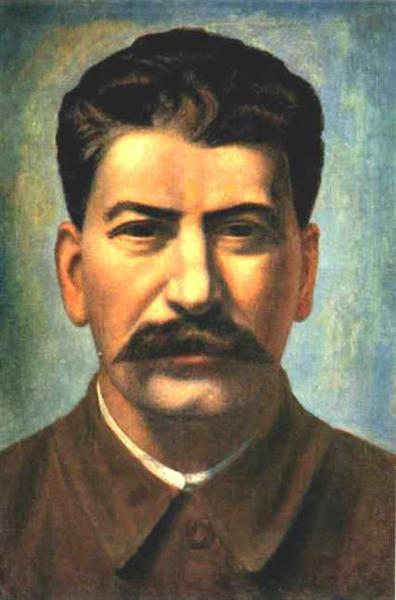
portrait-of-joseph-stalin-iosif-vissarionovich-dzhugashvili-1936.jpg!Large

   “Portrait of Joseph Stalin (Iosif Vissarionovich Dzhugashvili) (1936)

                   Pavel Filonov

                           _________

if you’ve been waiting for a Shostakovich 
to write home about among his early 
symphonies, here’s the one, his 
Symphony no 4 in C minor, opus 43 will
knock your socks off from its very 
opening gambit, have a seat, settle in, 
and get ready for an explosive hour

the Fourth was written in 1936, some 
years after the death of Lenin, and the 
instalment of Stalin as the supreme, 
and ruthless, authority, after several 
years throughout the Twenties of
maneuvering himself, cold-bloodedly,
into that position 

from Stalin, Death is the solution to 
all problems. No man – no problem.

fearing retribution after Stalin had 
criticized his recent opera, Lady 
Macbeth of Mtsensk“, Shostakovich 
cancelled the first performance of 
this new work, due to take place in 
December, ’36, others had already 
suffered internal exile or execution 
who had displeased the tyrant, a 
prelude to the infamous Great Terror

the Symphony was eventually played
in 1961, 25 years later, conducted by
no less than Kirill Kondrashin, who’d
partnered Van Cliburn a few years 
earlier in Cliburn’s conquest of Russia
but along with this time however the 
long-lived Leningrad Philharmonic 
Orchestra 

to a friend, I said, this is the biggest
thing since verily Beethoven, no one 
has so blown me away symphonically 
since then

he looked forward, he replied, to 
hearing it 

the Fourth Symphony has three distinct 
movements, to fit thus appropriately the 
definition of symphony, though the first 
and third have more than one section, 
something Shostakovich would have 
learned from already Beethoven, it gives 
the opportunity of experiencing a variety 
of emotions within one uninterrupted 
context, add several movements and 
you have a poignant, peripatetic musical 
journey, more intricate, psychologically 
complex, than many other even eminent
composers, Schubert, Chopin, 
Mendelssohn, even Brahms, for instance 

it’s helpful to think of film scores, and 
their multiple narrative incidents,
brimming with impassioned moments,   
however disparate, Shostakovich had 
already written several of them

let me point out that Shostakovich’s 
rhythms are entirely Classical, even 
folkloric in their essential aspects, 
everywhere sounds like a march, 
proud and bombastic, if not a 
veritable dance, peasants carousing,
courtiers waltzing, and repetition is
sufficiently present to not not 
recognize the essential music 
according to our most elementary
preconceptions

but the dissonances clash, as though 
somewhere the tune, despite its rigid 
rhythms, falls apart in execution, as 
though the participants had, I think,  
broken limbs, despite the indomitable 
Russian spirit

this is what Shostakovich is all about, 
you’ll hear him as we move along 
objecting, however surreptitiously,
cautiously, to the Soviet system, like 
Pasternak, like Solzhenitsyn, without 
ever, like them, leaving his country 
despite its manifest oppression, and 
despite the lure of Western accolades,
Nobel prizes, for instance, it was their 
home

and there is so much more to tell, but
first of all, listen

R ! chard 
  

Dmitri Shostakovich – Symphony no. 2 in B major, opus 14 – “to October”

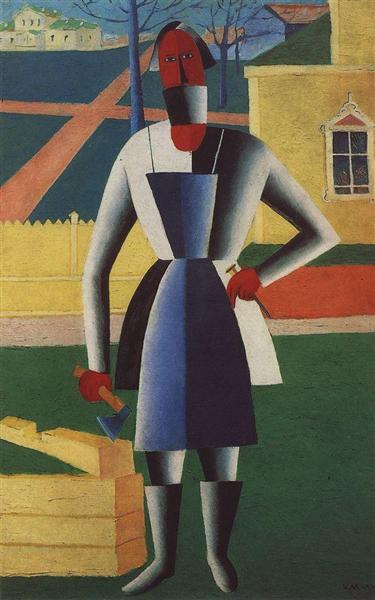
carpenter-1929.jpg!Large

    “Carpenter (1929) – note the industrialization 
                                       of the subject, however 
                                       Cubist, for better or for 
                                       worse

      Kazimir Malevich

             _________

Shostakovich’s Symphony no. 2 doesn’t 
sound like a symphony – one movement
only, a chorus – but was never meant to, 
it had been conceived as a piece in 
commemoration of the October 
Revolution, a significant event in the 
Communist cosmology, and
commissioned by that very polity, 
hence the name, to October

but later, the symphonic poem was 
included chronologically, thus no 2,  
in the Shostakovichian oeuvre – if 
you’ll excuse that pedantry, “oeuvre” 
being too sweet a word for me not to 
resist its austere territoriality – the 
Symphony no 2 in B major being 
first performed in 1927 

it starts a shade above inaudibly, which 
I often find irritating – unless, of course, 
it’s Wagner, or Richard Strauss, who 
knew what they were doing – suggesting 
something significant is rumbling, 
brewing on the musical horizon, after 
which we enter in a lively fashion upon 
a dance, full of folkloric flavour

but the harmonies are atonal, discordant, 
a society, however traditional, is in disorder, 
tonality, one of the stalwarts of Classicism, 
along with tempo and repetition, has been 
upended, distorted, the commune, the 
community, can, no longer unburdened, 
with only discordant harmonies, dance, 
though you can feel them trying

Ravel does something similar in his 
La valse“, where, with a distortion  
of tempo, the world is spinning  

with only a change in volume, intensity,
in Shostakovichthe music becomes 
martial, autocratic, peremptory, nearly 
even frightening

I found at this point that the subtlety of 
the move from the conviviality of dance  
to the aggression delivered by a more 
forceful music, marches and so forth,
lay in a mere alteration of the musical 
pulse, from seduction to, indeed, rape, 
in a simple change of rhythm – thus is it 
written in our very sensibilities 

a violin obbligato then intervenes, 
strangely, but welcome, in a piece of
brash, by this point, agitprop, but 
soon becomes as vociferous as 
earlier the crowd who wanted to, 
however awkwardly, dance

the obbligato, incidentally, instead of
an out and out solo part, as also with 
the piano in Shostakovich’s First 
Symphony, suggests the work of a
a community, a Soviet ideal, rather 
than that of an individual asserting 
hir particular predominance, if you  
listen between the lines

a particularly impressive chorus 
eventually delivers a tribute, a  
hagiographic poem, to Lenin, which 
Shostakovich abjured, but delivered 
nevertheless for the money, and for 
the influence, reportedly, however 
ignominiously, for he was young, 
not fully formed, innocent yet  

it resembles, of course, a cantata, a
religious chant – see Bach, one of the 
evident muses of Shostakovich – but 
which addresses here a political 
system, a cute trick of contemporary 
secular regimes, the several –isms 
within our post-religious ideological
societies 

watch for it

note the spoken, or rather, prosaically 
proclaimed last verses of the oration,
hortatory, don’t you think, or what

R ! chard

psst: incidentally, few composers are as 
          political, though few have been 
          under such ideological pressure,
          as Shostakovich