Dmitri Shostakovich – “Symphony No 5” in D minor, opus 47
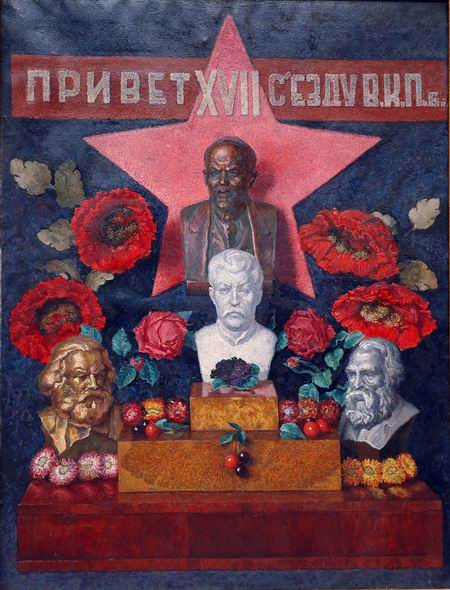
“Hi, XVII Congress of the CPSU (B)“ (1934)
__________
if I thought the Fourth would knock
your socks of, stockings, the Fifth
ought to leave you with, dare I say,
nothing on but your awe, it is
extraordinary, so settle in, pour
yourself a glass of wine, or vodka
if you want to be ethnic, for a
mesmerizing three-quarter hour
days only before the first performance
of Shostakovich’s new symphony, an
article showed up in a leading Moscow
paper suggesting that it would be “a
Soviet artist’s creative response to
justified criticism” in reference, of
course, to Stalin’s displeasure with
Shostakovich’s “Lady Macbeth of
Mtsensk“, which had led to the
cancellation of his Fourth Symphony,
read all about it here
disregard for Stalin’s opinion would
have meant certain execution in an
environment where the leader could
not be contradicted, the ruler wanted
uplifting tunes, the rule was Socialist
Realism, art to celebrate the Party
a similar thing was happening at the
same time in Germany, incidentally,
with Hitler objecting to “entartete
Kunst“, the degenerate art that
moderns were producing, Kirchner,
Klee, Dix, for example, who were
only painting, as Shostakovich was
only composing, what they heard,
saw, for which they were all
persecuted
a few necessary words about the
Fifth Symphony itself, if
Shostakovich had been moving
toward dissonance, you’ll find the
Fifth particularly notable for its
tonal melodies, however sometimes
astringent, more larger intervals,
sevenths, octaves, than strident
atonal conjunctions
and since Shostakovich had been
strictly adhering to the two other
Classical conditions, of tempo and
repetition, this symphony might as
well be a Romantic composition
listen to Beethoven’s Fifth and
compare, they sound nearly
identical but for a 130 years
distance, the peremptory opening,
loud, brash, bracing, followed
quickly by a lull in intensity, four
movements each, horns blare in
either military salvos, a propensity
toward dance rhythms, short, sweet
solo moments for several assorted
instruments, usually contemplative,
piercingly personal – after a
comparison, you’ll never see
Beethoven’s Fifth in the same light
again
Beethoven, however, though
forceful, indeed thunderous, is
more centred on the actual music,
which is jubilant, celebratory, an
exultation, while Shostakovich by
contrast, however equally martial,
sounds the implacability, the
ruthlessness of the fanfare, the
parade, you can feel the iron step
of the guard, their advance
inexorable, this is unquestionably
a political statement, then again
Beethoven didn’t live in France
it’s to be noted that both works
are products of a recent revolution,
the French, the Russian, and the
imminence of a Terror, as well of
the return of an autocratic leader,
the Emperor Napoleon in the first
instance, in the second, of course
Stalin
it’s helpful to view the bombastic
portions in Shostakovich, as the
unassailable positions of the Party,
the more melting moments and
single voices as those of the
oppressed proletariat, a people up
against the stringent requirements
of an unforgiving state growing up
all around them
a return to strict Classical
conditions, by the way, which is
to say “tunes”, might’ve been
Shostakovich’s way of placating,
however risky still, a dictator’s
fearful edicts regarding
permissible taste, that’s what
you can do when you can speak
the language
incidentally, the symphonies are
either composer’s Fifth, perhaps
not incidentally
R ! chard
psst: the applause at the first
performance, November 21,
1937, lasted over half an hour,
people were crying, they’d
found a prophet
 Richibi's Weblog