Richibi’s Weblog

Just another WordPress.com weblog

Tag: Kirill Kondrashin

Dmitri Shostakovich – “Symphony No 4” in C minor, opus 43
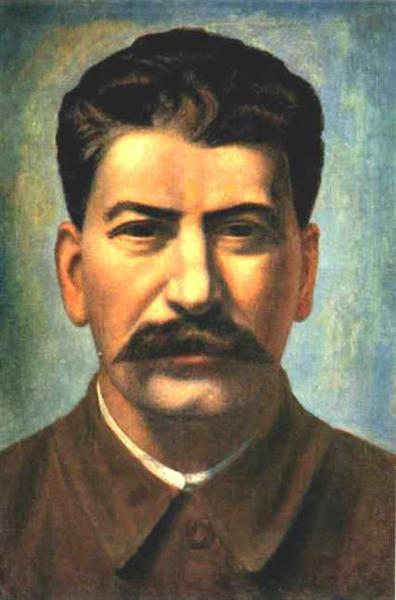
portrait-of-joseph-stalin-iosif-vissarionovich-dzhugashvili-1936.jpg!Large

   “Portrait of Joseph Stalin (Iosif Vissarionovich Dzhugashvili) (1936)

                   Pavel Filonov

                           _________

if you’ve been waiting for a Shostakovich 
to write home about among his early 
symphonies, here’s the one, his 
Symphony no 4 in C minor, opus 43 will
knock your socks off from its very 
opening gambit, have a seat, settle in, 
and get ready for an explosive hour

the Fourth was written in 1936, some 
years after the death of Lenin, and the 
instalment of Stalin as the supreme, 
and ruthless, authority, after several 
years throughout the Twenties of
maneuvering himself, cold-bloodedly,
into that position 

from Stalin, Death is the solution to 
all problems. No man – no problem.

fearing retribution after Stalin had 
criticized his recent opera, Lady 
Macbeth of Mtsensk“, Shostakovich 
cancelled the first performance of 
this new work, due to take place in 
December, ’36, others had already 
suffered internal exile or execution 
who had displeased the tyrant, a 
prelude to the infamous Great Terror

the Symphony was eventually played
in 1961, 25 years later, conducted by
no less than Kirill Kondrashin, who’d
partnered Van Cliburn a few years 
earlier in Cliburn’s conquest of Russia
but along with this time however the 
long-lived Leningrad Philharmonic 
Orchestra 

to a friend, I said, this is the biggest
thing since verily Beethoven, no one 
has so blown me away symphonically 
since then

he looked forward, he replied, to 
hearing it 

the Fourth Symphony has three distinct 
movements, to fit thus appropriately the 
definition of symphony, though the first 
and third have more than one section, 
something Shostakovich would have 
learned from already Beethoven, it gives 
the opportunity of experiencing a variety 
of emotions within one uninterrupted 
context, add several movements and 
you have a poignant, peripatetic musical 
journey, more intricate, psychologically 
complex, than many other even eminent
composers, Schubert, Chopin, 
Mendelssohn, even Brahms, for instance 

it’s helpful to think of film scores, and 
their multiple narrative incidents,
brimming with impassioned moments,   
however disparate, Shostakovich had 
already written several of them

let me point out that Shostakovich’s 
rhythms are entirely Classical, even 
folkloric in their essential aspects, 
everywhere sounds like a march, 
proud and bombastic, if not a 
veritable dance, peasants carousing,
courtiers waltzing, and repetition is
sufficiently present to not not 
recognize the essential music 
according to our most elementary
preconceptions

but the dissonances clash, as though 
somewhere the tune, despite its rigid 
rhythms, falls apart in execution, as 
though the participants had, I think,  
broken limbs, despite the indomitable 
Russian spirit

this is what Shostakovich is all about, 
you’ll hear him as we move along 
objecting, however surreptitiously,
cautiously, to the Soviet system, like 
Pasternak, like Solzhenitsyn, without 
ever, like them, leaving his country 
despite its manifest oppression, and 
despite the lure of Western accolades,
Nobel prizes, for instance, it was their 
home

and there is so much more to tell, but
first of all, listen

R ! chard 


Brahms violin concerto in D major, Op.77

though I’d’ve preferred to consider violin concertos for a while
after the Tchaikowsky, the Beethoven, a break from the usual,
though always eminently magisterial, piano, I was unable to
quickly find a performance of the work I had in mind that would
suit my needs, nothing primarily that was complete, that had all 
its unabridged movements
 
and what’s a concerto without its movements, a meal without
an appetizer, without its main course maybe, without even 
dessert, that’s making do, that’s subsisting, that’s got nothing
to do with appreciating a meal, not to mention our pending
Thanksgiving
 
then the Chopin struck, a very revelation, and I couldn’t, even
temporarily, put it aside 
 
I hope you enjoyed it   
 
 
because the Brahms in D major, opus 77, is after the first
two violin concertos I listed the third most revered and 
respected major string work, it cannot but be duly and
with great honour represented in any Classical music 
survey
 
the first movement, the allegro non troppo, or, jauntily but
not too much, in English, is played by David Oistrakh and 
conducted by the legendary Kirill Kondrashin, who conducted
Van Cliburn, famously, in both his Tchaikowsky One and
Rachmaninoff Three concertos in Moscow, 1958, when Cliburn 
won first prize, is he the best, Khrushchev asked when
nervous judges questioned awarding an American, give it
to him then, he most judiciously replied, in the very face
of Cold War bile and cynicism 
 
Kondrashin defected to the West in 1978 
 
David Oistrakh never left his homeland, Russia, though he
toured extensively enough in the West, surely dazzling
everywhere rapt audiences
 
 
the next two movements, the adagio, slow, the allegro 
but not too lively – little by little go faster, have the
glorious Leonard Bernstein jumping up and down even 
with exhilaration at the thrilling sounds they are making,
while the equally glorious Gidon Kremer struts inimitable,
incendiary stuff, a Tchaikowsky competition winner also
he, in 1970, who ‘s since dominated and championed an
impressively extensive and eclectic, even modern, 
repertoire  
 
note in passing that their accompanying Vienna Philharmonic
doesn’t have a single woman, which nevertheless doesn’t 
of course disqualify a superior sound, it is merely an archaic,
intransigeant, aristocratic institution, it would appear, with
counterintuitively melodious and undeniably winning soul
 
 
one course at one restaurant then, the next two at another,
you’ll need to adjust to atmosphere, menu variations,
service, but expect in either case only the very best, you
will not be disappointed 
 
 
Brahms violin concerto in D major, opus 77
 
              1 – allegro non troppo, Oistrakh, Kondrashin,
                                                          the Moscow Philharmonic Orchestra
              2 – adagio, Gidon Kremer, Leonard Bernstein, the Vienna Philharmonic
                                                              Kremer, Bernstein,  
                                                    the Vienna Philharmonic again
 
 
Richard 
 
psst: here is an alternate third movement by to me unknowns,
         an exquisite partial repast, perhaps the most impressive
         morsel here    


Rachmaninoff: Piano Concerto no 3, in D minor, opus 30

fully 150 years after Mozart the concerto was still a thriving
musical form though it had undergone some modifications,
you’ll hear a more passionate account in Rachmaninoff than
the more lyrical, less emotionally overt compositions of
Mozart, the variations in volume, tempo, tonality, the play
of harmonization and discords, all incidentally within a single
movement, show the passage of time, of Beethoven, of Chopin,
of Debussy between Mozart and the more Romantic, Impressionistic
Rachmaninoff, note the sweeping ritardandos, where the beat is
drawn out, stretched for pathos, a Chopinesque insinuation into
music not found in earlier stuff, one imagines torrid expressions
of fervent sentiment, note the evanescent flurry of notes passing
by like the fleeting glitter of stars, the ephemerality of an
incorporeal idea that Debussy originated and brought to music,
and of course note the irrepressibility, the authority, the masculinity
of a volcanic Beethoven underpinning the lot, you can hear them all

the Vladimir Horowitz Piano Concerto no 3 of Rachmaninoff at
Carnegie Hall, January 8, 1978, with Eugene Ormandy leading the
New York Philharmonic Orchestra is, after Van Cliburn’s historic
1950s account, May 19, 1958, again at Carnegie Hall but under Kiril
Kondrashin this time, and the now defunct Symphony of the Air,
don’t ask, the one I then grew up with, it was riveting even without
the pictures

with pictures here he is again a few months later at Avery Fisher
Hall in New York, September 24, 1978, under Zubin Mehta with
again the New York Philharmonic, so good you’ll even forgive
Mehta his usual sentimental excesses

incidentally Horowitz was 74 at this concert, he is astounding

Vladimir Horowitz, colossus and legend, 1903 -1989

enjoy, be transported, be transfixed, you have been warned

Richard