Richibi’s Weblog

Just another WordPress.com weblog

Tag: Khrushchev

Symphony no 11 in G minor, opus 103 (The Year 1905) – Dmitri Shostakovich
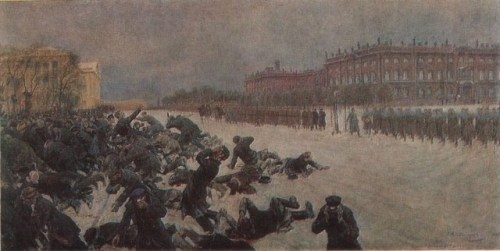
bloody-sunday-shooting-workers-near-the-winter-palace-january-9-1905-1  Bloody Sunday. Shooting workers near the Winter Palace January 9, 1905” 

       Ivan Vladimirov

            ________

if you don’t find a lot to hang on to in
Shostakovich’s 11th Symphony, as I
didn’t, apart from his everywhere
ravishing instrumentation, it’s that 
the piece is a commemoration of a 
particular event in Russian history, 
Bloody Sunday, when the Tsar’s 
Imperial Guard opened fire on a 
crowd of unarmed protestors who 
had come to petition Nicolas ll for 
better work conditions, akinindeed, 
to slavery then, there, January 22, 
1905, the first stirrings, thus, of the 
1917 Russian Revolution, which 
installed the Bolsheviks, Leninism, 
then Stalinism, and so forth

Bloody Sunday can be compared to 
China’s Tiananmen Square, June 4, 
1989it seems totalitarian states will 
blithely resort to such dire measures

Shostakovich had been commissioned 
to write a symphony for the 50th 
anniversary of the event, January 22, 
1955

he’d been reinstated by Khrushchev  
after the death of Stalin, who’d 
excused the tyrant’s condemnation 
of Shostakovich by saying the despot 
had been too subjective, and rescinded 
the law which that earlier ruler had 
imposed requiring all artists to  
conform to party ideology, see Hitler 
again on that one, his proscribed
entartete Kunsthis interdicted
degenerate art

but for personal reasons, Shostakovich 
was unable to compose this new work 
until 1957, the year after the Soviets had 
quashed the Hungarian uprising of 1956
with tanks and ammunition, an event 
too reminiscent of, to the composer, the
earlier tsarist massacre, and horrifying

furthermore, his father had been there,
and spoke of children having been shot 
out of the trees as they merely watched
the proceedings, felled too suddenly, 
apparently, to wipe the smiles off their 
innocent still faces 

the Symphony is called The Year 1905“,
it is mighty, but is too local to effect any
universal understanding, I think, the 
program is too specifically Russian to 
evoke more than historical attention to
an unacquainted observer, listener

I’d visited a church in Rome, Sant’Agnese
fuori le mura, St Agnes Outside the Walls,
once, a place I would not miss were I ever
to return to that illustrious city, before even 
the Vatican, the Coliseum, et cetera, the 
church was built in the 4th Century and 
has weathered the ages, the vicissitudes 
of time, with all their impositions 

the mass was in Italian, however, not the 
Latin that had once united all Catholics
in a common set of sounds that had been
internalized to represent the message of 
the service

but now I could only recognize the form,
no longer the content, something like the 
response a person without the history
of Russia would have here, I would 
contend

this is the dilemma of this, however 
significant, composition, I find

you might also imagine that a tribute to
Canadian soldiers who’d died at, say,
Vimy Ridge, or Passchendaele, might 
not be as moving to someone who    
wasn’t Canadian 


Shostakovich received the Lenin Prize
for his achievement, one of the Soviet 
Union’s most prestigious accolades


R ! chard

Brahms violin concerto in D major, Op.77

though I’d’ve preferred to consider violin concertos for a while
after the Tchaikowsky, the Beethoven, a break from the usual,
though always eminently magisterial, piano, I was unable to
quickly find a performance of the work I had in mind that would
suit my needs, nothing primarily that was complete, that had all 
its unabridged movements
 
and what’s a concerto without its movements, a meal without
an appetizer, without its main course maybe, without even 
dessert, that’s making do, that’s subsisting, that’s got nothing
to do with appreciating a meal, not to mention our pending
Thanksgiving
 
then the Chopin struck, a very revelation, and I couldn’t, even
temporarily, put it aside 
 
I hope you enjoyed it   
 
 
because the Brahms in D major, opus 77, is after the first
two violin concertos I listed the third most revered and 
respected major string work, it cannot but be duly and
with great honour represented in any Classical music 
survey
 
the first movement, the allegro non troppo, or, jauntily but
not too much, in English, is played by David Oistrakh and 
conducted by the legendary Kirill Kondrashin, who conducted
Van Cliburn, famously, in both his Tchaikowsky One and
Rachmaninoff Three concertos in Moscow, 1958, when Cliburn 
won first prize, is he the best, Khrushchev asked when
nervous judges questioned awarding an American, give it
to him then, he most judiciously replied, in the very face
of Cold War bile and cynicism 
 
Kondrashin defected to the West in 1978 
 
David Oistrakh never left his homeland, Russia, though he
toured extensively enough in the West, surely dazzling
everywhere rapt audiences
 
 
the next two movements, the adagio, slow, the allegro 
but not too lively – little by little go faster, have the
glorious Leonard Bernstein jumping up and down even 
with exhilaration at the thrilling sounds they are making,
while the equally glorious Gidon Kremer struts inimitable,
incendiary stuff, a Tchaikowsky competition winner also
he, in 1970, who ‘s since dominated and championed an
impressively extensive and eclectic, even modern, 
repertoire  
 
note in passing that their accompanying Vienna Philharmonic
doesn’t have a single woman, which nevertheless doesn’t 
of course disqualify a superior sound, it is merely an archaic,
intransigeant, aristocratic institution, it would appear, with
counterintuitively melodious and undeniably winning soul
 
 
one course at one restaurant then, the next two at another,
you’ll need to adjust to atmosphere, menu variations,
service, but expect in either case only the very best, you
will not be disappointed 
 
 
Brahms violin concerto in D major, opus 77
 
              1 – allegro non troppo, Oistrakh, Kondrashin,
                                                          the Moscow Philharmonic Orchestra
              2 – adagio, Gidon Kremer, Leonard Bernstein, the Vienna Philharmonic
                                                              Kremer, Bernstein,  
                                                    the Vienna Philharmonic again
 
 
Richard 
 
psst: here is an alternate third movement by to me unknowns,
         an exquisite partial repast, perhaps the most impressive
         morsel here