Richibi’s Weblog

Just another WordPress.com weblog

Tag: Keats

Piano Concerto no 1 in D minor, opus 15 – Brahms
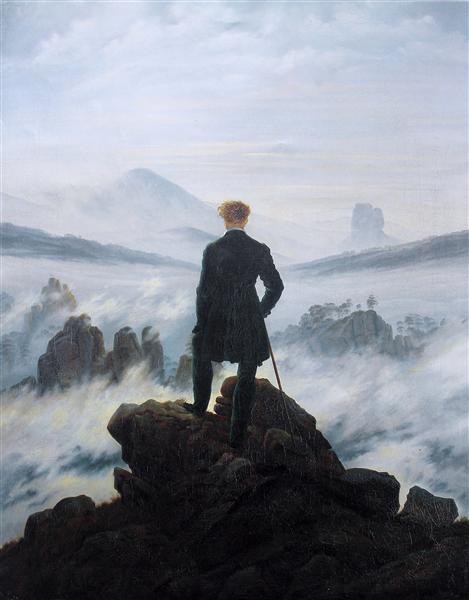
the-wanderer-above-the-sea-of-fog.jpg!Large

    “The Wanderer above the Sea of Fog (1818)

         Caspar David Friedrich

                  _____________

if Beethoven built the Church, along 
with Goethe maybe, of Romanticism, 
and be assured Romanticism is an 
ideology, a moral outlook, a 
motivational perspective, much like 
the economy is nowadays, 
supplanting any more humanistic 
imperatives, Brahms put up one of its 
Cathedrals, just listen, the First Piano
Concerto is a monument, as mighty 
as the Cologne Cathedral musically,
right next to Bonn, incidentally,  
Brahms‘ birthplace

with the disintegration of the 
supremacy of the Catholic deity 
at the onset of the Protestant 
Reformation, Luther, Calvin
Henry Vlll and all that, bolstered
by new discoveries in scientific
speculation, that the earth wasn’t 
flat, for instance, that it revolved 
around the sun rather than the 
other way around, contradictory, 
though convincing, voices began 
to abound, excite question  

in the 18th Century, the Age of 
Reason, the Christian Deity fell,
never effectively to be put back 
together again, see for Its final
sundering, Nietzsche

in France, after the Revolution
the Church was officially removed 
from political consideration, 
countermanding its centuries of 
morally heinous depredations, 
the United States had already at 
its own Revolution separated it 
from State  

Romanticism was an answer to 
a world wherein there might not 
be a God, a world with, however,  
a spiritual dimension, to respond 
to the clockwork universe 
envisioned by the earlier epoch,
the Enlightenmenta world where 
everything could be categorized,
analyzed, predicted

Romanticism called for the 
inclusion of inspiration in the mix,
there are more things in heaven 
and earth, Horatio, than are 
dreamt of in your philosophy, 
as Shakespeare would, for 
instance, have it – “Hamlet”,
1.5.167-8 
 
poets became prophets thereby, 
if they could manage it, very 
oracles, the world was blessed 
with, at that very moment, 
Beethoven, far outstripping the 
likes of, later, for example, Billy
Graham, or other such, however
galvanizing, proselytizers, 
whose messages would’ve been 
too, to my mind,  literal

for music cannot lie, obfuscate, 
prevaricate, music cannot be 
fake  

and then there was Schubert
and Chopin, TolstoyDickens
Elizabeth Barrett Browning
Roberther husband, 
TchaikovskyCaspar David
Friedrich, the Johann Strausses,  
ByronShelley, Keats, whose 
artworks, all, are as profoundly 
in our blood, our cultural system,
as, if not more so than, our 
present information about the 
details of our Christian myths, 
despite superfluity of them 
even, throughout the long 
indeed Middle Ages, and right 
up to, and including, the still 
fervent then Renaissancefor 
better or for worse still, for us

what Romanticism did, and 
specifically through the work 
of these seminal artists, was 
give each of us a chance, 
show us how to come 
through trial and tribulation,
what a faith does, any faith

it said, here, this is my dilemma, 
and this is how I deal with it

for me, Beethoven’s 32nd
Piano Sonata is, soundly, the 
epitome of that, but listen to 
Brahms put a stamp on it
with undaunted authority

we might be ultimately of no 
consequence in an indifferent 
universe, they say, but, hey, 
this is what we can do, and 
do gloriously, while we are 
at it

Woody Allen picks up the 
purpose in our own recent 
20th Century, following in 
the earnest footsteps of his 
Existential mentor, the much 
too dour, think, Ingmar 
Bergman  

but that’s another story
entirely 


meanwhile, listen

also watch, the conductor here
complete delight, is right out 
of Alice in Wonderland“, 
promise you’ll love it


R ! chard 

on odes

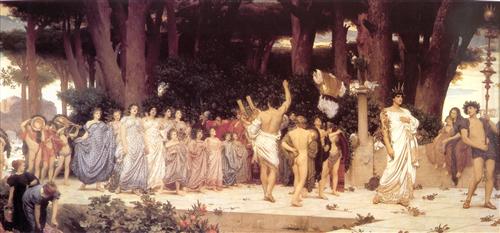
                          "The Daphnephoria" - Frederic Leighton

The Daphnephoria (c. 1875)

Frederic Leighton

________________

odes, with their suggestion of music
– despite a history of merely words
spoken in the intervening interim,
counting on meaning and rhythm
without music’s attendant tonality –
go back to the Greeks, the Seventh
Century, BCE, Sappho, for instance,
one of history’s most honoured
women poets, surely quite an
achievement for her in an age of
predominant, indeed
disenfranchising, masculinity

the ode was meant to accompany
tributes to people, events, things,
thereby acquiring an element of
acclamation and praise within its
dimensions, Pindar, ca 552 – 442
BCE, wrote odes for heroes of the
original Greek Olympics, for
instance

by the time of Horace, 65 – 8 BCE,
odes had become stylized,
independent of music, here’s one,
not inappropriately in this season’s
vernal context, to spring

odes remained spoken throughout
their resurrection in the wake of the
rediscovery of the Ancient World
during the Renaissance, onwards
through some famous Romantic
ones, Shelley, for instance, Keats,
up to even this one, by Stanislaw
Barańczak
, which I found in the
New Yorker
, April 20th, a gem, I
think, and in the very spirit of our
Age of Irony

Plywood

O plywood, second best to the real stuff,
believe me, one day I will say “Enough”

to my stooping shoulders, my slouched spine;
my sloped shape and your stiff boards will align,

and you’ll see how my backbone will unbend
and I’ll be standing straight until the end

of my makeshift but rectilinear
prayer, one stiff-backed as a chest of drawers

when we shove heavy furniture around;
I will rise from the dead, though on what ground

and which I, I don’t know; I’ll stand erect,
though my vertebrae’s hierarchic sect

won’t outlive plywood, no, it just can’t win
against that vertical eternity, so thin

and yet so sturdy in its ersatz pride;
as if the moon had shown me its dark side,

I lean, my ear glued to a cupboard’s back,
and I can hear its hollow and exact

hymn to its own cheap immortality;
no, wait, I still can straighten, still can be

square with this upright world (you knew I could),
just as plumb as four planks of real wood.

Stanisław Barańczak

(Translated, from the Polish,
by Clare Cavanagh and the author.)

__________

though you mightn’t’ve caught an “Ode”
in the title, the clue to its essence is in
the initial “O”, an acclamation

and yes, “O, Canada” is therefore also
an ode, as would be most anthems

incidentally Beethoven put the music
back into the form with his incendiary
use of Schiller’s poem for his vocal
triumph in his ninth Symphony, An
die Freude
“,
the Ode to Joy,
incomparable in this rendering for
an improbable 10,000
, yes 10,000, just
click

Richard

how to read a poem – “Alchemy” – Stephen Sandy‏


when I looked up “philodendron” in the dictionary,
it said it was an “arum” with a particular “foliage”,
I thought what kind of a dictionary is that, then
found out “arum” was a flower whose leaves have 
a particular shape, of a heart or a sword, but didn’t
take that conjunction further than to cock a wry eye
and wonder, briefly, heart or sword, that’s some
conjunction
 
we are inches away from being a philodendron, it
would appear, purportedly a “single atom” 
 
 
let me relate that when I worried about my position
in the universe, existentially, aesthetically, morally,
thinking that being no more, but also no less, than a
flower, really helped, was indeed the only thing that
helped, I didn’t want to imagine a world without
flowers, and I was a part of that 
 
 
Richard
 
            _____________________________
 
 
from the New Yorker, November 5, 2012
 
 
Alchemy
 
Chlorophyll C55H72N4O5Mg
differs from human blood
only by substitution of one
atom of magnesium
in philodendron
for the single atom of iron
in Keats.
 
 
                    Stephen Sandy 


XVlll. I never gave a lock of hair away – Elizabeth Barrett Browning

from Sonnets from the Portuguese

XVlll. I never gave a lock of hair away

I never gave a lock of hair away
To a man, Dearest, except this to thee,
Which now upon my fingers thoughtfully
I ring out to the full brown length and say
“Take it.” My day of youth went yesterday;
My hair no longer bounds to my foot’s glee,
Nor plant I it from rose- or myrtle-tree,
As girls do, any more: it only may
Now shade on two pale cheeks the mark of tears,
Taught drooping from the head that hangs aside
Through sorrow’s trick. I thought the funeral-shears
Would take this first, but Love is justified, –
Take it thou, – finding pure, from all those years,
The kiss my mother left here when she died.

Elizabeth Barrett Browning

_______________________________

with her one word, “this”, peremptory and indicative,
Elizabeth anchors us to a common present, making
us witness to the scene, a scene of the most tender
intimacies

these effortlessly transcend by their apparent
urgency and truth the usual meter of a sonnet,
leaving in the dust however always only perfect
rhymes, like wooden sentinels left twirling in too
strong a wind

enough of them however to constitute a poem

or what’s a poem

the same kind of thing happens in the history
of music, where notes skip deftly over a bar
without even the semblance of an
acknowledging curtsy, caught up in the more
compelling reality of their vivid and impetuous
imagination, like children who haven’t learned
quite all the rules yet

in Mozart, his piano sonata in D major, K576,
here for instance, the incorrigible child is
ever even present, even ever evident

both poets reflect a search for greater
authenticity, challenging established ideas
of beauty in its unending deliberation with
truth, see Keats on this irreducible dichotomy

Richard

“Winter Mood” – Leonid Afremov


                                                                                                                                                                                                                                      “Winter Mood
                                                                                                                                                                                                                             
Leonid Afremov 
 
     _____________
 

the thick application of paint in this painting, impasto,
and the disorder of acid colours in the foreground leaves, 
bring to mind Cézanne for me, 
and by inference, I guess, the more appealing, I think, Van Gogh
  
but the Belarusian Afremov, you might find interesting to know,
is from Vitebsk, the birthplace of Chagall,
studied at the school Chagall founded there,
as did incidentally in their times Malevich and Kandinsky also  
  
but the poetry of solitude by which this work touches me so
I find most reminiscent of Friedrich Caspar David‘s “The Wanderer“,
no less iconic a Romantic figure in art than Byron, Shelley, Keats became,
not to mention in Germany Goethe‘s tragic “Werther“, or in France, Victor Hugo 
  
in Spain the much earlier Don Quixote, inspired much later his compatriot Picasso,
whose own lonely horseman is to my mind recalled here, 
and in film more recent lonesome cowboys ride instead of on an open range
an empty street through a park in Paris maybe, Dresden, or Toronto
  
as on life’s journey they find, and we, each our road to follow 
  
                                                                                                                                                                                                                                      thought I’d pass it along  
 
Richard