Richibi’s Weblog

Just another WordPress.com weblog

Tag: Katharine Hepburn

“A Delicate Balance” – Edward Albee
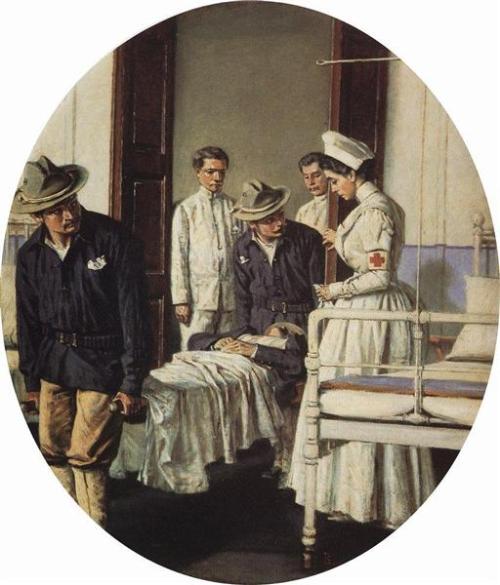
in-the-hospital-1901.jpg!Large

      “Theatre Drama 


             Kuzma Petrov-Vodkin

 
                           ___________


there are only a very few 20th-Century

American playwrights who’ve weathered

the rigours of time, two with several 

successes, Eugene O’Neill, and 

Tennessee Williams, but only one to 

tower above those two with only one 

work to outmatch them, Edward Albee,

his Who’s Afraid of Virginia Woolf? 

is every inch a king


this is not an impossible feat, Margaret

Mitchell wrote her only book, Gone 

with the Wind“, a contemporary Iliad“,

which will find its rightful place again 

in world literature, note, when our own 

too reverberant still times cede to the 

concerns of another, less pertinently 

fraught era, like reading “War and

Peace“, for instance, now that 

Napoleon is long gone


Gone with the Wind, quick, name 

another 20th-Century novel to top it, 

seconds are too long, Gone with 

the Windis in our bloodstream, 

like Walt Disney or Marilyn Monroe

even if you’ve never read it, which 

you should


but Edward Albee wrote another play

which deserves some attention, and 

with redoubtable performances from 

both the consummate ever Katharine 

Hepburn, and from our own Canadian 

tower of unutterable talent, Kate Reid

abetted by masterful presentations 

from no less than the revered Paul 

Scofield and the iconic Joseph Cotten 

when their supporting numbers come 

up, here is a show to watch for, if 

nothing else, those individual stellar

contributions


but A Delicate Balance“, also an 

incontestable masterpiece, is about 

friendship, and tells a lesson you’ll

not soon forget, friendship is more 

than, for better or for worse, just 

knowing each other, it says, an 

idiosyncratic, indeed recurrent,

Albee theme


cinematography, note, is, here

dreadful, though actually in that 

manner conceived, however 

improbably, by an otherwise 

noteworthy director, you’ll even 

think they’ve shrunk his frame


but visual style shouldn’t let you 

forego the play’s profound substance, 

nor the triumphant work of its illustrious 

cast, at the very top, mostly, of their 

considerable, even defining, powers


watch


R ! chard

“Medea” – Euripides

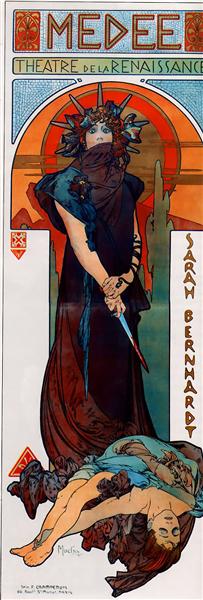
medea-1898-jpglarge

       Medea (1898) 

       Alphonse Mucha

          ____________

catching up on my Greek tragedies 
for a course I’m following online, I
happened upon this marvel

Medea, by Euripides, was written 
in 431 BCE, the next significant 
playwright in world history was
Shakespeare, the Dark Ages had
been “Dark” indeed, it took a 
Renaissance, in fact a new 
flowering of Greek and Roman
arts and institutions to get us 
moving forward again, you’ll 
notice how much of Euripides 
there is in Shakespearenot to 
mention in the French Classicists, 
Racine and Corneille

none of these, incidentally, have 
yet been equalled, never mind 
surpassed, except by maybe 
Anton Checkov, the superb 
Russian playwright

Zoe Caldwell won the 1982 Tony 
Award for best actress for her
incarnation of Medea, she was 
up against Katharine Hepburn 
and Geraldine Pageno less, 
among other distinguished 
luminaries, this is, in other 
words, no ordinary performance, 
watch her turn a mere script, 
however incandescent, into 
set of spoken arias worthy of 
the most celebrated divas

everyone else in the play is also
strong, excellent, impeccable

note the application of the three 
unities, of time, place, and action,
there is no set change, everything 
takes place within 24 hours,
according to the dictates of the 
very plot, the action surrounds 
the expulsion from Corinth of 
Medea and her two, and Jason’s, 
sons, the restrictions of the form 
put the tension, the drama, utterly 
in the hands of the poet, the 
success of the work depends not
on stunts, special effects, but on
words, poetry

Aristotle says in his Poetics“, 
section I, part VI, “The Spectacle has, indeed, an
emotional attraction of its own, but, of all the parts,
it is the least artistic, and connected least with the
art of poetry. … Besides, the production of
spectacular effects depends more on the art
of the stage machinist than on that of the poet.”  

the three unities have no room,
therefore, for Spectacle“, their 
product must be reflections of 
the poet’s humanity, heart, 
straight through, if s/he can, 
to ours

Richard
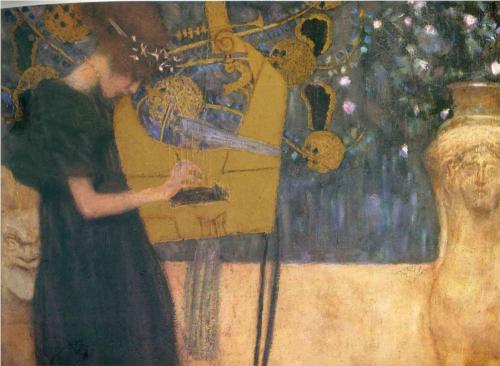
“Music”

Gustav Klimt's "Music"

Music (1895)

Gustav Klimt

______

not for lack of imagination, lately, but for,
rather, lack of confidence, the complaint
of any would-be poet, the complaint of
any proponent of oneself, one’s persona,
one’s own, however benign, however even
benevolent, ideas, I retreated into myself,
surrendering to forthright inspiration for
any, elusive enough, courage

inspiration, through its usual unsuspected
channels, and as ever categorically, gave
me, reliably, Music“, Klimt‘s ineluctable
masterpiece, not even for its iconic image,
but for its transcendental comment on
art’s interpretive counterpart, music

world’s meld

a “magical mystical miracle” happens, as
Katharine Hepburn, in her utterly
enchanting movie, Summertime“,
would have it, irrepressible as ever

I had to share

Richard

psst: note the juxtaposition of contrasting
colours, patterns, impressions, note
the Baroque presentation of Classical
imperatives, touched with Romantic
sensibilities, kicking off, not
incidentally, Modernism

Katharine Hepburn, among the prophets‏

 
to the icons of my art-infused philosophy,
Proust, primarily, and Beethoven, I am
adding this day, on the strength of this
very video, the indomitable Katharine
Hepburn, a veritable cultural treasure
and, here, a fierce and guiding light   
 
 
Richard


“Wait Until Dark”‏

Wait Until Darkout-Hitchcocks Hitchcock,
this is not an unremarkable feat
 
the director, Terence Young, had already
managed the early James Bond films,
Goldfinger“, and so had already
achieved noteworthy experience,
not to mention acclaim
 
here he delivers perhaps the most satisfying
suspense film ever
 
Audrey Hepburn is again more than luminous,
she claims again, following so many impeccable
performances, her inviolable spot as a veritable
legend and immortal goddess of art, though she
loses again the Oscar, this time to the other
incandescent Hepburn   
 
she chooses all her own clothes for the movie,
incidentally, in Paris
 
 
Alan Arkin has been equalled only recently, to
my mind, as a villain, by Heath Ledger‘s Joker
in The Dark Knight“, a much less convincing,
however, movie, Richard Widmark was pretty
nasty too, come to think of it, in 1946’s Kiss
 
when quizzed on why he didn’t get a nomination,
one, one would think, he should’ve had in the
bag, he replied, “You don’t get nominated for
being mean to Audrey Hepburn!” 
 
gotcha
 
or touché, as we say in French
 
 
you’ll notice that the entire movie takes place
in one setting, a restriction imposed by the
fact of being originally a play, which must
abide such constraints, see Give ’em Hell,
Harry
 
however, having been raised in French I fully
subscribe to the Classical imperatives of unity
of time, unity of place, unity of action, which
this play delivers in spades   
 
the impositions, when masterfully maneuvered,
deliver entertainment of an even more impressive
order, see Who’s Afraid of Virginia Woolf?for
another celebrated such instance 
 
 
when Wait Until Dark” was first screened lights  
were darkened “to the legal limit” during the
climactic scene
 
even in your well-lit viewing room, even over
forty years on, think of it, you’ll still need to
hold onto your seat, pacemaker 
 
 
Henry Mancini, however unlikely here, though
not especially ineffectively, does the music  
 
in the last scene he’s heartstoppingly hot
 
 
enjoy
 
 
Richard


“The Trojan Women” – Euripides

the purpose of any art essentially is to either
inform or entertain, preferably both together,
therefore comedy would be associated with
entertaining whereas tragedy with informing
and, as such, this last would be perhaps more
intellectually demanding, so be it 
 
the strength nevertheless of great tragedy is in
its level of delivering immediacy and fascination,
which is to say entertainment, of great comedy
its obverse, insight  
 
The Trojan Women” was written in 415 BC by
Euripides, a tragedian at the very summit still,
2400 years later, count them, of remarkable 
historical achievement 
 
the war with Troy had taken place a full 800
hundred years earlier, Homer had written the
alternate Bible to our Western civilization,
The Iliad“, still with Proust to my mind the
very summit of our Occidental accomplishment,  
resonating across the ages as powerfully as
even the pyramids, extraordinary to read,
from about, again count them, astounding
millennia, nearly unimaginable centuries, 
850 BC  
 
 
Helen had been abducted from Sparta, according
to that side of the story, by Paris, the son of King
Priam of Troy, she had been whisked away not
unwillingly according to that prince of that city,
from where she became known to us as Helen of
Troy, rather than of her original Sparta
 
the Trojan War ensued
 
 
the Trojans were creamed by the Achaeans, the
Greeks, the Spartans, interchangeable terms,
under Menelaus, king of Sparta, and his brother,
Agamemnon, older brother, and king of Mycenae,
the greater incorporating kingdom   
 
the Trojan women remain to pay the price of
war, after so many centuries still their horror is
vivid, nor do we need to look far for equivalent
modern instances, they were all slaughtered or
enslaved, ‘nough, or maybe not ‘nough, said 
 
 
here we get perhaps the best interpretation
we’ll ever see, with a cast we’ll probably not
in a long while again put together – Katharine
Hepburn in perhaps her greatest role – “Once
I was queen in Troy”, she says, and you will
profoundly believe her – Vanessa Redgrave
doesn’t get ever much better as she reaches
chthonically, which is to say from the very
entrails of her earth, her soul, for a cry of
anguish you are not likely to ever forget – 
Geneviève Bujold, a mad Cassandra, and
Irene Papas, the very incarnation of the
most beautiful woman in the world
 
all tear up the screen in their moments,
leaving you breathless and helpless before
their art and evocative power, only Helen,
because of her beauty, insidiously manages
in the story to reasonably comfortably
survive, making mincemeat meanwhile
out of her big bad, he would have it, 
Menelaus
 
Helen had been the gift to Paris, who’d had
to choose among the goddesses, Hera, Athena,
Aphrodite, which of these was the most
beautiful, but only when Aphrodite had bribed
him with the gift of the most beautiful woman
in the world instead of from either other deity
power and glory, had he chosen Helen
 
the other two of course reponded with the
devastation at Troy, Olympians were not prone
to be easy, Christian mercy would find in that
pagan unequivalency propitious ground 
 
  
wonderful rendering of the traditional Greek
chorus – the Greek version of back-up girls,
“doo-wop, doo-wop” or “she loves him, she
loves him” – commenting on the tempestuous
story     
 
one of my favourite ever films   


Richard