Richibi’s Weblog

Just another WordPress.com weblog

Tag: Juno / queen of the gods

“The Story of Calisto” – Ovid
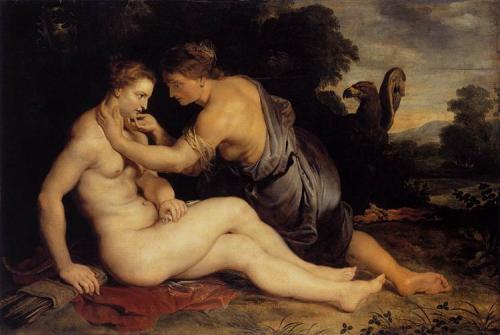
jupiter-and-callisto-1613.jpg!Large

   Jupiter and Callisto (1611 – 1613) 


            Peter Paul Rubens


                 ___________


after having read Homer’s Iliad, the 

greatest work of fiction, to my mind, 

ever told, resounding through the 

centuries and millennia with power,

pathos, and profound humanity, I 

found it hard for one reason or 

another to complete other 

acclaimed epics, Virgil’s Aeneid,

for instance, too brimming with 

bombast and bravado, much like

many American war movies,

wherein the Americans win every

conflict, whether or not they’ve 

indeed won, all on their own, with

little acknowledgment of the other

international militaries that might’ve

also played essential roles


Ovid’s Metamorphoses, as I read 

on, is becoming more and more 

offensive because of its recurrent

abuse of women, nymphs, virgins,

so that I can no longer champion 

this work, however enthusiastic I

might’ve been at the beginning


I’m not ready to personally give it 

up, but intend to relate it in brief

segments, with perhaps, here 

and there, noteworthy verses


the myth that follows the 

transformation of Cycnus into 

a swan, and the restoration of

Earth after its near conflagration 

upon the death of Phaeton, has 

Jove / Jupiter / Zeus cast[ing] 

an eye on ev’ry diff’rent coast in 

order to ensure that all is aright,

which it is, and Nature smiles 

again


but he spies by chance a nymph,

a follower of Diana, virginal

goddess of the Countryside, and

despite concerns about Juno, his

goddess wife, pursues the maiden


who was easy prey, did whate’er a 

virgin cou’d … / With all her might 

against his force … / But how can 

mortal maids contend with Jove?


following which Diana arrives with 

her train of nubile followers, to the 

dismay of the young victim, who 

could only try to hide her shame, 

which her altered demeanour 

must’ve somewhat, it is supposed, 

uncovered


                   How in the look does conscious guilt appear! 
                   Slowly she mov’d, and loiter’d in the rear; 
                   Nor lightly tripp’d, nor by the Goddess ran, 
                   As once she us’d, the foremost of the train. 


but now the moon had nine times 

lost her light, and any doubt about 

her condition was erased, so that 

Diana, unforgiving, a not uncommon 

reaction, I’ve found, among women, 

banished her to eventually alone 

give birth to a son


meanwhile Juno, now doubly 

incensed – This boy, she rails, shall 

stand a living mark, to prove / My 

husband’s baseness and the strumpet’s

love – turns the wretched mom into a

bear


but when the son had fifteen summers 

told, and came inadvertently upon this 

beast while in the forest, unaware it was 

his mother, and to protect himself, he
 

                                    aim’d a pointed arrow at her breast,  
                   And would have slain his mother in the beast;  
                   But Jove forbad, and snatch’d ’em through  
                   In whirlwinds up to Heav’n, and fix’d ’em there!


where now we know them as either 

the Great Bear and the Little Bear, 

Ursa Major and Ursa Minor or, 

more familiarly, as the Big Dipper 

and the Little Dipper


who could ‘a’ ever thunk it


R ! chard


“The Transformation of Io into a Heyfer” (III) – Ovid

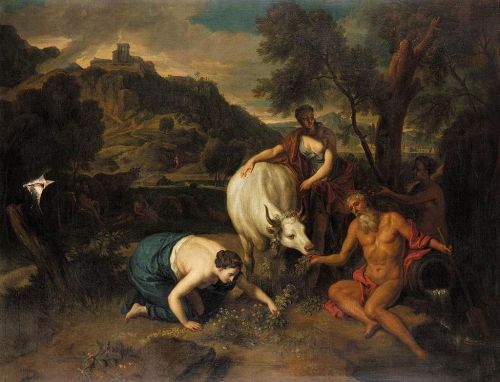
1024px-Victor-Janssens_Io-recognized-by-her-father

     Io Recognised by Her Father 


          Victor Honoré Janssens


              ______________


               The head of Argus (as with stars the skies)
               Was compass’d round, and wore an hundred eyes. 


not only did [t]he head of Argus have

an hundred eyes, but they circled,

compass’d, round his head, as with

stars the skies, as with stars the

geocentric firmament 


note the passive form of the verb to 

compass in the two lines above 

standing in for the inverted sentences

I earlier made mention of as literary 

devices Ovid, or Dryden, uses 

throughout the poem


the standard sentence, the active

sentence,  should read, an hundred

eyes compass’d [t]he head of Argus


compass’d, encircled


               But two by turns their lids in slumber steep;
               The rest on duty still their station keep;
               Nor cou’d the total constellation sleep. 


never could all the eyes, the total

constellation, sleep, or in slumber 

steep, since only two of them would 

turn[ ] their lids, close, at a time, 

while the others continued diligently

to keep watch


steep, incidentally, is a verb here, 

as in to put the kettle on, not an 

adjective, as in dauntingly

pitched, threateningly angled 


               Thus, ever present, to his eyes, and mind,
               His charge was still before him, tho’ behind. 


even when she was standing behind

him, Argus could still see Io, [h]is

charge, with the eyes he had in the

back of his head


               In fields he suffer’d her to feed by Day,
               But when the setting sun to night gave way,
               The captive cow he summon’d with a call;
               And drove her back, and ty’d her to the stall.
               On leaves of trees, and bitter herbs she fed,
               Heav’n was her canopy, bare earth her bed:
               So hardly lodg’d, and to digest her food,
               She drank from troubled streams, defil’d with mud. 


hardly lodg’d, given difficult living 

conditions


               Her woeful story fain she wou’d have told,
               With hands upheld, but had no hands to hold. 


fain, gladly


               Her head to her ungentle keeper bow’d,
               She strove to speak, she spoke not, but she low’d: 


to low is to make the sound that 

cows do, to moo


               Affrighted with the noise, she look’d around,
               And seem’d t’ inquire the author of the sound. 


the sound that she herself was making 

not only [a]ffrighted her, frightened her, 

but had her wondering where could 

it possibly be coming from 


               Once on the banks where often she had play’d
               (Her father’s banks), she came, 


Her father, Inachus, god of rivers


                                                    and there survey’d
               Her alter’d visage, and her branching head;
               And starting, from her self she wou’d have fled. 


much as the sound of her altered

voice had [a]ffrighted Io, now her 

reflection in the water chastened 

her as well, enough to make her

start, be startled, and want to run 

away from her self


               Her fellow nymphs, familiar to her eyes,
               Beheld, but knew her not in this disguise.
               Ev’n Inachus himself was ignorant;
               And in his daughter, did his daughter want. 


no one recognized Io, not even 

her father, who, in his daughter, 

the one who stood before him, 

the altered Io, could not make 

her out 


did his daughter want, as in to 

be found wanting, in the cow, 

to not even be suggested in

the, however conspicuous, 

heifer, not at all part of the 

picture 


Io is there but, simultaneously, 

disconcertingly, not there


               She follow’d where her fellows went, as she
               Were still a partner of the company: 


it should be remembered that 

Io was a beautiful heifer, even 

Juno had been impressed, so

that her fellows, her companions,

only other maidens, I’ll point out, 

fellows taking on its sexually 

indiscriminate meaning here, 

not at all restricted to males, 

would have easily let her follow


note the symmetry, incidentally, 

between follow’d and fellows, 

the nearly hidden alliteration, 

a delightful literary effect, 

though if you blinked you’d 

miss it


               They stroak her neck; the gentle heyfer stands,
               And her neck offers to their stroaking hands.
               Her father gave her grass; the grass she took;
               And lick’d his palms, and cast a piteous look;
               And in the language of her eyes, she spoke. 


her lowing would’ve had no effect,

would’ve let no one in on the fact

that beneath the animal exterior 

there might be an Io


               She wou’d have told her name, and ask’d relief,
               But wanting words, in tears she tells her grief.
               Which,


and here we get the punchline,

the plot twist, which turns this

story into, relatively speaking,

a total enchantment, as though 

Ovid were giving us, prefiguring

in fact, Walt Disney, our own 

20th Century mythologist


                            with her foot she makes him understand;
               And prints the name of Io in the sand. 


see above


R ! chard


“Syrinx” – Claude Debussy‏

big

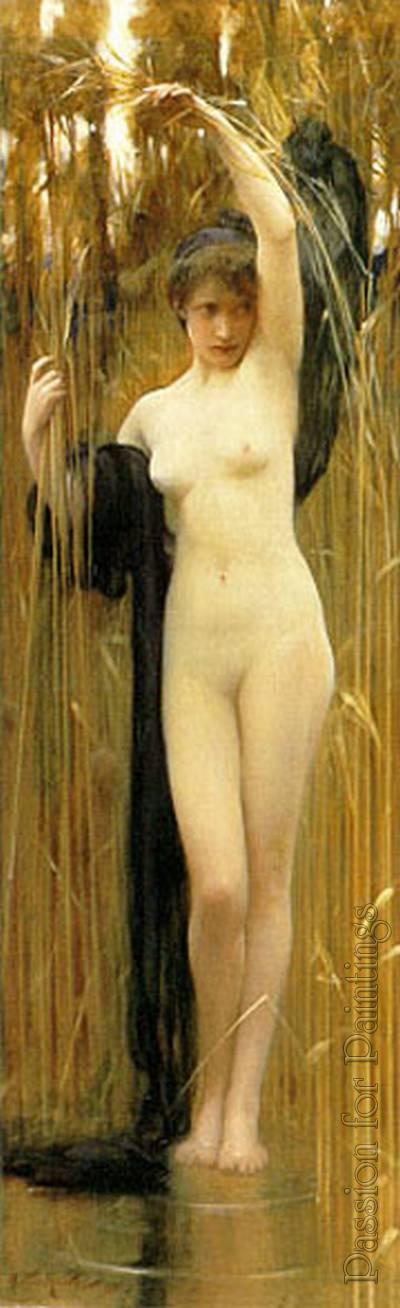
         Syrinx (1892)
 
          Arthur Hacker
 
            __________
 
 
though Debussy would’ve called his
Syrinx “Flûte de Pan”, “Pan Flute”,
alas, the name had already been 
taken, he therefore came up with the 
much more inspired Syrinx
 
Syrinx, with the help of other nymphs, 
who’d come at her cry for help as she 
fled the god Pan, a pursuer, had been 
turned into a bush of reeds, its canes 
producing a song so sweet as to 
confound and disarm him, impelling
him to create of them that sublime 
instrument  
 
Hermes had been telling Argus, Argus 
Panoptes, the giant with the hundred 
eyes, the story about the pipes he  
was playing, an implement received 
from Jove, apparently, god of all the 
gods, who wanted him to kill Argus, 
for confining Io, who’d been turned 
into a heifer by Juno, Jove’s wife, 
who’d caught him chasing her, Io’s 
plaintive lows had been getting to 
Juno as Io fretted unfettered through 
the fields too close to Olympus 
 
when Hermes’ music finally closed the
giant’s last two eyes, he beheaded him,
but Juno, in merciful recognition of his
service, however ultimately ineffectual, 
set them into the variegated tail of the 
peacock
 
are you kidding me, I always think when
I read Ovid’s “Metamorphoses”, and am
ever nevertheless entirely enchanted
 
a flute solo had not been composed in
over 150 years when Debussy composed
his Syrinx“, 1913, after C.P.E. Bach’s not  
at all unimpressive Sonata in A Minor 
of 1747, it duly set off a new life for the 
long overlooked flute, a reed which 
Mozart famously didn’t like
 
note the tonal, rhythmic, and repetition 
shifts from the rigid Classical model, 
where these are much more strict, 
Impressionism was not only breaking 
down pictures, the pictorial arts, but its
sound world as well, it was an utterly
new era, new sensibility, new zeitgeist, 
and you can feel it, though you might
not be quite able to immediately 
verbalize it, the arts were again, as
they ever ‘ve been, the canary in the 
gold mine
 
 
Richard
 
psst:
 
   The Transformation of Syrinx into Reeds 
 
Then Hermes thus: A nymph of late there was 
Whose heav’nly form her fellows did surpass. 
The pride and joy of fair Arcadia’s plains, 
Belov’d by deities, ador’d by swains: 
Syrinx her name, by Sylvans oft pursu’d, 
As oft she did the lustful Gods delude: 
The rural, and the woodland Pow’rs disdain’d; 
With Cynthia hunted, and her rites maintain’d: 
Like Phoebe clad, even Phoebe’s self she seems, 
So tall, so streight, such well-proportion’d limbs: 
The nicest eye did no distinction know, 
But that the goddess bore a golden bow: 
Distinguish’d thus, the sight she cheated too. 
Descending from Lycaeus, Pan admires 
The matchless nymph, and burns with new desires. 
A crown of pine upon his head he wore; 
And thus began her pity to implore. 
 
Now while the lustful God, with speedy pace, 
Just thought to strain her in a strict embrace, 
He fill’d his arms with reeds, new rising on the place. 
And while he sighs, his ill success to find, 
The tender canes were shaken by the wind; 
And breath’d a mournful air, unheard before; 
That much surprizing Pan, yet pleas’d him more. 
Admiring this new musick, Thou, he said, 
Who canst not be the partner of my bed, 
At least shall be the confort of my mind: 
And often, often to my lips be joyn’d. 
He form’d the reeds, proportion’d as they are, 
Unequal in their length, and wax’d with care, 
They still retain the name of his ungrateful fair.
 
                                                  Ovid