Richibi’s Weblog

Just another WordPress.com weblog

Tag: Jove / Jupiter / Zeus / god of gods

“The Story of Phaeton” – Ovid
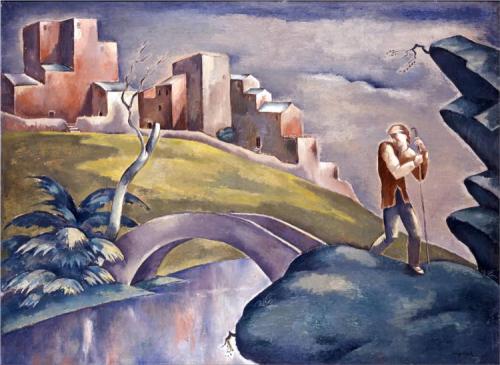
landscape-with-a-palace-1916.jpg!Large

   Landscape with a Palace (1916) 


             Eugeniusz Zak


                  ________


               Her son was Epaphus, at length believ’d
               The son of Jove, and as a God receiv’d; 


without proof, it could not have been 

absolutely determined, during this 

ancient mythological era, that  

Epaphus, son of Io become Isis, was 

indeed the son of Jove / Jupiter / Zeus

though that’s what at length, eventually, 

came to be believed


and as such Epaphus was


               With sacrifice ador’d, and publick pray’rs,
               He common temples with his mother shares. 


both Isis and Epaphus are worshipped

in common, in the same places, and 

with a similar degree of devotion


               Equal in years, and rival in renown
               With Epaphus, the youthful Phaeton
               Like honour claims; 


Phaeton, another youth, [e]qual in 

years to Epaphus, and in renown,

as famous, [l]ike honour claims, 

puts forward, his own illustrious 

heritage


                                      and boasts his sire the sun. 


the sun, Phoebus / Apollo, god,

among a number of other things,

of that very orb


               His haughty looks, and his assuming air,
               The son of Isis could no longer bear:
               Thou tak’st thy mother’s word too far, said he,
               And hast usurp’d thy boasted pedigree. 


Epaphus, son of Isis, challenges 

Phaeton, says that his mother’s 

claim that her consort was the 

god of the Sun is false, and that 

he, Epaphus, is only promoting 

the fabricated story of his high, 

his boasted, pedigree, ancestry 


               Go, base pretender to a borrow’d name. 


Epaphus delivers a double whammy, 

base pretender, borrow’d name, ouch


               Thus tax’d, he blush’d with anger, and with shame;
               But shame repress’d his rage: 


tax’d, confronted


repress’d his rage, Phaeton didn’t 

slug Epaphus


                                                            the daunted youth
               Soon seeks his mother, and enquires the truth: 


is he truly the son of the god of the 

Sun, Phaeton asks his mother, nearly 

intolerable drama must surely follow, 

turning on this burning question 


               Mother, said he, this infamy was thrown
               By Epaphus on you, and me your son.
               He spoke in publick, told it to my face;
               Nor durst I vindicate the dire disgrace:
               Even I, the bold, the sensible of wrong, 


Even I, Phaeton asserts, the sensible 

of wrong, as he describes himself, the 

impatient of improprieties, however 

bold, quick to respond, impetuous, 

might he be, durst not, dared not, 

vindicate, validate, the dire disgrace, 

Epaphus‘ profoundly distressing insult    


               Restrain’d by shame, was forc’d to hold my tongue. 


I was unable, Phaeton says, too 

[r]estrain’d by shame, humiliated, 

to even answer


               To hear an open slander, is a curse:
               But not to find an answer, is a worse. 


a worse, we would say just worse, 

but note that worse, here, is not a

noun, but the adjective for curse,

which has been elided, left out, 

worse curse, which, included, 

would’ve altered, however, the 

metre, the pentameter, and thus, 

the poetry, style having trumped, 

for better or for worse, in this

instance, the substance 


a, incidentally, is the first beat of the 

iamb, which is to say, the weak beat,

while worse, is the second, the one 

with the accent, the determining 

thump, worse, da, dum, an iamb 


Dryden didn’t have, in other words, 

much choice, were he wanting to 

be a poet, but to deftly press his, 

surely masterful, grammar, to fit 

his meaning to his, however

constricting, verse


               If I am Heav’n-begot, assert your son
               By some sure sign; 


assert your son, acknowledge him,

[b]y some sure sign, Phaeton 

demands of his mother 


                                      and make my father known, 


at the same time, make … known, 

identify, Phaeton continues, point

him out, my father 


              To right my honour, and redeem your own.
               He said, 


it is the honour[able] thing to do,

the required thing to do, [h]e said, 

to restore, [t]o right, our reputations


                                   and saying cast his arms about
               Her neck, and beg’d her to resolve the doubt. 


a son imploring his mother, can 

anything be more poignant


               ‘Tis hard to judge if Clymene were mov’d
               More by his pray’r, whom she so dearly lov’d, 


Clymene, wife of Helios, or Phoebus / 

Apollo, sun god, mother of Phaeton 


               Or more with fury fir’d, to find her name
               Traduc’d, and made the sport of common fame. 


Traduc’d, translated, transmitted


common fame, the casual, everyday

sport, entertainment, however 

inappropriate, however malicious,
of many

               She stretch’d her arms to Heav’n, and fix’d her eyes
               On that fair planet that adorns the skies; 


that fair planet that adorns the skies, 

the sun, though Dryden must’ve 

known the sun wasn’t a planet, nor 

Ovid, for that matter, literary licence

having given style, here again, sway 

over substance, for better, it’ll be up 

to you to say, or for worse


literary licence, where style 

overtakes substance


               Now by those beams, said she, whose holy fires
               Consume my breast, and kindle my desires; 


girlfriend, I have to here interject, your 

temperature is, ahem, showing, you’re 

sounding, however uncharacteristically, 

awfully intemperate, aroused, [c]onsume 

my breast indeed, kindle, you audaciously 

request, my desires


               By him, who sees us both, and clears our sight,
               By him, the publick minister of light,
               I swear that Sun begot thee; 


Clymene swears an oath upon the 

very sun, her sire, the publick minister 

of light, the very priest of illumination, 

of clarity, for everyone, the sun’s 

manifest incarnation


                                                                if I lye,
               Let him his chearful influence deny: 


don’t shine on me, Helios / Phoebus /

Apollo, him, Helios / Phoebus / Apollo

himself, Clymene cries, if I lye, lie, if I

tell an untruth


               Let him no more this perjur’d creature see; 


Let him, let yourself, Helios / Phoebus /

Apollo, be unable any longer to see me,

perjur’d creature that I, Clymene, am 


               And shine on all the world but only me. 


obliterate me, she defies, from your

purview, let the world receive your 

rays, but not myself


               If still you doubt your mother’s innocence,
               His eastern mansion is not far from hence;
               With little pains you to his Leve go,
               And from himself your parentage may know. 


Leve, where Helios / Phoebus / 

Apollo lives


               With joy th’ ambitious youth his mother heard,
               And eager, for the journey soon prepar’d. 


Phaeton is off on his mission


               He longs the world beneath him to survey; 


he wants to see the world from the 

perspective of the sun, an astronaut,

a dreamer, pulsing with ambition


               To guide the chariot; and to give the day: 


to drive his father’s car, chariot, how 

contemporary, how immediate


               From Meroe’s burning sands he bends his course, 


Meroe, a city on the Nile, you’ll 

remember that we’re still in Egypt, 

where Io / Isis prevails, with Epaphus

her son, the one who started all this  


               Nor less in India feels his father’s force: 


the sun, his father’s force, is no less 

vigorous in India than it is, he, Helios

/ Phoebus / Apollo, is, in Egypt


               His travel urging, till he came in sight; 


His travel urging, impatient to speed 

up his pace, hastening his metaphorical

horses


               And saw the palace by the purple light. 


purple light, evening, though purple 

is also, since antiquity, the colour of 

royaltyPhaeton is perhaps seeing 

both, the palace, at evening  


see above


R ! chard


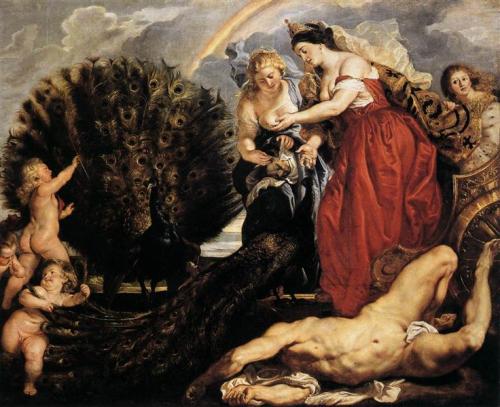
“The Eyes of Argus transform’d into a Peacock’s Train” – Ovid

juno-and-argus.jpg!Large

    Juno and Argus (c.1611) 


           Peter Paul Rubens


                         ______


                  While Hermes pip’d, and sung, and told his tale,
                  The keeper’s winking eyes began to fail, 


The keeper, Argus, of Io, nymph

become heifer


                  And drowsie slumber on the lids to creep; 
                  ‘Till all the watchman was at length asleep. 


all the watchman, all of Argus‘ eyes, 

were closed, asleep, at length, after 

a time 


                  Then soon the God his voice, and song supprest; 


the God, Hermes, messenger of the

gods, on a mission from Jove / 

Jupiter / Zeus to save Io, nymph 

become heifer


his voice, and song supprest, Hermes 

stopped talking, stopped playing his

song, his music


                  And with his pow’rful rod confirm’d his rest: 


his powerful rod, the caduceus, with

which Hermes could both waken those

asleep as well lull the wakeful to

slumber


                  Without delay his crooked faulchion drew, 


faulchion, now spelled falchion, 

is a short sword with only one 

sharp edge, a sort of sickle


since falchions go back only to the 

13th Century, Dryden‘s translation 

from the Latin has to be an 

anachronism


just saying


                  And at one fatal stroke the keeper slew.
                  Down from the rock fell the dissever’d head,
                  Opening its eyes in death; and falling, bled;
                  And mark’d the passage with a crimson trail:
                  Thus Argus lies in pieces, cold, and pale;
                  And all his hundred eyes, with all their light,
                  Are clos’d at once, in one perpetual night.
                  These Juno takes, that they no more may fail,
                  And spreads them in her peacock’s gaudy tail. 


see above


Juno, wife of Jove / Jupiter / Zeus,
queen, therefore, of the gods and 

goddesses


                  Impatient to revenge her injur’d bed, 


Juno had been offended by the fact 

that Jove / Jupiter / Zeus had

transgressed 


                  She wreaks her anger on her rival’s head; 


her rival, Io


                  With Furies frights her from her native home; 


Furies, also known as Erinyes

goddesses of vengeance, the 

oldest of all the deities, they live 

in Erebus, the Underworld, look 

frightful, snakes in their hair, bat’s 

wings, and haunt, unsettle, the 

disrespectful, the insolent, those 

who betray, are not true to, their 

word 


frights, frightens


                  And drives her gadding, round the world to roam: 


her, Io, nymph become heifer


to gad, to wander


                  Nor ceas’d her madness, and her flight, before
                  She touch’d the limits of the Pharian shore. 


Pharian, relating to Pharos, island off 

the coast of Alexandria, notable for 

its lighthouse, itself called Pharos

one of the Seven Wonders of the 

Ancient World


                  At length, arriving on the banks of Nile,
                  Wearied with length of ways, and worn with toil,
                  She laid her down; 


She laid her down, she laid herself 

down, stopped, stayed in place


                                                 and leaning on her knees,
                  Invok’d the cause of all her miseries: 


the cause of all her miseries, Jove /

Jupiter / Zeus, who’d abandoned 

her, Io, to the wrath of Juno, his 

wife, when she’d discovered him 

to be unfaithful 


                  And cast her languishing regards above,
                  For help from Heav’n, and her ungrateful Jove.
                  She sigh’d, she wept, she low’d; ’twas all she cou’d;
                  And with unkindness seem’d to tax the God. 


to tax, to accuse, to make 

responsible for


                  Last, with an humble pray’r, she beg’d repose,
                  Or death at least, to finish all her woes. 


repose, relief, Io, nymph become 

heifer, has completely had it


                  Jove heard her vows, and with a flatt’ring look,
                  In her behalf to jealous Juno spoke, 


a flatt’ring look, a seductive approach,

toward Juno, his reproachful wife


                  He cast his arms about her neck, and said,
                  Dame, rest secure; no more thy nuptial bed
                  This nymph shall violate; 


Dame, or Madam


                                                       by Styx I swear, 


Styx, one of the five rivers that 

separate Earth from the 

Underworld, also one of the 

earliest goddesses, after whom

the river itself was named, who 

had, significantly, sided with Jove /

Jupiter / Zeus during the Giants’ 

War, for which, upon having won, 

Jove / Jupiter / Zeus ordained that 

all oaths be sworn upon her, Styx

much as we, in our own day, swear 

upon Bibles


this all precedes, note, Bibles


                  And every oath that binds the Thunderer. 


the Thunderer, Jove / Jupiter, Zeus,

god, indeed, of Thunder


                  The Goddess was appeas’d;  


The Goddess, Juno


                                                       and at the word
                  Was Io to her former shape restor’d.
                  The rugged hair began to fall away;
                  The sweetness of her eyes did only stay,
                  Tho’ not so large; her crooked horns decrease;
                  The wideness of her jaws and nostrils cease:
                  Her hoofs to hands return, in little space: 


little space, the blink of an eye


                  The five long taper fingers take their place,
                  And nothing of the heyfer now is seen,
                  Beside the native whiteness of the skin.
                  Erected on her feet she walks again:
                  And two the duty of the four sustain. 


rather than walk on four feet, Io

now stands erect, [e]rected, on 

two


                  She tries her tongue; her silence softly breaks,
                  And fears her former lowings when she speaks: 


she can hardly believe she’s  

become, not just a nymph,

but indeed 


                  A Goddess now, through all th’ Aegyptian State:
                  And serv’d by priests, who in white linnen wait. 


Io has become the Egyptian 

goddess Isis


but that’s an entirely other story 


stay tuned


R ! chard


“The Afternoon of a Faun” – Debussy / Nijinsky / Nureyev

397px-Faun_merse

      Faun and Nymph (1867)


              Pál Szinyei Merse               


                      ________


to take a break, for a moment, from the

travails of Io, a heifer still, though her

father, Inachus, is aware of the situation,

and Hermes, messenger of the gods, is 

out, on the orders of Jove/ Jupiter / Zeus

to save her, and, at the same time, 

inspired by the music Hermes tells Argus

her many-eyed keeper, Pan, god of the

wilds, has been playing, with reeds he’s 

been left with of Syrinx, the nymph he  

would’ve loved had she not been 

transformed into rushes, as imagined by 

Debussy in his evocative Syrinx for solo 

flute, as highlighted in my last instalment

I could not not remember Debussy‘s 

other similarly mythological, and intimately

related, work, his Prelude to the Afternoon 

of a Faun, as modified itself by Vaslav

Nijinsky, legendary dancer and 

choreographer, into an event that verily 

shook the early 20th Century 


retitled, L’après-midi d’un faune, The

Afternoon of a Faun in English, the 

performance captures everything one

would gather from Ovid’s myths of its 

primitive, primal, sensibilities


the faun, needless to say, is representative 

of Pan, god of the wild, woodlands, a satyr, 

part instinct, part man, see above 


watch Rudolf Nureyev, then, his equally 

celebrated successor, take on the role

Nijinsky made famous, without any 

alterations made to the original 1912 

production, however improbably, 

though entirely successfully, we’re in 

Paris, May 29, though transposed,

faithfully and superbly, to New York,

Broadway, 1979 


proceed, however, at your own discretion, 

The Afternoon of a Faun is steaming, it’s 

about what happens when a young buck’s 

fancies, implacable and irrepressible, turn 

to love, not for the scrupulous, where does 

love begin, it asks, and lust retire, or is it 

the other way around, where does yin, in 

other words, meet, become, yang


these are questions that more and more 

begin to come up, you’ll find, in Greek 

and Roman, and most other ancient, 

for that matter, mythologies, something 

that isn’t at all touched upon in the 

Abrahamic traditions, Christanity, Islam, 

Judaism, monotheistic, though they’re 

at least as old, where nature, the place 

of animals, vegetation, land, water, our

intimate interconnection with them, 

don’t much, for better or for worse, 

come up


I miss the wonder of the more 

pantheistic, the pagan, perspective 


enjoy


R ! chard


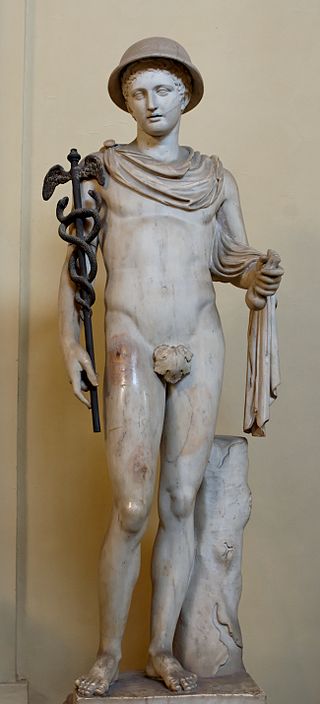
“The Transformation of Io into a Heyfer” (V) – Ovid

320px-Statue_Hermes_Chiaramonti

     Statue of Hermes (Vatican Museums)

                     ___________________

though Io might still have been “not

out of the woods”, when last we saw 

her, there remained nevertheless 

her original suitor, Jove, god of gods


                 Now Jove no longer cou’d her suff’rings bear;
                 But call’d in haste his airy messenger,
                 The son of Maia, with severe decree
                 To kill the keeper, and to set her free.  
 

The son of Maia, Hermes, messenger

of the gods


Maia, one of the Pleiadesplaymates

of Artemisgoddess of the Hunt,

daughters, also, of Atlasfamously 

condemned, he, to hold up the

heavens for eternity


                 With all his harness soon the God was sped, 
 

Hermes, no sooner equipped,

[w]ith all his harness, livery,

attire, was sped, got under

way


                 His flying hat was fastned on his head,
                 Wings on his heels were hung, and in his hand
                 He holds the vertue of the snaky wand. 
 

vertue, virtue, but having retained, 

still in 1717, its root, vertu, French 

for virtue, benefit 


Hermes is usually shown wearing

[h]is flying hat, [w]ings on his heels,

a snaky wand, identifying accessories


snaky wand, his caduceus


see above


                 The liquid air his moving pinions wound, 


pinions, the feathers of a bird’s wing


wound, to injure, but also to wrap 

around, according to its two 

differing pronunciations


                 And, in the moment, shoot him on the ground.


to rhyme with wound, note


Hermes has landed, but apparently

uncomfortably


                 Before he came in sight, the crafty God
                 His wings dismiss’d, but still retain’d his rod: 


dismiss’d, put aside, made invisible,

[h]is wings


                 That sleep-procuring wand wise Hermes took,
                 But made it seem to sight a sherpherd’s hook. 


though Hermes kept his rod, he made

it look, seem to sight, like a shepherd’s 

staff, hook


                 With this, he did a herd of goats controul;  


controul, control


                 Which by the way he met, and slily stole. 


by the way, as he walked along


slily stole, deities make up their

own rules


                 Clad like a country swain, he pip’d, and sung;
                 And playing, drove his jolly troop along. 


swain, young man


                 With pleasure, Argus the musician heeds; 


Argus heeds the musician, again

an inverted sentence, in order to 

rhyme with


                 But wonders much at those new vocal reeds. 


vocal reeds suggests Pan pipes

here, a wind instrument consisting 

of several tubes of increasing length 

placed side by side, where the piper 

creates the melody by moving his 

lips, her lips, from embouchure to 

embouchure, the openings through 

which to blow


               And whosoe’er thou art, my friend, said he,
               Up hither drive thy goats, and play by me: 


Argus asks Hermes to stay, drive thy 

goats away, [u]p hither, he directs, 

and play thy instrument, keep him 

company


                 This hill has browz for them, and shade for thee. 


browz, browse, matter, twigs, shoots,

upon which goats might graze


                 The God, who was with ease induc’d to climb,  


to climb, [u]p hither, in order to drive

the goats 

                Began discourse to pass away the time;
                 And still betwixt, his tuneful pipe he plies;   


betwixt, meanwhile


plies, continues


                 And watch’d his hour, to close the keeper’s eyes.


his hour, his opportune moment  


the keeper, Argus, over Io


                 With much ado, he partly kept awake; 


the calming effect of the Pan pipes

was making it hard, much ado, for

Argus to stay awake 


                 Not suff’ring all his eyes repose to take: 


never allowing, suff’ring, all his eyes 

to close, repose to take, at the same

time


                 And ask’d the stranger, who did reeds invent,
                 And whence began so rare an instrument? 


how do you do that, Argus asks,

which leads to an interpolated story,

wherein Hermes, before we learn

much more about Io, answers the 

questions 


stay tuned


R ! chard