Richibi’s Weblog

Just another WordPress.com weblog

Tag: Jove

“Metamorphoses” (The Giants’ War, XII) – Ovid
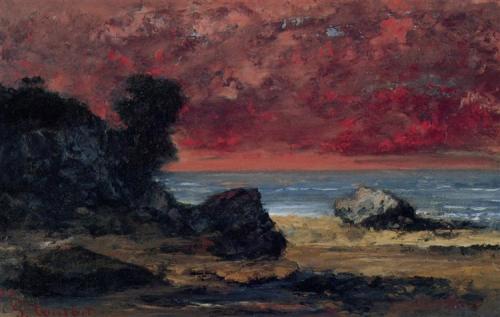
after-the-storm-1872.jpg!Large

      “After the Storm (1872)


            Gustave Courbet


                __________


                  A thin circumference of land appears;
                  And Earth, but not at once, her visage rears,
                  And peeps upon the seas from upper grounds; 


as the land begins to peep[ ] through 

the water, a circumference of land 

appears, a circle of Earth within the 

earlier universal water


to rear, to raise upright, boldly, the better,

here, for Earth‘s visage, Earth‘s face, to 

peep[ ] upon the seas from newly gained 

upper grounds


                  The streams, but just contain’d within their bounds,
                  By slow degrees into their channels crawl; 


streams, just recently redefining their  

boundaries, or bounds[b]y slow 

degrees settle, become waterways, 

channels, rivers, rivulets, rills


I love crawl here, incidentally, the slow, 

insidious, infiltration of a territory, silent 

and immutable, as [t]he streams, at the 

dispassionate pace of nature, find their 

individual course


                  And Earth increases, as the waters fall. 


the waters fall, the waters recede


                  In longer time the tops of trees appear, 


[i]n longer time, after a while


                  Which mud on their dishonour’d branches bear. 


for which the only solution here, would

be, I thought, however ironically, a

shower, rain


but I digress

                 
                  At length the world was all restor’d to view;

                  But desolate, and of a sickly hue:  

see, for instance, above


                  Nature beheld her self, and stood aghast,
                  A dismal desart, and a silent waste. 


desart, is desert, even my spellcheck 

insisted


meanwhile, back on Mount Parnassus

our two survivors, look around


                  Which when Deucalion, with a piteous look
                  Beheld, he wept, and thus to Pyrrha spoke: 


let me point out that what follows, 

which is to say when Deucalion 

… thus to Pyrrha spoke, we have 

an extended monologue, rather 

than a narration, the poet, Ovid

has given a voice to Deucalion

his character, his creation


I was reminded of Shakespeare‘s 

monologues, especially since the 

metre is iambic pentameter,

Shakespeare‘s signature poetic

rhythm 


it should be noted that this translation

of Metamorphoses is from 1717, a

century and a very year after 

Shakespeare‘s demise, in 1616, time 

for poets to have imbibed his already 

profound influence


nor could they not have been marked

by the spirit of their own time, and the 

many transformative epochs since 

Metamorphoses had been written, in 

the year 1, that would’ve affected the 

translation 


the original Latin text, for instance,

was in dactylic hexameter, not 

iambic pentameter


                  Oh wife, oh sister, oh of all thy kind
                  The best, and only creature left behind,
                  By kindred, love, and now by dangers joyn’d;
                  Of multitudes, who breath’d the common air,
                  We two remain; a species in a pair:
                  The rest the seas have swallow’d; nor have we
                  Ev’n of this wretched life a certainty.
                  The clouds are still above; and, while I speak,
                  A second deluge o’er our heads may break.
                  Shou’d I be snatcht from hence, and thou remain,
                  Without relief, or partner of thy pain,
                  How cou’dst thou such a wretched life sustain?
                  Shou’d I be left, and thou be lost, the sea
                  That bury’d her I lov’d, shou’d bury me.
                  Oh cou’d our father his old arts inspire,
                  And make me heir of his informing fire,
                  That so I might abolisht Man retrieve,
                  And perisht people in new souls might live.
                  But Heav’n is pleas’d, nor ought we to complain,
                  That we, th’ examples of mankind, remain. 


cou’d our father, JoveDeucalion asks,

breathe into me his inspiration, his old 

arts, his informing fire, so that I could 

reconstitute Man, retrieve him, and 

supply the perisht people with new, and

presumably more honourable, souls


                  He said; the careful couple joyn their tears: 


He said, or this he spoke, and the

couple joyn their tears


                  And then invoke the Gods, with pious prayers.
                  Thus, in devotion having eas’d their grief,
                  From sacred oracles they seek relief;
                  And to Cephysus’ brook their way pursue: 


Cephysus, or Cephissus, was a river god,

associated with the river Cephissus, which 

runs through Central Greece


                  The stream was troubled, but the ford they knew; 


the ford, the way across the stream


                  With living waters, in the fountain bred, 


living waters would gush from a 

spring, around which a fountain 

would’ve been built


                  They sprinkle first their garments, and their head,
                  Then took the way, which to the temple led.
                  The roofs were all defil’d with moss, and mire,
                  The desart altars void of solemn fire.
                  Before the gradual, prostrate they ador’d;
                  The pavement kiss’d; and thus the saint implor’d.


the gradual is a hymn sung within

the context of a full religious service


desart here is again desert, but in

this instance signifying deserted


the saint, an anachronism here, 

for saints were not at all even a

concept at the time of Ovid

would’ve been Themis, goddess,

at Delphi, on Mount Parnassus

of Divine Justice


R ! chard


the ensuing Ages – Ovid‏

    The Silver Age - Lucas Cranach the Elder

                            The Siver Age  (c.1516)

                              Lucas Cranach the Elder

                                                     ________


it is interesting to note how profoundly Ovid‘s mythological
setting marked Christian notions of the Creation, which at
least in the West have held sway now for some nearly two
thousand years
 
it is a tale then twice told, the last time however with not
half even the first one’s contagious exuberance, I think  
 
I believe more in Ovid then, also in Cranach and da Cortona,
worthy indeed proponents of that earlier oracular deity 
 
 
Richard
 
                       ____________________


But when good Saturn, banish’d from above,
Was driv’n to Hell, the world was under Jove.
Succeeding times a silver age behold,
Excelling brass, but more excell’d by gold.
Then summer, autumn, winter did appear:
And spring was but a season of the year.
The sun his annual course obliquely made,
Good days contracted, and enlarg’d the bad.
Then air with sultry heats began to glow;
The wings of winds were clogg’d with ice and snow;
And shivering mortals, into houses driv’n,
Sought shelter from th’ inclemency of Heav’n.
Those houses, then, were caves, or homely sheds;
With twining oziers fenc’d; and moss their beds.
Then ploughs, for seed, the fruitful furrows broke,
And oxen labour’d first beneath the yoke.
 
 
To this came next in course, the brazen age:
A warlike offspring, prompt to bloody rage,
Not impious yet…


   The Age of Iron - Pietro da Cortona
 
                             The Age of Iron”  (1637)
 
                                      Pietro da Cortona
 
                                            __________


Hard steel succeeded then:
And stubborn as the metal, were the men.
Truth, modesty, and shame, the world forsook:
Fraud, avarice, and force, their places took.
Then sails were spread, to every wind that blew.
Raw were the sailors, and the depths were new:
Trees, rudely hollow’d, did the waves sustain;
E’re ships in triumph plough’d the watry plain.

Then land-marks limited to each his right:
For all before was common as the light.
Nor was the ground alone requir’d to bear
Her annual income to the crooked share,
But greedy mortals, rummaging her store,
Digg’d from her entrails first the precious oar;
Which next to Hell, the prudent Gods had laid;
And that alluring ill, to sight display’d.
Thus cursed steel, and more accursed gold,
Gave mischief birth, and made that mischief bold:
And double death did wretched Man invade,
By steel assaulted, and by gold betray’d,
Now (brandish’d weapons glittering in their hands)
Mankind is broken loose from moral bands;
No rights of hospitality remain:
The guest, by him who harbour’d him, is slain,
The son-in-law pursues the father’s life;
The wife her husband murders, he the wife.
The step-dame poyson for the son prepares;
The son inquires into his father’s years.
Faith flies, and piety in exile mourns;
And justice, here opprest, to Heav’n returns.

 
                                               Ovid 
                                                                    
                                   (fromMetamorphoses“, Book I, in a translation by
                                   Sir Samuel Garth, John Dryden, Alexander Pope,
                                   Joseph Addison, William Congreve and other
                                   eminent hands)