Richibi’s Weblog

Just another WordPress.com weblog

Tag: “Johnny Appleseed”

Dmitri Shostakovich – Symphony no. 1, opus 10, continued
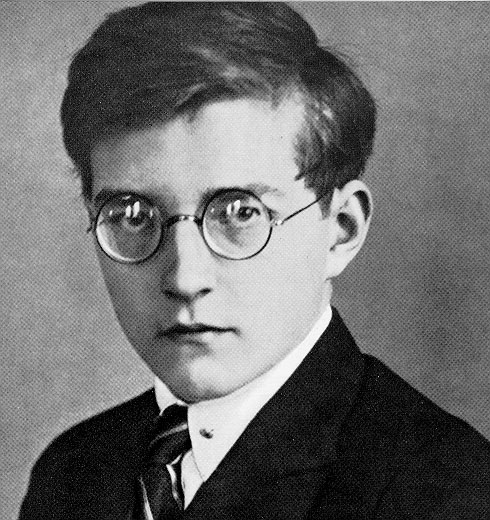
Dmitrij_Dmitrijevič_Šostakovič_(Дми́трий_Дми́триевич_Шостако́вич)

        Shostakovich in 1925

                   __________

                                        for Barbara, who died recently,
                                                 she would’ve loved this 

Shostakovich was just nineteen when
his Symphony No.1, opus 10 was 
first performed – it had been his 
graduation piece the previous year
from the Petrograd Conservatory –  
by, then, which is to say 1926, the 
Leningrad Philharmonicrenamed the 
Saint Petersburg after the fall of the 
U.S.S.R., the name it had held before 
the Bolshevik Revolution, the oldest 
philharmonic orchestra, therefore, 
incidentally, in our Russia, going  
back to 1882 

the work was a complete success, not 
surprisingly, if you’ll consider its scope, 
its power, and its novel musical 
interpolations, I mean a piano as an 
integral orchestral instrument rather 
than as a distinct, however interrelated, 
component, a pas de 40 instead of 
pas de deuxsomething I can’t remember 
anywhere else having seen for piano 

not to mention the drum roll between 
the last two movements, drums making 
splash in an orchestral setting, who’d 
‘a’ thunk it, though Richard Strauss had
done just that in his extraordinary 
Burleske” several decades earlier,  
another youthful work, Strauss only 21

but meanwhile back in Russia, before 
too seriously digress, Shostakovich  
was immediately compared to another 
earlier young prodigy there, Alexander 
Glazunovwho’d himself put out his 
own First Symphony, the Slavonic“,
at age 16, introducing, incidentally, his 
own instrumental novelty then, an oboe 
obbligato, which by very definition is 
lovely
  
Glazunov also mentored, by the way, 
Shostakovich at the Petrograd, proved
to be instrumental indeed in his 
progress

it’s interesting to put these last two 
together, to compare, the Glazunov, 1881,
follows the traditional Romantic 
imperatives, tempo, tonality and 
repetition, but with more bombast, to my
mind, than its European counterparts,
its fields are the Russian steppes with 
troikas, horse-drawn carriages, flying 
across vast unhampered vistas of the 
Russian snow-covered, therefore 
pristine, tundra, to whet the unbridled 
Russian spirit, the Europeans, Brahms,
MendelssohnMahler, conversely, 
are confined to the hunt, however ever
glorious, but with shrubs, copses,   
thickets, if not veritable forests, to blur
the sonic arena, inspire dreams, 
consequently, less far-reaching than  
those of Johnny Appleseed even, of 
the North American Prairies poets,    
their own far-flung, boundless  
imaginations, inspiration, you can 
hear it all, blatantly, in the resonance
of the horns

you’ll note the movements follow 
essentially the same rhythmic order 
in either symphony, the first two fast 
enough, then a third that’s somewhat 
slower, a variation from the strictly 
Classical order of fast, slow, fast, then
a last, eclectic, movement 

but Shostakovich is more atonal, 
melodically divergent, an eccentricity 
he’ll later polish to a degree of 
politically subversive brilliance

for not submitting, however, to the rule 
of repetition, which is manifest, though,  
in GlazunovShostakovichI find, leaves
us trying to find our bearings as his music 
rolls along, kind of like in biographical 
movies, when you start looking at your 
watch to determine how many life 
incidents remain in this particular, 
however significant, existential drama

as spectacle – and it must be noted that 
symphonic displays were at the time 
indeed spectacles – there was no 
phonographic, photographic 
equipment to transmit such 
experiences, the symphony itself was 
the show, it had, right there, itself, to 
wow the audience

in all of these cases, all of them did 

Shostakovich, however, of all of them 
remained eventually potently 
pertinent, powerfully paramount, 
watch

R ! chard

Beethoven, piano sonata no 15, opus 28‏


Beethoven’s piano sonata no 15, opus 28,
the Pastorale, is all about nature,
efflervescence and spring, one of my very
favourites, I call it his Johnny Appleseed
Sonata

in this instance, something I’ve never
experienced before, Tomoki Sakata made
me feel as though I were his instrument,
responding to his fingers, something
entirely transcendental, but with
rushes running up my spine

Classical music indeed

watch

if you dare

Richard

Apollo Appleseed

a friend of mine, Apollo, having
appropriated that name already
to launch a, not unpromising,
career as an artist, had never
to date considered a surname
for what I called his nom de
pinceau
, his brush name

but in a farfelu moment, French
for having lost one’s head – my
head, not his, having surrendered
immediately to his fantasy – he’d
happened upon “Appleseed” as
maybe a fitting, and to be
considered, apposition, addition,
to his presently truncated name,
I jumped on it

he later called the phenomenon,
at a loss for provenance, an
inspiration, to which I forthwith
concurred, Apollo Appleseed,
can you dig it, I told him he now
had to live up to it

inspiration is always the source
of poetry, I said, poetry is what
we all live for, to make our lives
beautiful

it involves following our inspirations,
however fanciful, however out there,
people have built lives around art,
literature, dreams, madeleines, for
goodness’ sake, fording oceans,
climbing mountains, and have
become not to be forgotten, it’s the
magic that counts, ever the aim of
inspiration

when inspiration strikes it is ever
charged with possibility, perspicacity,
delight, it is not a negative function

when inspiration strikes it is time
to stand and deliver, it knows the
ineluctable way, the one that’s in
your heart

you too can plant apple trees across
the land, of your own potentialities, if
only you dare follow even one of your
dreams

Richard

psst: you’ll have to forgive my ardour,
it’s been my Johnny Appleseed
speaking

and don’t forget to click

Beethoven piano sonata no 23, opus 57, “Appassionata”‏

despite its apparently appropriate appearance
Beethoven’s “Appassionata” once again was
not so titled by Beethoven, but posthumously
even only, by an otherwise inconsequential
publisher with respect to our story, it is filled
with brilliance and verve, as had been
Beethoven’s wont, but a new spirit has
invaded this work, to my mind, which
hadn’t been evident in his earlier, even
more recent sonatas  
 
Beethoven has ceded to contemplation,
no longer merely the bravura that bristled
thrillingly when his fingers flew across a
dazzled, surely, keyboard, dashing off
feats of musical dexterity, indeed of
outright improbable prestidigitation, the
inspired and omnipotent fury of a youth
in all his promise and pulsating
exhilaration
 
here, in the second movement mostly,
the very heart of the piece, his quest is
philosophical, this is no longer merely
a musical air, but a striving for meaning
 
from here on Beethoven, where earlier
he’d been an adventurer, a Johnny
Appleseed, if you’ll remember my calling
him that, in his idyllic Pastorale“, full of
determination and fire, still impervious 
to any danger, now has suffered doubt,
and begins here, at the height of his
compositional powers to display it 
 
this is no longer entertainment, this is
conversation, it’s like going from the
Beatles’ I Want to Hold Your Hand to
John Lennon’s Imagine having been
through the intermediate Sergeant
Pepper“, the later works meant to
actually change the world, not only
just to regale it 
 
this is also only the start, Beethoven
will become extraordinary, a sage, 
music’s highest priest, and prophet  
 
watch, listen, wonder
 
 
Richard


Beethoven – “Pastorale” Sonata, no 15, opus 28‏

from the very beginning of this musical series I’ve
been wanting, looking forward to, highlighting
somewhere, somehow, this incandescent piece
by Beethoven, but hadn’t yet found either a
complete nor, more significantly, a worthy
interpretation, though one briefly came and
went in a blazing virtual, as it were, transit, that
would’ve been perfect, and may now be never 
seen again, o, vast, too vast, eternity   
 
here Konstantin Semilakovs, not even a finalist at
Competition last September, 2012, the competition
must’ve been severely tough, plays an enchanted
rendition 
 
Beethoven is at the height of his euphoria here,
after his 7th sonata, his opus 10, no 3, he’d
followed through with his still resounding 8th, 
hisPathétique“, opus 13, through several
significant others to just before this one his
 
the Pastorale“, his opus 28 – “pastorale”,
incidentally, usually retains the German spelling,
for the feminine word in German “Sonate”, and
it is generally pronounced, with an enunciated
“e”, that way – is in all of music the piece I find
the most enchanting, I call it my “Johnny
Appleseed” sonata for its youth, freshness,
exhilaration, sense of adventure, infinite and
effervescent possibility, there isn’t a single
adagio here, note, just, at the very slowest,
an andante, a normal walk, there’s too much
wonder and fascination in the music to slow 
anything here down
 
you’ll note that Beethoven doesn’t too much
sway from the rigours of Classical structure,
the beat doesn’t significantly, nor even
infinitesimally much alter, though there are
some idiosyncratic Romantic liberties taken,
not an uncommon occurrence, by the interpreter,
fully redeemed however by his magical, meticulous 
rendition
 
nor does Beethoven touch tonality, we remain
always in the same key, each according to its
own movement
 
repetition is also there in spades, but you get
there only after he’s taken you through a veritable
rabbit hole, like Alice, and you don’t even know
where you are, where you started, but there you
are again suddenly, to your enchanted wonder,
but already he’s starting you up again for another
apparently iteration, o joy, o even ecstasy  
 
 
note intimations of Prokofiev already a century
earlier in the third movement, the sprightly
scherzo (allegro assai)”, note the eccentricity
of the syncopation, already the future is here,
spreading its nascent but fully burgeoning
wings into even our very own 21st Century,
decisively, we will not hang Beethoven out
to dry, that’d be like losing Shakespeare
     
 
the elements of Classicism, to summarize, 
remain strong with Beethoven, even essential
to his conception of music, the profound
difference is with the impact of the piano,
soft, loud, the hold petal, his use of volume,
his use of, from solemn to effervescent, pace 
 
with these opportune tools he changed the
face of music, channeling through them his
profound, his supremely inspired, genius,
becoming along the way and incontestibly
the Homer, the highest priest and most
revered elder, of Western music, to this very
day unchallenged, still not outshone, nor
even ever yet matched, just listen 
 
 
Richard   
 
psst: you might want to compare this Beethoven  
           with Schubert’s  “Wanderer” Fantasy, for
           their itinerary spirit