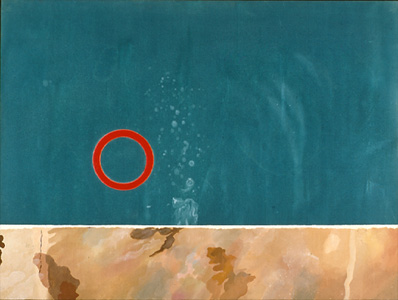
“Rubber Ring Floating in a Swimming Pool“ (1971)
David Hockney
_________
in responding to the powerful dictates
of Abstract Expressionism, dominant
in mid-Twentieth-Century art, its return
to essentials, the technical elements
of the medium – as indeed was taking
place in music and literature as well
during that period, see John Cage,
or Samuel Beckett, for instance, if
you dare – David Hockney, as well
as other related artists at the time,
were, it would seem, looking to
reconnect with a more general public,
their, after all, burgeoning market in
the post-war rise of the Middle Class,
not only with objects it would find
familiar, even iconic, Campbell Soup
cans, Marilyn, but with outright fun,
a not inconsequential attribute
out with ontological musings, they
were saying, dry taxonomy, and in
with, as it were, the bomp sh’ bomp
sh’ bomp
or Pop Art
noteworthy for its sense of
outrageousness, levity
and fashion, incidentally
not either inappropriately, fashion
was what the popes had been doing,
after all, adorning the Sistine Chapel
David Hockney here takes colour field
– flat, undifferentiated areas of a single
colour, a founding element of Abstract
Expressionism – and applies it to a
recognizable surface, which,
incidentally, he insists in his very title,
is not “Abstract”
we delight in the ingenuity of this
conjunction, form has become
function, or the reverse
and note furthermore the aptness
of other painterly preoccupations,
texture, a consideration that goes
back to Vermeer, and further
dimensionality, there is no horizon
to force representation of a third
dimension, which nevertheless
ingeniously doesn’t obliterate
clear three-dimensional
perspective
geometry, a hats-off to Mondrian
perhaps, and Cubism, though
we’ve come a long way from the
more diaphanous and shimmering
Cubism, just click
in fine, I’m impressed by the manner
in which this painting, despite its
naked and overt representation of
its subject, devoid of any context,
urges a more theoretical
consideration than substantial,
indeed “Abstract” rather than
grounded, rock, materially
speaking, solid
does “Rubber Ring Floating in a
Swimming Pool“ inform the form,
in other words
or does the form inform the
“Rubber Ring Floating in a
Swimming Pool“
is this grammar or a poem
you tell me
Richard

 Richibi's Weblog