Richibi’s Weblog

Just another WordPress.com weblog

Tag: Johann Strauss ll

the Nutcracker Suite – Tchaikovsky

vzevolozhsky's_costume_sketch_for_nutcracker

 original costume sketch for “The Nutcracker” (1892)


       Ivan Vsevolozhsky


              __________


it didn’t take me long, after wondering 

about precedents for Debussy’s nursery

piece, Children’s Corner, to ferret out 

Tchaikovsky’s The Nutcracker, a work

with a similar theme, childhood 

fantasies


but the Nutcracker Suite


         l. Miniature Overture

        ll. Danses caractéristiques

                a. Marche

                b. Dance of the Sugar Plum Fairies

                c. Russian Dance

                d. Arabian Dance

                e. Chinese Dance

                f. Reed Flutes

       lll. Waltz of the Flowers


is not to be confused with the complete 

balletfrom which it had been excerpted 

to great acclaim before the ballet itself 

was presented, but to much less 

enthusiasm, until George Balanchine 

revived it in the 1960s


note that Tchaikovsky’s Suite, in 1892, 

contains still the traditional elements 

of the suite – see above – a prelude, or 

overture, followed by a series of 

dances, only a few years before 

Debussy’s Children’s Corner, 1908, 

redefined the form, made the 

movements indiscriminate, not 

confined to dance rhythms


note also that Tchaikovsky sounds 

a lot more like the Strausses, father

and son, Romantics both, than he 

does like Debussy, an Impressionist,

a generation later only
here’s the orchestral Nutcracker Suite,

a suite, in other words, is not limited

to one instrument


here’s a riveting version of it for two 

pianos, not to be missed 


R ! chard

“Lament From Epirus” – Christopher King

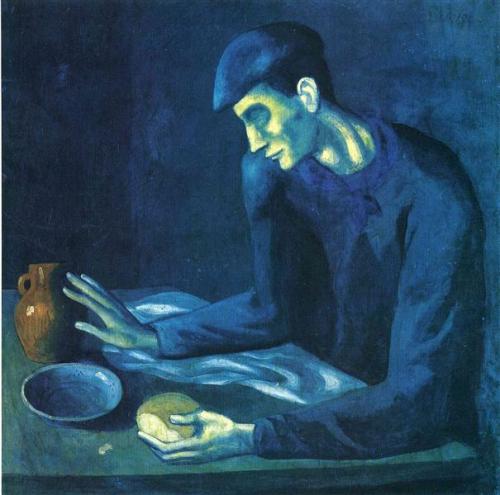
breakfast-of-a-blind-man-1903.jpg!Large.jpg

   “Blind Man’s Portion (1903) 

          Pablo Picasso

                ________

though you’ll have to actively listen 
to Christopher King rather than 
merely hear him hereas you might 
have been doing with many of my 
suggested musical pieces, should 
you be at all interested in the history 
of music, he is fascinatingdates his 
investigations back millennia to very 
Epirus, Ancient, nearly primordial, 
Greece, to mirologia there, ancient 
funerary chants

some have survived, and have been 
recorded for posterity, onein 1926, 
by Greek exile fled to New York City,
Alexis Zoumbas, a year laterhowever 
improbably, by an Americanblind 
man, his own story inspirational, akin 
to that of Epictetus, one of the two 
iconic Stoic philosophers, the other,
incidentally, an emperorthough the 
blind man here, Willie Johnson, was 
never himself slave, but only, by a 
historical whisker, the emancipations 
of the American Civil War


Christopher King‘s comparison
of an Epirotic miralogi with an 
American one brings up, for me,
the difference between Mozart 
and Beethoven, notice how the
Willie Johnson version is more
rhythmic, the cadence is much 
more pronounced than in the 
Greek one, Johnson would’ve
got that from the musical 
traditions Europeans had 
brought over from their native 
continent, probably also from
Africa, Africans

Beethoven would’ve been 
surroundedmeanwhile, by Roma, 
perhaps called gypsies then, their 
music ever resonant in his culture, 
not to mention later Liszt‘s, and 
the Johann Strausses’ even, for 
that matter, Paganini also seems 
to have been imbued with it, it 
having come up from Epirus 
through, notably, Hungary – not 
to mention, later still, that music’s 
influenceand I’ll stop there, on
late 19th-Century Brahms


Christopher King, incidentally,
sounds a lot like someone you 
already know, I think, from his 
eschewing Gesundheit – cell 
phones, for instance, to his 
enduring preoccupation with 
death, not to mention his 
endearing modesty, indeed 
his humility, his easy 
self-deprecationdespite his,
dare I say, incontestable, and 
delightful, erudition

makes one wonder why that 
other hasn’t become also 
famous yet

what do you think


R ! chard

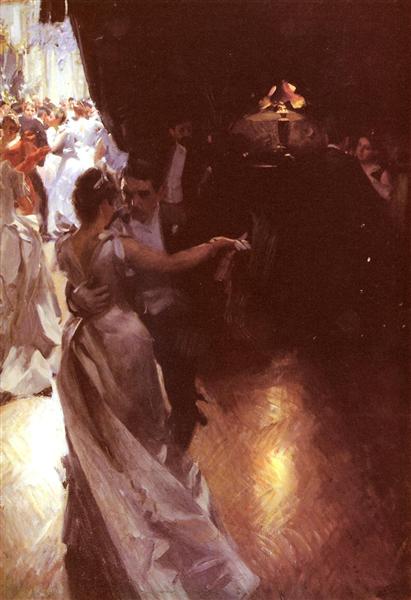
on the origins of the waltz

waltz-1891.jpg!Large.jpg

       Waltz (1891) 

         Anders Zorn

        ____________

had the waltz been confided to any 
other but the Johann Strausses, 
father and inveterate son, we may
never have distinguished it from 
the polka 

at the start, this amorphous new 
dance was deemed shameless, 
even shocking, by a scandalized
apparently, aristocracy, used to 
the more discreet, less conjugal, 
minuet

some nobles, sowing wild
irresistible oats, however, at the
festivities of their more irreverent 
servants, brought the new dance 
back home to their more informal, 
less stuffy, entertainments, avidly, 
though surely under their hats

to BelvedereSchönbrunneven 
Schloss EsterházyHaydn‘s  
stately old stomping haunt

thus was the waltz born, whirling 
indiscriminately like a polka at first
with indefinite stillhowever, timing

which then was reduced to only ever 
3/4 time, by the Strausses, the metre 
in which this comment, coincidentally, 
is written

read it aloud, you’ll want to wrap 
your arms around the nearest  
partner, assure you, and whirl, 
twirl, deliriously surrender

had we not had the Strausses, neither 
had we had Fred AstaireGinger Rogers,
Shall We Dance” from the glorious 
“The King and I”, nor the irrepressible 
So You Think You Can Dance either

nor me, for that matter, writing in 3/4 
verse, essentially, dactylic poetic metre 
about these celebrated accomplishments, 
something I deem eminently worthy of
reporting 

such is the impact of veritable art, I
warrant, the waltz was not inevitable

listen to Strauss Jr’s’ “Wiener Blut”, 
Viennese Blood“, or … Spirit
in English, for instance, for 
corroborating confirmation, and
corresponding, however inadvertent,
even, inspiration   

ever 

R ! chard