Richibi’s Weblog

Just another WordPress.com weblog

Tag: Jesus

“The Story of of Cadmus” (V) – Ovid
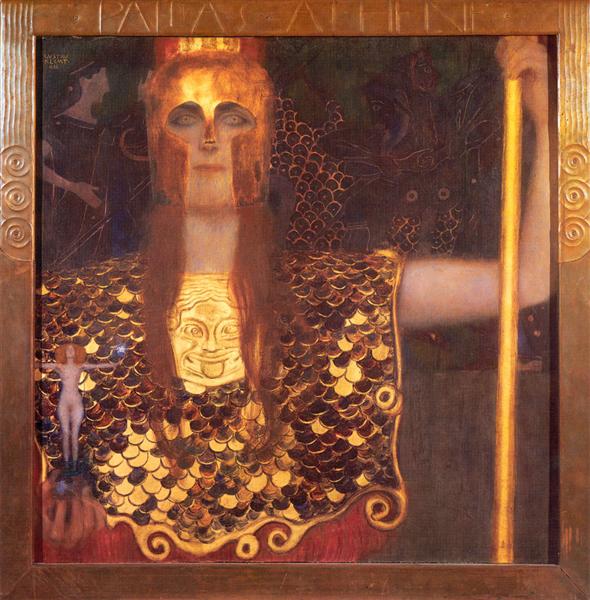
Minerva or Pallas Athena, 1898 - Gustav Klimt

         Minerva or Pallas Athena” (1898)


                Gustav Klimt


                       ______


an interesting thing has happened with

the story of Cadmus, he is not only a

mythical figure, but also a legendary

one, which is to say that Cadmus has

roots in actual history, he’s not just an

imaginary construct like those that

until now have peopled Ovid’s text


Cadmus appears to have actually

founded Thebes, whose origins,

however, are lost in antiquity, going

back to, it appears, the late Bronze

Age, around 2000 BC, goodness


stories evidently grew around

Cadmus, that transformed him into

our first documented hero, indeed

superhero


counterparts exist in other traditions,

consider David, for instance, who

slew his own dragon, Goliath, before

becoming king of the Israelites, 10th

Century BCE, at Jerusalem, where

he consorted, incidentally, later, with

Bathsheba, however illicitly, but

that’s another story


King Arthur, late 5th to early 6th

Centuries CE, stems from British

lore, though his historical actuality

has been contested, is also a hero

with preternatural capabilities based

on some historical accountability


in our day, there’s James Bond,

based on real, living and breathing,

personalities


or, dare I say, even Jesus


the point here is that actual people

are being included in the, however

culturally specific, mythologies,

which, in each, had earlier consisted

of metaphorical constructs merely,

the concept of History, in other words,

was being born, memorable events

were to be remembered, recorded,

documented, if only, originally, orally,

around, say, campfires, however

aggrandized might have been their

recollected heroes


Cadmus, meanwhile, in our story, is

about to establish his own historical,

and archeologically confirmed, note,

credentials


            The dire example ran through all the field,
            ‘Till heaps of brothers were by brothers kill’d;


The dire example, the dragon’s teeth,

grown into men, had begun, if you’ll

remember, to slaughter one another


example, display


            The furrows swam in blood: and only five
            Of all the vast increase were left alive.
            Echion one, at Pallas’s command,
            Let fall the guiltless weapon from his hand,


Echion, one of the five surviving

brothers


Pallas, Pallas Athena, goddess of

Wisdom, also of War


see above


            And with the rest a peaceful treaty makes,
            Whom Cadmus as his friends and partners takes;


the rest, the four other survivors


            So founds a city on the promis’d earth,
            And gives his new Boeotian empire birth.


promis’d earth, the premonition of

the oracles whose counsel Cadmus

had sought at Delphi, if you’ll

remember


            Here Cadmus reign’d; and now one would have guess’d
            The royal founder in his exile blest:


his exile, from Tyre, Cadmus’ original

home, from which his father, Agenor,

had sent him, not to return, he’d

warnedwithout his sister, Europa


            Long did he live within his new abodes,
            Ally’d by marriage to the deathless Gods;


Ally’d by marriage, at the end of a

period of penance for having killed

the dragon, which had been sacred

to Ares, god of War, the gods gave

Cadmus Harmonia, goddess of

Concord, to be his wife


Ares would eventually exact mighty

vengeance, but that’s another story


            And, in a fruitful wife’s embraces old,
            A long increase of children’s children told:
            But no frail man, however great or high,
            Can be concluded blest before he die.


even Cadmus, though he might

enjoy a long life, and many, a long

increase of, children, is not immune

to any of the vicissitudes of life either

until his own time has come, the poet

advises, however ominously


and here Ovid also introduces the

subject of his next metamorphosis,

Actaeon, however early, luring us

thereby, deftly, literarily, towards

his next instalment, Actaeon’s

story, eponymously, there, given

its title


            Actaeon was the first of all his race,

            Who griev’d his grandsire in his borrow’d face;

            Condemn’d by stern Diana to bemoan
            The branching horns, and visage not his own;


his grandsire, his grandfather,

Cadmus was the father of Autonoë,

who was the mother of Actaeon


borrow’d face, Actaeon was

transformed into a stag by the

goddess Diana / Artemis, of the

Hunt, of the Moon, of Chastity,

for having seen her naked as

she was bathing


he now has the face, the visage, of

someone, something, he hadn’t

been before, borrow’d


            To shun his once lov’d dogs, to bound away,
            And from their huntsman to become their prey,


having been transformed into a

stag, or metamorphized, Actaeon

would end up hunted, and worse,

by his own, once lov’d, dogs


            And yet consider why the change was wrought,
            You’ll find it his misfortune, not his fault;
            Or, if a fault, it was the fault of chance:
            For how can guilt proceed from ignorance?


to have been at the wrong place

at the wrong time, yet to suffer,

however unfairly, the consequences,

that, Ovid asks, is the question, the

conundrum


stay tuned


R ! chard

“Metamorphoses” (The Giants’ War, II) – Ovid, 110

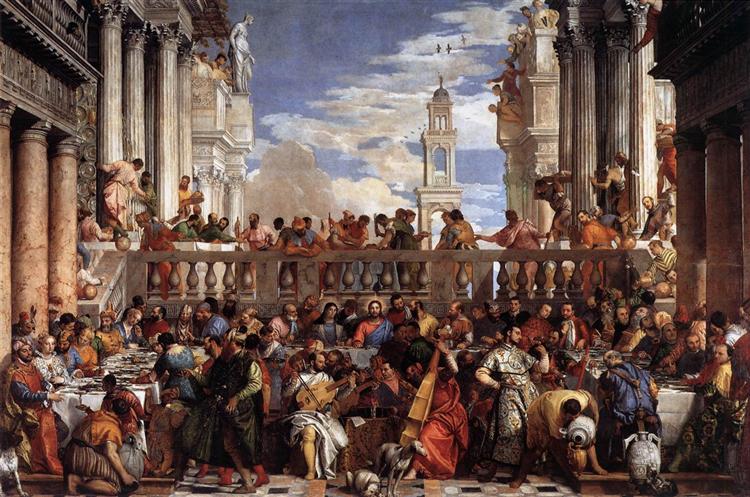
the-marriage-at-cana-1563.jpg!Large

      “The Marriage at Cana (1563) 


              Paolo Veronese


                  _________


Jove “sigh’d;” if you’ll remember, “nor 

longer with his pity strove; / But kindled 

to a wrath” which was worthy of him


           Then call’d a general council of the Gods;

           Who summon’d, issue from their blest abodes,

           And fill th’ assembly with a shining train. 


Jove calls the gods together to discuss 

the abhorrent conditions on Earth, who, 

upon being summon’d, leave their blest, 

or blessed, homes, and fill Jove’s 

assembly hall with their glittering train, 

their advancing pageantry


           A way there is, in Heav’n’s expanded plain,

           Which, when the skies are clear, is seen below,

           And mortals, by the name of Milky, know. 


when the skies are clear in Heaven’s

expanded plain, its wide expanse, 

mortals can see the Milky Way


           The ground-work is of stars; through which the road

           Lyes open to the Thunderer’s abode: 


this Milky Way is paved with stars, which

lead to Jove’s, the Thunderer’s, domain


           The Gods of greater nations dwell around, 

           And, on the right and left, the palace bound;


the dwellings of the gods who represent 

the greater nations of the era, of Rome, 

for instance, or Greece, surround,

encircle, the Thunderer’s abode, his 

palace 


           The commons where they can: the nobler sort

           With winding-doors wide open, front the court. 


the more common gods, those of 

lesser nations, live where they can, 

while the winding-doors of the nobler 

gods, doors which can be activated

mechanically, on hinges, though 

perhaps here divinely, stand wide 

open for this colloquy, this exalted 

conference, before the celestial 

court 


           This place, as far as Earth with Heav’n may vie,

           I dare to call the Louvre of the skie. 


if one were to compare [t]his place

this court, to anything on Earth, have 

it vie with, one would liken it, Ovid 

says, to the Louvre


there’s evidently an anachronism 

here since the Louvre didn’t exist at

the time of Ovid, so that the translators 

have replaced the “Palatia” of Ovid’s 

original Latin, which refers to the 

Palatine, the most central of Rome’s

Seven Hillswhere imperial palaces

were built at the time of Augustus

63 B.C. to 14 A.D., which is to say 

during Ovid’s time, 43 B.C. to 

17 /18 A.D., by this relatively more 

recent palatial residence, the Louvre,

in order to make the text more

contemporary, like settings and 

attire are used in Renaissance

art to kindle the viewer’s sense 

of connection


see, for instance, above, where 

Veronese depicts the scene of Jesus 

attending a marriage at Cana, a village 

in Galilee, and transforms water there 

into wine to accommodate a shortage,

midst Roman, note, rather than Galilean, 

trappings, splendour


           When all were plac’d, in seats distinctly known, 

           And he, their father, had assum’d the throne,


seats distinctly known means the

traditionally assigned places, with 

Jove, “their father”, at the head of

the convocation 


           Upon his iv’ry sceptre first he leant,
           Then shook his head, that shook the firmament: 


leant, or leaned, [t]hen shook his head

in revulsion


           Air, Earth, and seas, obey’d th’ almighty nod;
           And, with a gen’ral fear, confess’d the God. 


the elements, Air, Earth, and seas“, 

acknowledge, or confess’d, the God, 

with quivering anxiety


           At length, with indignation, thus he broke
           His awful silence, and the Pow’rs bespoke. 


Jove, after a silence, bespeaks, or 

addresses, the assembled Pow’rs, 

the other divinities


R ! chard


“Meditations”, Book 5 – Marcus Aurelius

“In the morning when thou risest unwillingly, let this thought be present – I am rising to the work of a human being. Why then am I dissatisfied if I am going to do the things for which I exist and for which I was brought into the world? Or have I been made for this, to lie in the bed-clothes and keep myself warm? – But this is more pleasant. – Dost thou exist then to take thy pleasure, and not at all for action or exertion? Dost thou not see the little plants, the little birds, the ants, the spiders, the bees working together to put in order their several parts of the universe? And art thou unwilling to do the work of a human being, and dost thou not make haste to do that which is according to thy nature? – But it is necessary to take rest also. – It is necessary: however nature has fixed bounds to this too: she has fixed bounds both to eating and drinking, and yet thou goest beyond these bounds, beyond what is sufficient; yet in thy acts it is not so, but thou stoppest short of what thou canst do. So thou lovest not thyself, for if thou didst, thou wouldst love thy nature and her will. But those who love their several arts exhaust themselves in working at them unwashed and without food; but thou valuest thy own own nature less than the turner values the turning art, or the dancer the dancing art, or the lover of money values his money, or the vainglorious man his little glory. And such men, when they have a violent affection to a thing, choose neither to eat nor to sleep rather than to perfect the things which they care for. But are the acts which concern society more vile in thy eyes and less worthy of thy labour?”

Meditations“, Book 5, 1

Marcus Aurelius

___________

though Marcus Aurelius produces
a seemingly logical argument in the
first paragraph of his fifth book of
meditations, his premises are not
air-tight

are we meant to “work”, a notion
already roundly infiltrating Christian
ideology, by the “sweat of its brow”,
as it were, at the time of Marcus
Aurelius, with those roots already in
early Stoicism, with Zeno of Citium,
a good 350 years before Christ

this notion is alive and well, indeed
thriving still, in the Protestant Ethic,
where very salvation is achieved
through labour, a consequence of
the Fall, which is to say, the expulsion
from the Garden of Eden

and Utilitarianism, where effort, which
is to say, work, is required to maximize
happiness, minimize suffering

these are profound pathways based
on faith, not necessarily ineluctable,
Epicureanism, an opposite philosophy,
of savouring the moment, though less
purported, less proclaimed, appears
ever flourishing nevertheless in our
voluptuous 21st Century

Marcus Aurelius brings up another
issue tangentially here, though he
expounds on it in later passages,
that of the primacy of either the
person or the community, a central
question of our times, socialism
versus democracy

he favours community, after Plato,
so, incidentally, does Jesus

these are not easy questions to
answer, what, essentially, are the
conditions required before one
starts to smell the flowers, is
smelling the flowers an abomination
when people are cruelly suffering,
dying

how can I help, should I, and when
do I say no to myself

therefore philosophy

your life, indeed your very next step,
depend on it

cheers

Richard