Richibi’s Weblog

Just another WordPress.com weblog

Tag: Jean-Honoré Fragonard

how to listen to music if you don’t know your Beethoven from your Bach, cont.

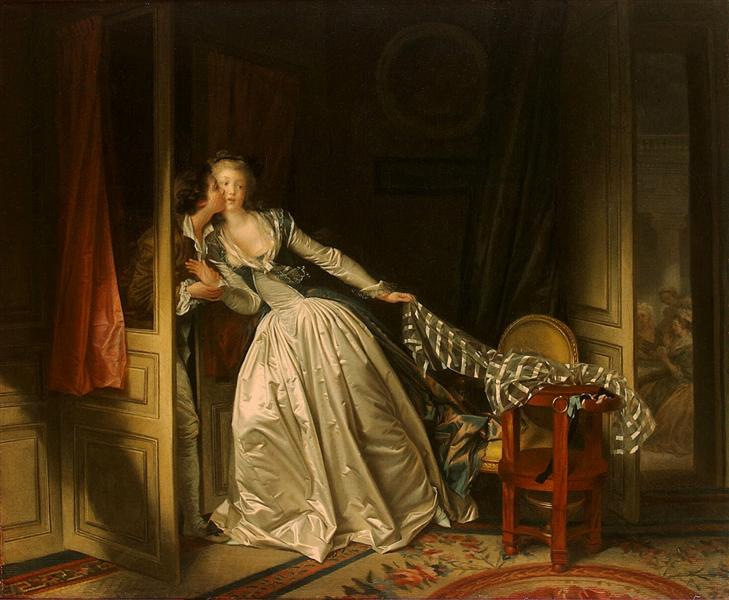
The Stolen Kiss, 1788 - Jean-Honore Fragonard


        The Stolen Kiss (1788)


       Jean-Honoré Fragonard


               _____________


if you listened to the couple of pieces I

recommended in my last commentary,

you would’ve indeed recognized, if

even only subconsciously, that the

first work wasn’t composed by the

composer of the other, that different

spirits infused either


a visual representation of the same

thing might be to juxtapose a

contemporary painting of the one

epoch with a corresponding painting

of the other


over a hundred years had passed

between Mozart and Prokofiev,

Mozart’s Piano Sonata no 18, K576

– his last piano sonata, incidentally,

he died a short two years later –

was written in 1789, the year of the

French Revolution, a still safe

distance from Vienna, where

Mozart could still cater to an,

however endangered, species


Jean-Honoré Fragonard, a contemporary

painter, 1732 – 1806, had been doing the

same thing, The Stolen Kiss, 1788, for

instance, a mere year earlier, see above


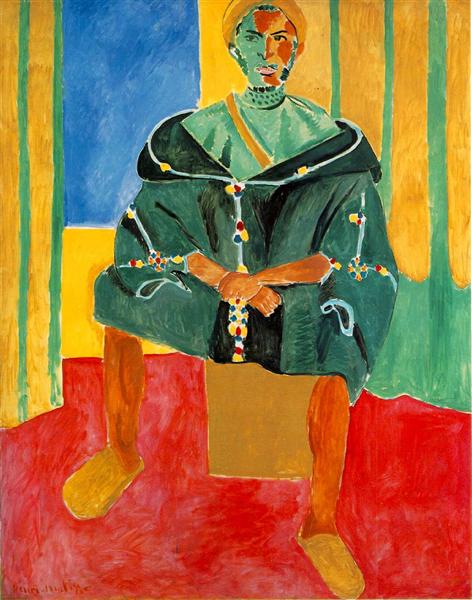
meanwhile, over a hundred years later,

inches only away from the First World

War, Matisse is doing in art what

Prokofiev is doing in music, taking the

temperature of his own time, Seated

Riffian (1911 –1912) – a Riffian, a Berber,

a North African tribesman – see below,

to corroborate Prokofiev’s equally

emblematic vision of their shared era


you can hear this in the music


mostly through the difference in the use

of volume, languorous softs, thunderous

louds, but also in the more expansive use

of pace, fast, slow, the rapidity of some

notes, the embrace, the extended caress,

of others, in the later composition


which, in a word, follows the development

of the piano from harpsichord to the

instrument we’re used to today


Mozart still had the harpsichord in his ear,

he was writing for the fortepiano, which

evolved, through the pianoforte, to the

piano we know of today, no flexibility of

pace, no flexibility of volume then, listen,

hearyou can hear it in the juxtaposition


we hear a lot more than we think we

hear


R ! chard


                  __________


Seated Riffian, 1912 - 1913 - Henri Matisse


        Seated Riffian (1911 – 1912)


                Henri Matisse


                  __________

“Paths of Glory”‏

hot on the heels of Sergeant Yorkhere’s
another war story, of war movies the one
that has left of all of them with me the most
indelible impression, Stanley Kubrick‘s 
searing Paths of Glory
 
incongruities exist, Kirk Douglas plays the
French Corporal Dax, not sounding at all like
a Frenchman but like the American voice of
reason back when such a position held, nor
do most of the other players, apart from,
among especially the military leads, more
formal, aristocratic, which is to say, viable
accents
 
but these inefficiencies soon cede to the
power of a compelling story, all consistently
thickening drama, to the very inexorable end
 
some situations are heightened of course
for the sake of tension, but this is a completely
valid metaphorical device of fiction, I argue, for
the sake of a more profound truth, reality would
be too fraught with its own not as readily 
scrutable inconsistencies and conundrums 
 
the tale is as involving, incidentally, as a
Beethoven sonata, with even its own
incandescent coda, a short musical epilogue,
that will leave you blubbering, a scene of such
subtlety and vision, poetry and powerit has 
remained personally etched forever on my
however maybe too impressionable heart 
 
you’ll need, I think, some Kleenex
 
Kubrick even married his leading lady,
remaining together with her till ’99, the
year of his surely greatly grieved demise
 
 
interiors incidentally by Fragonard,
exteriors by the ravages of war 
 
 
Richard
 
psst: where have we heard about
           courts-martial lately


Mozart Concerto for Two Pianos and Orchestra, K365‏

  Blind Man's Bluff - Jean-Honore Fragonard

                               Blind Man’s Bluff(1769-70)

                                               Jean-Honoré Fragonard
 
                                                      _______________
 
 
the spirituality that is everywhere in Bach, the
sense of musical exploration and ultimate solace,
will not be found again in the history of music
for another hundred years, in Anton Bruckner
then, 1824 – 1896, a profoundly devout Catholic
organist – Bach, 1685 – 1750, was Lutheran –
then for another hundred years again, in Olivier
Messiaen, 1908 – 1992, again a profoundly
devout Catholic organist, perhaps a
reincarnation, like a Dalai Lama 
 
already in his day Bach was being considered
old-fashioned, gasp, the new age was revelling
in courtly extravagance, see also for instance
François Boucher, and Fragonard, featured for
your convenience above
   
Mozart would fit right in, for a good time call
Wolfgang Amadeus  
 
 
Mozart takes the tools that Bach created, the
newly installed well-tempered clavier and does
what kids do with their parents heritage, play
with it, Mozart doesn’t explore, he entertains,
notes are the toys in his sandbox, and he makes
the very most of it, never leaving his kindergarten
sanctum, nor would anybody be as effervescent
again for, this time, another 150 years, with
Prokofiev, 1891 – 1953, even more outrageous,
though ultimately not for that more famous,  
being perhaps for many too out there, fun like
jack-in-the-box, too unnervingly unpredictable, 
still 
 
Mozart, though eminently delightful, is
appropriately predictable for his epoch
 
 
of all of his works my favourite, is what I put
on for instant exhilaration
 
it never fails me
 
 
enjoy
 
Richard 


a cello concerto‏

Portrait of Marquise de Pompadour, 1759 by Fran?ois Boucher

               “Portrait of Marquise de Pompadour

                                 François Boucher  
 
                                     __________
 
 
Joseph Haydn, 1732 to 1809, who preceded and outlived
Mozart, 1756 to 1791, was also an older contemporary of
the more imperious Beethoven, 1770 to 1827 
 
of the three Haydn is the most pleasant, polite, courtly,
witty, elegant, congenial, the musical equivalent of, say, 
the painters Boucher or Fragonard, though with a perhaps
more restrained sensuality 
 
his audience, and indeed his sponsors, were aristocrats,
his music makes no political, emotional, ideological
demands, it is meant merely to delight, which it does
in spades 
 
one of his symphonies, the number 45, for instance, loses
instrumentalists one at a time in its final movement until
two only remain, Haydn himself and the concertmaster,
the orchestra had been wanting to go home but had been
retained by the count at his summer palace, Esterhazy,
longer than anyone expected, each one, according to
instructions in the score, was to put out the candle on
his music stand, in Vienna, incidentally, not one of
them of course was a woman, then was to leave the
shrinking stage, the not inconsiderate count let them
scurry the very next day
 
 
Mozart is more spontaneous, less academic than Haydn,
playful, unaffected, less inhibited, younger, by very
definition therefore less refined, more maybe, as a
consequence, unintentionally magical
 
Beethoven meanwhile is a quantum leap from their
Classicism, which is to say the musical groundwork
for our epoch set down by both those other
foundational pillars, into Romanticism, unleashing
upon his forebears’ firm structural, Classical, base 
his more humanist, less formalized, view of the
emotions, paving the way, for instance, blazing a
very trail for, among others, its later towering
figure, Chopin 
 
 
in 1761, Eve-Marie Caravassilis plays the cello, Patrick
Botti conducts the Concilium Musicum de Paris in the
Church of St-Catherine of Hungary in Paris, all of these
to me unknown, August 10, 2011, just last year  
 
I was not unimpressed
 
 
note the consistency throughout of the pace, and the
courtly discretion ever, in even the nimble, never 
boisterous or brash, concluding, for instance, presto
pithy, pert, but always peremptorily polite, it would
never come crashing down 
 
what Revolution, it assumes, what 1789, let’s party