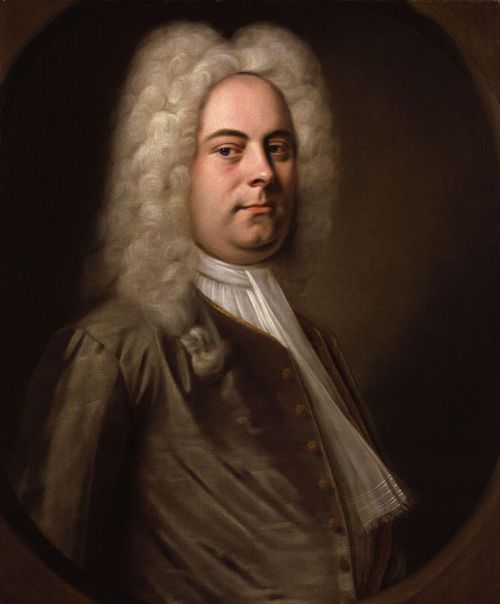
“Apollo e Dafne” – George Frideric Handel
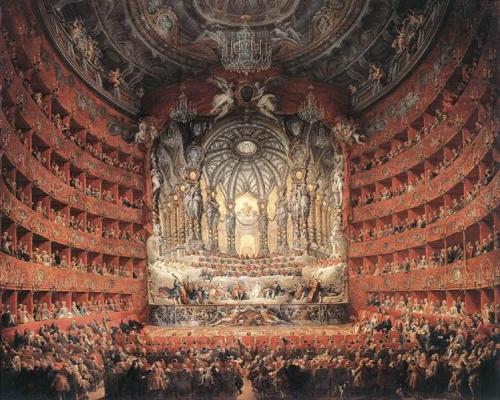
“Musical Fête“ (1747)
____________
though by now you must be assuming
that Beethoven had been defining the
entire early Romantic Period all by
himself, 1803, let’s say, to, say, 1810,
when Schubert, 13 by then, started
kicking in, however immaturely, with
his D1 – D1, note, not D960, over a
thousand compositions later, a work
imbued, so early, not unexpectedly,
with the irrepressible spirit of Mozart,
and therefore, by then, incidentally,
audibly outdated – but you would be,
we would be, overlooking the extraordinary
influence of a maverick, a relic of the
earlier Italian domination of the arts,
from the Renaissance, at least, on –
Paganini – the wizard of the
violin, who’d sold his soul, like Faust,
to the devil, it was susurrated, for his
extraordinary gift
Bach had not only changed the course
of musical history, in the early 18th
Century, but shanghaied the very
language of art as oracular expression,
and substituted music as the voice that
spoke for the people, music will define
henceforth, for a time, the period
there is the Italian Baroque, of course,
utterly masterful paintings, sublime
even, see above, but it has been
supplanted in our 21st-Century
popular imagination by the Baroque
of the German nations, their music,
Bach’s, transcendental then, though
ever so intricate, descriptions of his
particular epoch
this dominance will migrate to Paris,
eventually, and back to art, painting,
after over a hundred tumultuous,
and impermeable, years, with the
Impressionists, in the late 19th
Century
meanwhile, Paganini will get in the
way, 1780 – 1840, an exact, more or
less, contemporary of Beethoven,
1770 – 1827, and show off what
Romantics can do, unleashed,
before a newly enfranchised, and
thrilled, as you will surely be,
audience
R ! chard
psst: the “Caprices“ are essentially
cadenzas, the improvised solo
sections in concertos, where
instrumentalists get to show
off their stuff, and riff, however
exponentially, on their subject
Paganini, makes an art form
of that, as do others, whom
I’ll bring up, trust me, later
stay tuned
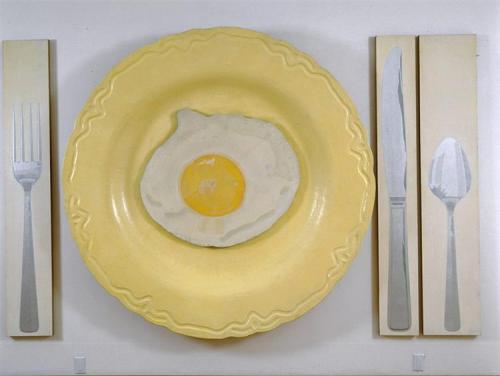
“Egg on Plate with Knife, Fork, and Spoon“ (1964)
____
after my somewhat prolonged side trip
into Bach country, though it is a land
of many more wonders, I’ll get back
on track, more or less, here, with
Beethoven’s Second Cello Sonata,
the other half of his Opus 5
till then, the cello had served as
accompaniment, essentially, for other
more discursive, higher pitched, less
sonorous, less stentorious
instruments
but Beethoven puts the cello back
into the hottest seat in the house, right
next to the ubiquitous piano, a
requirement in any instance following
the neglect of the cello during the
intervening Classical Period, despite
Bach’s earlier luminous illustration of
its incandescent potential
the Opus 5, no 2 starts, audaciously,
with an adagio, not always a wise
choice, as you’ve heard me repeat
here before, it can be unentertaining
but Beethoven gives his adagio tension
by introducing breaks often, which,
rather than stultify, creates momentum,
therefore a narrative, a story to follow
the rhythm is no longer adjusted to
dance essentially, such a spin as is
heard in the second and third
movements, for instance, would
surely sweep one off one’s feet
but the art is in the dance that
Beethoven allows and creates between
the piano and the cello, the first the
filigree on the arm of the more grounded,
more entrenched latter, the crystal, the
silverware that adorn, symbolically, an
however majestic oak table, the creamy
Hollandaise that makes an egg, however
elemental, irresistible, the literary turns
that might transform mere prose into,
verily, poetry, icing on a cake, in a word,
to complement, in stunning and equal
cooperation, the inextricable
counterpart
there is even a moral lesson transmitted
here
Beethoven can often be long-winded,
I’ve found, but there’s always, always,
at the end of the road something
entirely worth the extra minute, the
even several extra minutes
R ! chard
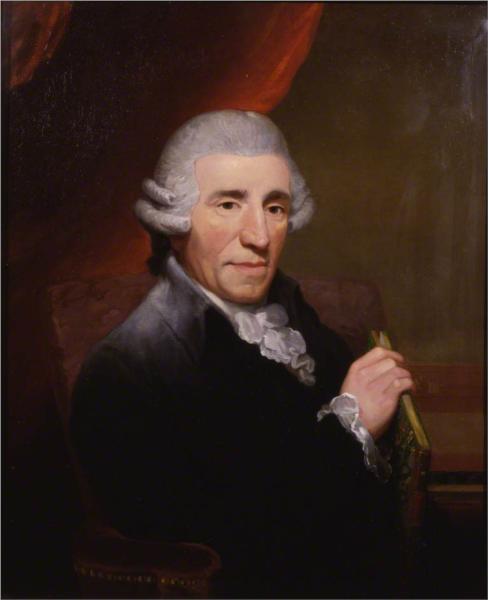
“Joseph Haydn“ (1791)
______
to not consider other musical forms of
Shostakovich would be unfair, his
symphonies are mostly propaganda,
however often, though somewhat
culturally specific, riveting
my favourite works of his, works I
consider iconic, are mostly chamber
pieces, piano solos, string quartets
a string quartet, after a symphony, is
like sitting down to dinner with four,
at the very least, acquaintances,
rather than being a guest at a party,
the conversation is more intimate,
every person plays hir part, everyone
is heeded, if even only with courtesy,
a social, a Classical, an aristocratic,
prerequisite
movements can be compared to
courses, distinct and identifiable for
their particular culinary, musical,
propriety
later variations on this reflect the
variations in social mores, where
restaurants, the modern way of
socializing, allow for disparate
choices, often superimposed,
throughout the meal for any,
every, occasion
dim sum, tapas, celebrate this, not
unhappily
but string quartets can be tricky, I
thought I’d start from the beginning,
with some Haydn, their recognized
Father, you’ll understand when you
hear this, his Opus 76, no 1, an
outstanding string quartet to live
up to
Haydn set the standard for string
quartets when the norms of Western
music were being established, Bach
had given us the alphabet, the
well-tempered clavier, Mozart, the
grammar, the structure of music,
tempo, tonality, repetition, Beethoven
gave us the literature, the poetry, the
philosophical, the transcendent
Haydn is somewhere between these
last two, but decidedly, still, the king
of the string quartet, though Beethoven
does a good job of trying to best him,
and so does Shostakovich, you’ll have
to pick
but first, let’s start with Haydn, that’ll
be already, you’ll see, or hear, enough
later, I’ll get into it
R ! chard
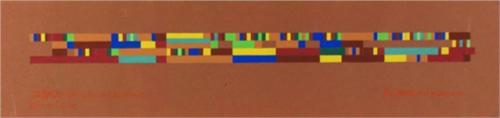
““J.S. Bach, Wohltemp. Klav. Bd. I, No. IV. (Extrait) / (Duo de Tristesse)” (1957)
________
if I’ve been getting on their backs
about their Bachs at the Tchaikovsky
Competition, it’s that they’re playing
Bach as though he were mediocre
Beethoven, it’s like asking Duke
Ellington to be Pink Floyd, it’s just
a completely different generation,
era
Bach wrote for the harpsichord, a
precursor to the piano, it could not
control the volume, nor the length
of a note, the pianoforte came
along to resolve both issues
therefore before Beethoven, who
made full use of the new invention
and worked hard the pianissimos
and the fortissimos, to degrees that
often became either inappropriate
or too authoritative, indelicate or
obnoxious if you’re not in the mood
– I remember wanting to play his so
solemn 111 at my father’s funeral,
but realized late that the first
movement was not especially in
that situation warranted, nor even
parts of the transcendental, but not
always not obstreperous, adagio –
and thumbed thus his nose at the
aristocracy, who earlier, before
the citoyens had demanded their
rights and when the world had
been considered to be of a
rational, logical order, a clock,
and as regular, would never have
tolerated such impudence
Bach and Mozart do not sway
much from strict rhythm, neither
do they alter volume much at all
so that the constant display of
heartfelt Bach and passionate
Mozart becomes cloying, and
not at all what these Classical
and Baroque masters would
have approved of
nor Beethoven, nor Chopin, for
that matter, whose strict tempo
markings didn’t include much
rubato, ritardandos, which you
could think of as milking a note,
putting velvet on your canvas,
it doesn’t work, the composition
itself unaided by bathos, pathos,
delivers, check out, of course,
Glenn Gould
Andrei Korobeinikov sat me right
down the other night with his
arresting BWV868, thrilling,
followed by more dazzling
pyrotechnics, though he fizzled,
and fractured his Beethoven, the
very 111 I care so much for, I
couldn’t even finish, you don’t
need a velvet canvas behind the
111, neither cloying ritardandos,
just skill, nor tangles of notes,
for that matter
Richard
 Richibi's Weblog