Richibi’s Weblog

Just another WordPress.com weblog

Tag: Impressionism

a veritable Schubertiade, III

Impression, sunrise, 1872 - Claude Monet


     Impression, Sunrise (1872) 


               Claude Monet


                   ________


what struck me most about Schubert’s Piano 

Sonata no. 17 in D major, his D850, was, more

than its emotional impact, its technical

wizardry, from the start Schubert dazzles with 

his prestidigitation, his manual dexterity, the

notes fly


there’s a lot of Beethoven in this composition,

working against the beat, apart from the fourth 

movement, the rondo, Schubert is being 

unequivocally Beethoven


the fourth movement is, incidentally, utter 

Mozart, you can tell from the preponderance

of trills


texture, meanwhile, overcoming melody, 

in, most notably, the third movement, is 

right out of Chopin, his Winter Winds 

for instance, an inspired combination

of both melody and texture, where is

the supremacy of either, listen, you tell 

me, do the Winds conquer the groans, 

the tribulations, of the underlying melody, 

the left hand, the low notes, the chthonic, 

the earth, or does the dexterousness of 

the right hand, the ephemeral, the 

transitory, win the day


texture will overcome melody eventually, 

as the century moves along, Impressionism 

will prioritize perspective over emotion, the 

head over the heart, Debussy, among 

others, Renoir, Monet, Pissaro, will 

dominate, see above,  but that’s another

story


meanwhile Schubert


listen


R ! chard

how to listen to music if you don’t know your Beethoven from your Bach, XIV – more rhapsodies

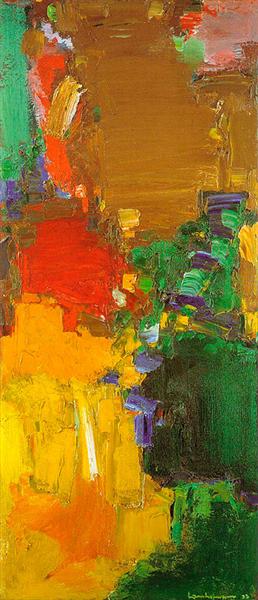
Rhapsody, 1958 - Hans Hofmann


    Rhapsody” (1958) 


         Hans Hofmann


                _______


now that you’ve heard New York in

Gerschwin’s Rhapsody in Blue, and

Vienna in Rachmaninov’s Rhapsody

on a Theme of Paganini, listen to 

Hungary, or rather its Gypsy

component, however rejected, 

reviled, at the time, but proud 

enough, resilient, to strike back 

with its infectious music, how

many times have we heard that

story before


Budapest doesn’t sound at all like 

Vienna, though they’re only mere 

blocks away, essentially, listen,

Liszt’s Hungarian Rhapsody no 2,

in C# minor, he wrote nineteen, 

you’ve probably heard this one,

it’s in our DNA


here are a couple of Spanish

rhapsodies, meanwhile, if we’re to 

follow a national agenda, Chabrier, 

a name you’ve probably never 

heard before, but not so, I assure

you, his music, his España,

Rhapsody for Orchestra, is

written in our blood, listen


Ravel wrote also a Rapsodie 

espagnole, more French than

Spanish, to my mind, steeped

in its early Twentieth Century

Impressionism,  all textures,

soundscapes, not rhythms


Ravel makes up for it, though, in his

Bolero, perhaps the most Hispanic 

piece ever of all, you tell me


both Chabrier and Ravel, incidentally, 

were French, doing what Dvořák, a 

Czech, had done, would do, for 

Americans, honour their fascinating

rhythms


Liszt, by the way, was Hungarian, his

rhapsodies were native, if profoundly

influenced by Vienna 


listen, enjoy


R ! chard

Études – Chopin /Debussy

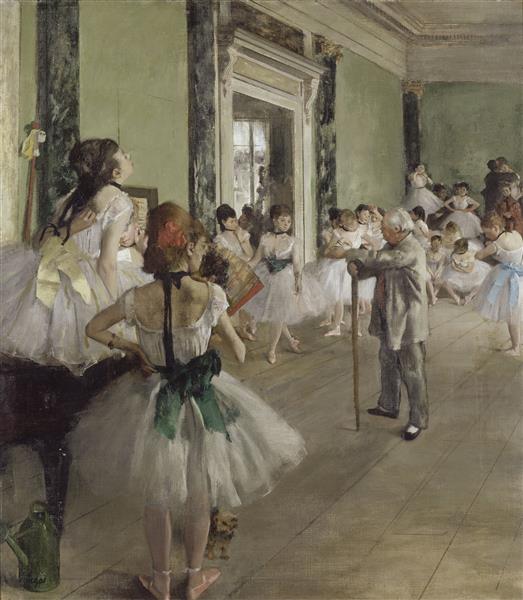
edgar-degas-the-ballet-class.jpg!Large.jpg

   “The Ballet Class (1871 – 1874) 


          Edgar Degas


             ________


ballet dancers will attach weights 

to their ankles during exercises 

to add lift to their legs when they 

are on stage, such is the point of 

études for a piano player, a 

workout for the fingers before 

public performance 


Chopin, however, made them, by

themselves, works of great art,

followed by, among others,

Debussy


here’s Chopin, his Opus 25


here’s Debussy, his own Études

pour piano, Livre 1“, or Book 1


how are they different


you tell me


listen


R ! chard


psst: this is an easy one, Chopin is

          Romantic, Debussy, manifestly,

          is not, Debussy is Impressionistic,

          it is a new perspective, you can 

          hear it, it’s textural rather than 

          emotional, indeed, it’s even

          abstract


          but nearly a century has gone by,   

          and Impressionism is the new  

          aesthetic, the new preoccupation


          which belongs to not only the  

          painters, let me point out, but to  

          all the arts, for better, once again, 

          or for worse

Bassoon Sonata, opus 168 – Camille Saint-Saëns

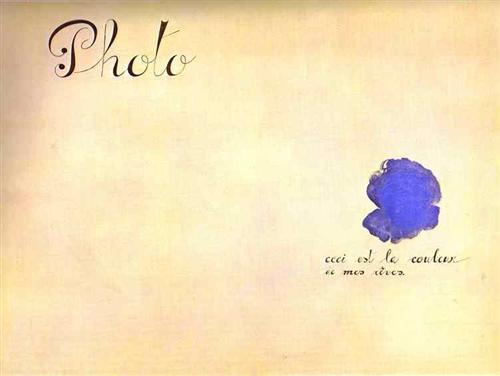
photo-this-is-the-color-of-my-dreams.jpg!Blog

                  Photo; This is the Color of My Dreams (1925)
 
                                                Joan Miró 
 
                                                   ______


 for  my sister

a competition program that pits
youngsters against each other,
but on a variety of instruments,
with some operatic voice, has
riveted us to our sets on Friday
evenings, seven o’clock local
time throughout Canada

out of the province of Quebec,
however, and therefore in
French

Virtuose lives up to its name
with extraordinary performances
from mere children, and some
adolescents, you can catch all of
the past episodes, and performers,
on their website

last week a young man delighted
us with a movement from a bassoon
sonata
, an unlikely instrument, of 

Saint-Saëns, his opus 168

my sister expressed surprise,
un basson, she marvelled

quickly I sought out, of course, the
full composition, it’s otherwise for
me like reading one chapter only
out of a book

it’s a short piece, no longer the
grand statements of the earlier
Romantic Period, but a series of
pastiches, fleeting impressions,
impromptu ruminations rather
than extended dissertations,
something like what I’m doing
here with these texts

you’ll recognize also a similar
approach in other composers of
the period, Debussy especially,
but too Satie, Ravel, Poulenc to
name only a few, the speed of
the new century precluded
extended musical peregrinations,
you’ll remark on the dearth of
symphonies, concertos,
composed during this epoch

the composition is in G major, my
cleaning lady had come over, was
already busy in an adjoining room
at the time, I was nearing the
end of the first movement, the
allegro moderato, a wistful
evocation of spring, I thought,
an innocent, fragile blossom
unfurling its delicate petals
with unaffected grace and
unconscious poetry

the final note sounded, the
bassoonist removed his lips from
the tube, but the note kept on
playing, coming, as I soon
understood, not from the video I
was watching, but from the other
room, Jo had turned on the
vacuum cleaner

o my god/dess, I uttered, hurried
over to where she was, subdued
my enthusiasm in order not to
unduly rattle her, as I brimmed
with my scintillating insight

your vacuum cleaner vacuums in
G, I gushed when she turned to
acknowledge me, it continued the
last note, I explained, of the first
movement of my sonata, Saint-
Saëns’ – say that three times with
a lisp, I interjected – until you
turned your vacuum cleaner off,
which is also, I pointed out, a
wind instrument

her delight was modest compared
to mine, however ever nevertheless
congenial, and quickly she returned
to her duties

I went back tickled pink to my
monitor and the following
movement, the sprightly and equally
enchanting allegro scherzando

Richard
String Quartet in G minor, opus 10‏ – Claude Debussy

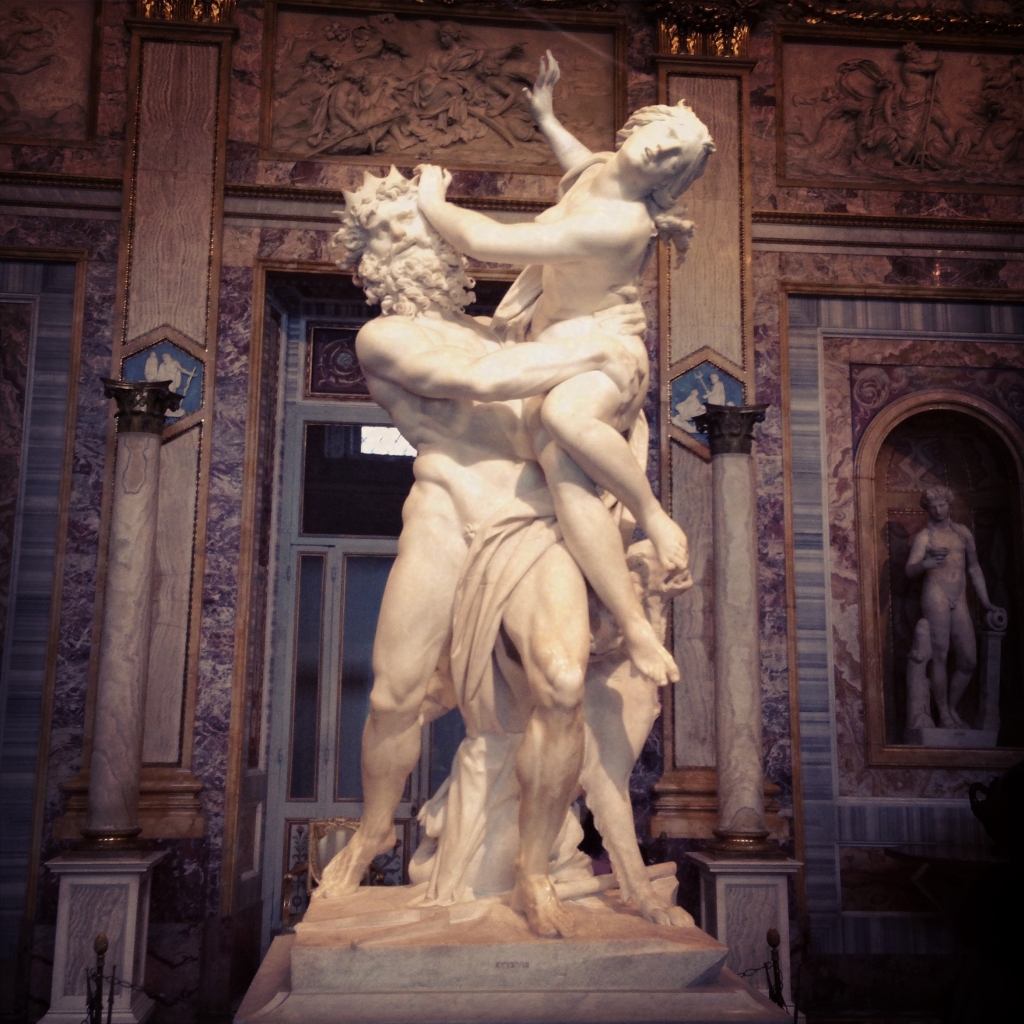
Il-ratto-di-Proserpina-Galleria-Borghese
                                        
                                    “Pluto and Persephone” (1522)
 
                                               Gian Lorenzo Bernini
 
                                                  ______________
 
 
if I’ve been away from my post for so long,
it’s either because my muse had left me, 
abandoned me to the rigours of an 
especially inclement winter, cold, driving 
rain, short somber days, weather for 
isolation, insulation, hibernation
 
or, like Persephone, I’d been abducted 
as to an Underworld, moral as well as 
meteorologicalhowever cosseted might’ve 
been there my stay, eiderdown pillows, 
blankets, books, Internet movies, concerts, 
plays, until by permission of Plutofateful 
consort, God of the Netherworld, by the
intercession of Mother Demeter, Queen of 
the Harvest, I’ve been allowed, even urged, 
to return for spring
 
where cherry blossoms are burgeoning, 
flowers bud in their variety of colours, 
birds sing, trees, like myself, begin to 
scratch out their brimming script onto 
the open-armed page of heaven
 
 
I’d left the string quartet evolving towards
Bohemia and Russia, in the capable hands 
of Smetana and Borodin respectively, from 
its solid roots in Vienna with Haydn and 
 
it would evolve westwards, of course, too 
to France eventually, as the centre of art 
shifted somewhat from Vienna to Paris in 
the late 19th Century, and spread, through 
paint mostly, the eye superseding the ear, 
wresting the cultural reins from music as 
oracle for the times, the new perspective 
of Impressionism
 
minor, his opus 10, a world away from 
the emotional seductiveness of 
Romanticism, but rather driving, electric, 
cosmopolitanteeming with traffic, it’s 
1893, the zeitgeist has changed
 
 
Richard

String Quartet no 1, “From My Life” – Bedřich Smetana‏

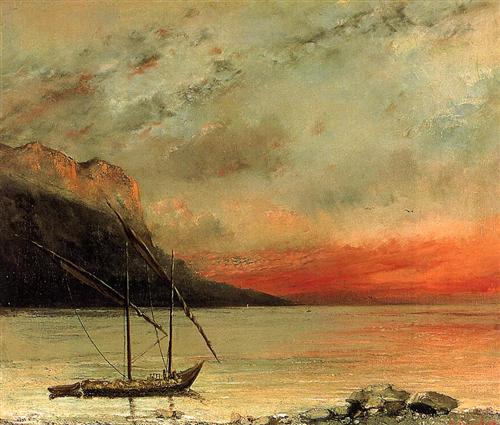
"Coucher de soleil sur le lac Léman" - Gustave Courbet

Coucher de soleil sur le lac Léman (1874)

Gustave Courbet

_________

paying attention to tenuti is not as
easy as all that, you’ll have found
probably that the music’s kept on
going and you’re not so sure if
what just went by indeed was a
tenuto, so brief, however stressed,
might’ve been the impression

rubati are easier, it’s hard to miss
them when they come round, for
being spread out through the
musical passage as a
consequence of being at the very
least three notes, usually
considerably more

tenuti happen on one note only,
one fleet fish in an ebullient river
rather than a more noticeable and
synchronous school

interestingly, not many of either,
rubati, tenuti, show up in music
history until the late Romantic
Era, the mid- to late 1800s, they’d
been only theoretically, and here
and there, part of the musical
vocabulary for having had no
purchase in music written for the
harpsichord, an instrument that
had allowed only minimal
resonance, though it laid the
foundations for composition,
and therefore dictated taste
into the very mid-nineteenth
century, a whole hundred years
after the invention of the piano,
by having entrenched the ideal
of strict tempo, the reflection,
note, of an ideal, and belief
then in a scientifically cogent
world

that was the Enlightenment

Romanticism came along to
express the ineffable reality of
the truths of the human heart,
in contrast to merely reason –
“Le coeur a ses raisons que la
raison ne connaît point”,
says
Pascal, “The heart has its own
logic which allows it to
understand what the rational
mind cannot”,
though he in a
somewhat other, much more
theological, context

but the shoe snugly fits, so I’ll
wear it, though with the same
consideration I’d render the
shoes, understand, of my
father

you can tell we’ve reached the
late 1800s when you start
hearing tenuti, ritardandi,
atonality, for that matter, and
also obscure and eccentric
repetitions

this pattern is probably more
evidenced in pictorial art,
where precision gives way to
individualized expression,
and the blurred lines of Early
Impressionism, see above

at the same time, the German
grip on the history of Western
music which it had held for a
hundred and fifty years, from
Bach to Brahms, began to loosen,
along with the idea, incidentally,
of a rationally, even irrationally,
conceived world, you can hear
it in the evolution of the tenuti,
the rubati, like canaries sense
altered conditions in a coal
mine

note however that music itself
is as indifferent to bald facts
as mathematics, it merely
describes, doesn’t comment

listen to Bedřich Smetana, a
Czech composer, his String
Quartet no 1, “From My Life”

follows in the footsteps of
the Germans, but with a
distinctively folkloric air,
there’s even a polka

tend the tenuti, relish the
rubati, if you can identify
them, they’re milestones
to the modern

but, more than anything,
enjoy

Richard
 

Bruch Violin Concerto in G minor‏, opus 26

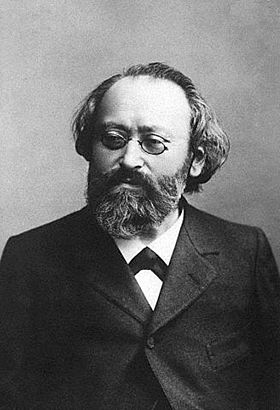
Max Bruch

Max Bruch

______

still under the spell of the captivating
Akiko Suwanai, it didn’t take me long
to search out this enchantress further

as a follow-up to the perhaps tonally
discomfiting Berg I earlier highly,
nevertheless, recommended, I found
this utterly thrilling Bruch

Max Bruch, a Late Romantic, a
composer of the full flowering of the
Romantic Age, before Brahms, for
instance, Impressionism and the turn
towards social grievances rather than
the merely personal, Karl Marx, and
the rush towards isms, Capitalism,
Fascism, Communism, even indeed
Impressionism – is famous for
especially his Violin Concerto in G
minor
, his first of three, and Kol
Nidrei
, a setting for the introduction
of a Jewish service, suggesting
Bruch might’ve been Jewish, which
he wasn’t

I’ve always been indifferent to the
Kol Nidrei“, perhaps because I’m
an utterly lapsed Catholic

but the Violin Concerto is something
else

listen

Richard

psst: compare the Bruch to the Berg
for powerful historical insight
into the evolution of music in
the West

Olivier Messiaen – “Et exspecto resurrectionem mortuorum”

just in time for Easter here is something from
Olivier Messiaen, whom I consider to be, after
Shostakovich, the most important composer of
the Twentieth Century, and may one day, with
more distance, prove to be, of the two,
preeminent 
  
Messiaen, a devout Catholic, wrote specifically
to the glory of the Catholic God, an interesting
return to the music of the Baroque period, and
earlier, when the Church sponsored essentially
all the arts  
 
perhaps Messiaen is also a precursor – the Et
exspecto resurrectionem mortuorum“, which
I’m presenting, or, in my humble Latin,”In 
is from 1964 – of the resurgent fundamentalism
we’ve been witnessing in all churches,
synagogues, mosques, in our own times
 
Et exspecto resurrectionem mortuorum“, is
not at all Romantic, not even Impressionistic,
two world wars have been fought since, man  
has stepped on the unglorious moon, God even
died in the early sixties leaving us to reinvent
our own future, a time of youth and flowers,
and great indeed expectations, as it turned out  
 
the even profound assumptions of the earlier
order however, in the language of music
represented fundamentally by beat and tonality, 
hadn’t worked, couldn’t work anymore, having
been manifestly discredited, women had received 
the vote, financial and sexual independence,
traditional authority had been categorically
overthrown, there was no going back
 
 
Richard Strauss had already suggested this new
broader horizon, in 1896, with his “Also Sprach 
Zarathustra, a mighty work, made famous, even
unforgettable, by the movie  “2001: A Space   
Odyssey“, when the very sun bursts upon the
intergalactic universe to its interstellar strains
 
but Messiaen takes you even further into the
reaches of the infinite 
 
I couldn’t help thinking of a more adult Miró –
the individualized elements – but more profoundly 
metaphysical, I have rarely seen, heard, something
so transfixing, powerful, even the silences between
movements, there are five, are riveting
 
 
happy Easter

 
Richard 


Rachmaninoff: Piano Concerto no 3, in D minor, opus 30

fully 150 years after Mozart the concerto was still a thriving
musical form though it had undergone some modifications,
you’ll hear a more passionate account in Rachmaninoff than
the more lyrical, less emotionally overt compositions of
Mozart, the variations in volume, tempo, tonality, the play
of harmonization and discords, all incidentally within a single
movement, show the passage of time, of Beethoven, of Chopin,
of Debussy between Mozart and the more Romantic, Impressionistic
Rachmaninoff, note the sweeping ritardandos, where the beat is
drawn out, stretched for pathos, a Chopinesque insinuation into
music not found in earlier stuff, one imagines torrid expressions
of fervent sentiment, note the evanescent flurry of notes passing
by like the fleeting glitter of stars, the ephemerality of an
incorporeal idea that Debussy originated and brought to music,
and of course note the irrepressibility, the authority, the masculinity
of a volcanic Beethoven underpinning the lot, you can hear them all

the Vladimir Horowitz Piano Concerto no 3 of Rachmaninoff at
Carnegie Hall, January 8, 1978, with Eugene Ormandy leading the
New York Philharmonic Orchestra is, after Van Cliburn’s historic
1950s account, May 19, 1958, again at Carnegie Hall but under Kiril
Kondrashin this time, and the now defunct Symphony of the Air,
don’t ask, the one I then grew up with, it was riveting even without
the pictures

with pictures here he is again a few months later at Avery Fisher
Hall in New York, September 24, 1978, under Zubin Mehta with
again the New York Philharmonic, so good you’ll even forgive
Mehta his usual sentimental excesses

incidentally Horowitz was 74 at this concert, he is astounding

Vladimir Horowitz, colossus and legend, 1903 -1989

enjoy, be transported, be transfixed, you have been warned

Richard

Still Life with Teapot and Fan – Wang Weidong‏

Still Life with Teapot and Fan by Wang Weidong

                           ” Still Life with Teapot and Fan ” 
 
                                       
Wang Weidong  
 
                                   _________________  

                                                                                                                                                                                                                                despite bifurcations in the direction of abstract art – Impressionism Surrealism, Expressionism, Pop – representational art, with its evident demands on the artist – formal excellence, not just heat and heart – still inspires perhaps our foremost admiration 
 
perhaps it’s true however that still lifes, nearly by definition, are bloodless, as is to my mind, here again, this exquisite nevertheless “Teapot“, which reaches out to your intellect rather than to your emotions
 
it speaks of duty rather than love, tradition rather than innovation, a nostalgia for security, conformity, philosophy perhaps, and ultimately by inference faith and trust  
 
if you let your sense of taste do the talking
  
 
Richard


                           __________________________