Richibi’s Weblog
Just another WordPress.com weblog
Tag: “Iliad” – Homer
August 23, 2020
“The Story of Calisto” – Ovid
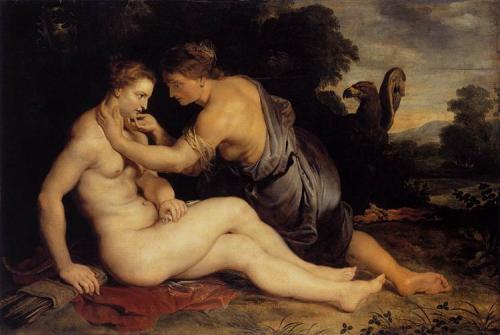
“Jupiter and Callisto“ (1611 – 1613)
Peter Paul Rubens
___________
after having read Homer’s Iliad, the
greatest work of fiction, to my mind,
ever told, resounding through the
centuries and millennia with power,
pathos, and profound humanity, I
found it hard for one reason or
another to complete other
acclaimed epics, Virgil’s Aeneid,
for instance, too brimming with
bombast and bravado, much like
many American war movies,
wherein the Americans win every
conflict, whether or not they’ve
indeed won, all on their own, with
little acknowledgment of the other
international militaries that might’ve
also played essential roles
Ovid’s Metamorphoses, as I read
on, is becoming more and more
offensive because of its recurrent
abuse of women, nymphs, virgins,
so that I can no longer champion
this work, however enthusiastic I
might’ve been at the beginning
I’m not ready to personally give it
up, but intend to relate it in brief
segments, with perhaps, here
and there, noteworthy verses
the myth that follows the
transformation of Cycnus into
a swan, and the restoration of
Earth after its near conflagration
upon the death of Phaeton, has
Jove / Jupiter / Zeus cast[ing]
an eye on ev’ry diff’rent coast in
order to ensure that all is aright,
which it is, and Nature smiles
again
but he spies by chance a nymph,
a follower of Diana, virginal
goddess of the Countryside, and
despite concerns about Juno, his
goddess wife, pursues the maiden
who was easy prey, did whate’er a
virgin cou’d … / With all her might
against his force … / But how can
mortal maids contend with Jove?
following which Diana arrives with
her train of nubile followers, to the
dismay of the young victim, who
could only try to hide her shame,
which her altered demeanour
must’ve somewhat, it is supposed,
uncovered
How in the look does conscious guilt appear!
Slowly she mov’d, and loiter’d in the rear;
Nor lightly tripp’d, nor by the Goddess ran,
As once she us’d, the foremost of the train.
but now the moon had nine times
lost her light, and any doubt about
her condition was erased, so that
Diana, unforgiving, a not uncommon
reaction, I’ve found, among women,
banished her to eventually alone
give birth to a son
meanwhile Juno, now doubly
incensed – This boy, she rails, shall
stand a living mark, to prove / My
husband’s baseness and the strumpet’s
love – turns the wretched mom into a
bear
but when the son had fifteen summers
told, and came inadvertently upon this
beast while in the forest, unaware it was
his mother, and to protect himself, he
aim’d a pointed arrow at her breast,
And would have slain his mother in the beast;
But Jove forbad, and snatch’d ’em through
In whirlwinds up to Heav’n, and fix’d ’em there!
where now we know them as either
the Great Bear and the Little Bear,
Ursa Major and Ursa Minor or,
more familiarly, as the Big Dipper
and the Little Dipper
who could ‘a’ ever thunk it
R ! chard
April 14, 2020
art in a time of crisis

“Prelude to Alice“ (1955)
Charles Blackman
__________
in all the fallout from the very early
reactions still to the present global
crisis, self-isolation, a retreat from
the, not only usual but consolidating,
aspects of our communal interactions,
there remain effective manners of
dealing with this sea, this profoundly
existential, change we are viscerally
experiencing
a social animal is being asked to
eschew – Gesundheit – social contact,
this is not an inconsequential ask
religions might’ve earlier been common
recourses for many believers, but the
restrictions on assembly are already
impeding such solutions, we are left,
therefore, to find personal answers to
our prescribed isolation – what do I do
with my time, how do I subsist when
my supports are disintegrating
let me suggest immersion in the lessons
art has bequeathed us through the ages
it isn’t a bad time to review, for instance,,
the majesty of Homer’s Iliad, Ovid’s
Metamorphoses, his interpretation of
the origin of the world, its genesis,
Shakespeare’s tragedies, Beethoven’s
transcendental music, since many of us
are confined to our homes
rather than rue, bristle, use our time, I
suggest, to contemplate, learn, discover
in looking for flowers recently, for a
friend who’s undergone her own
private agony, unrelated to the
recent international medical crisis,
I fell upon, again, the magical
inventions of this utterly inspired
painter
like many other, even celebrated, even
revered, artists, this, however insulated,
however apparently isolated, visionary,
with the strength of his inspiration,
gives weight to the power of mere
poetic passion, a thrust towards what
is thought of as beautiful, however
individual, suggesting that each our
own aesthetic is of value, when
fervently followed, pursued,
check him out
meanwhile, I’m learning to sing, creating
a repertoire, what have I got to lose
R ! chard
November 11, 2018
“A Delicate Balance” – Edward Albee
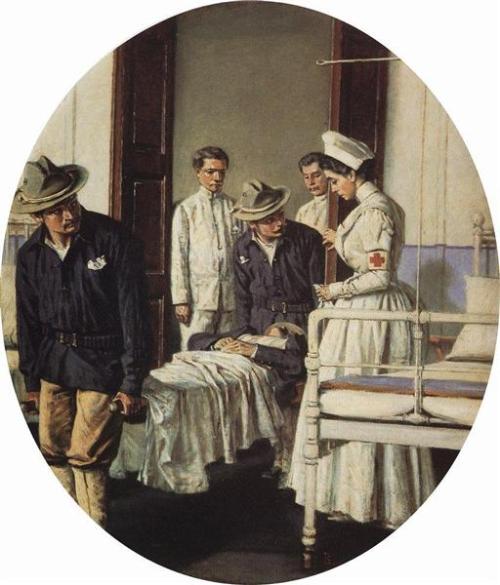
“Theatre Drama“
Kuzma Petrov-Vodkin
___________
there are only a very few 20th-Century
American playwrights who’ve weathered
the rigours of time, two with several
successes, Eugene O’Neill, and
Tennessee Williams, but only one to
tower above those two with only one
work to outmatch them, Edward Albee,
his “Who’s Afraid of Virginia Woolf?“
is every inch a king
this is not an impossible feat, Margaret
Mitchell wrote her only book, “Gone
with the Wind“, a contemporary “Iliad“,
which will find its rightful place again
in world literature, note, when our own
too reverberant still times cede to the
concerns of another, less pertinently
fraught era, like reading “War and
Peace“, for instance, now that
Napoleon is long gone
“Gone with the Wind“, quick, name
another 20th-Century novel to top it,
seconds are too long, “Gone with
the Wind” is in our bloodstream,
like Walt Disney or Marilyn Monroe,
even if you’ve never read it, which
you should
but Edward Albee wrote another play
which deserves some attention, and
with redoubtable performances from
both the consummate ever Katharine
Hepburn, and from our own Canadian
tower of unutterable talent, Kate Reid,
abetted by masterful presentations
from no less than the revered Paul
Scofield and the iconic Joseph Cotten
when their supporting numbers come
up, here is a show to watch for, if
nothing else, those individual stellar
contributions
but “A Delicate Balance“, also an
incontestable masterpiece, is about
friendship, and tells a lesson you’ll
not soon forget, friendship is more
than, for better or for worse, just
knowing each other, it says, an
idiosyncratic, indeed recurrent,
Albee theme
cinematography, note, is, here,
dreadful, though actually in that
manner conceived, however
improbably, by an otherwise
noteworthy director, you’ll even
think they’ve shrunk his frame
but visual style shouldn’t let you
forego the play’s profound substance,
nor the triumphant work of its illustrious
cast, at the very top, mostly, of their
considerable, even defining, powers
watch
R ! chard
November 18, 2016
the judgment of richibi
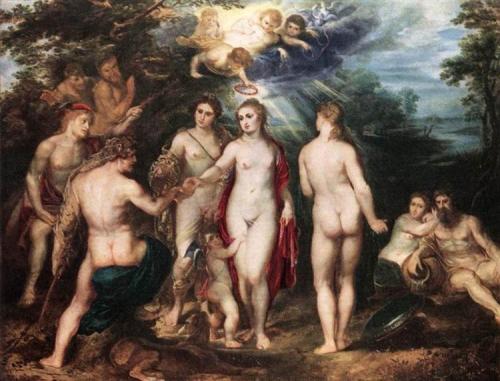
“The Judgment Of Paris“ (1625)
___________
at the end of a long overdue visit to
a friend’s home the other night, she
asked me, did you notice their facial
skin, which of us do you think had
the best complexion, you can be
honest, she insisted
we had intended to watch the finals
of a voice competition we’d both
been following, over a glass of
wine, or two, each, when a friend
called, from, essentially, the door,
with a second friend in tow on their
way to a concert in the city
the friend of the friend, a lovely,
effervescent woman, from Poland
originally, with a story to tell of
growing up behind the Iron
Curtain, was also a beautician in
a spa she runs in a nearby resort
city
the first friend, equally effervescent,
had been telling my own friend of the
intervening events since last they’d
met, while I lapped up, more or less
by default, this other alternate Soviet
reality, perfumed as it was irresistibly
throughout with the friend’s
friend’s mellifluous Polish accent
I hadn’t paid any attention whatsoever
to skin quality apart from accepting
a spa courtesy card for my mother, who
would, naturally, be interested
my dearest dear, I answered, I am
not going anywhere near that one,
look what happened to Paris when
he fell into that trap
what happened, she asked
the Trojan War, I answered
the Trojan War, she asked
Paris was the son of Priam and Hecuba,
king and queen of Troy, I explained, he,
one of its princes, he’d been awarded
Helen, wife of Menelaus, king of Sparta,
by Aphrodite, goddess of love, he’d
chosen Aphrodite to be the most
beautiful among the goddesses, that
was her prize
but let me step back a little, I
interrupted, you need more context
Eris, goddess of discord, had not been
invited to the marriage of Peleus and
Thetis, I recounted, he a Greek hero,
she a sea nymph, parents both later to
Achilles, hero at Troy, slain, incidentally,
by that very Paris, you can read all about
it in the “Iliad“, I highly recommended
during the festivities, Eris tosses a
golden apple among the assembled
divinities, which reads
“to the fairest”
you can hear the stirrings of the much
later Sleeping Beauty, incidentally, in
this earliest of tellings, reconfigured
from the original myth
Athena, Aphrodite and Hera, all assume
they are meant to receive the apple, and
ask Zeus, father and husband, to decide
you’ll have to get someone else to touch
that one, he replies, much as I did
and delegates the task, with the help
of Hermes, the messenger god, to the
the guileless Paris, son of Priam and
Hecuba, Trojan king and queen, as I
said, he, Paris, prince
Paris was tending sheep on Mount Ida
when, fatefully, by a spring, the nubile
goddesses appeared vaunting their
unadorned splendours, stark, flagrant,
manifest, to the musical accompaniment
of the Graces, Faith, Hope and Charity,
also the Horae, the Hours, goddesses
of the seasons, maidens all in complicit
attendance
Paris, mere mortal, would never have
stood a chance
but to sweeten, nevertheless, the
deal, were it not yet sufficiently sweet,
Hera promises Paris Europe and Asia
should he choose her, Athena,
conquest in war, Aphrodite, goddess
of love, was set to give him the most
beautiful woman in the world
Paris opts for Aphrodite, and is
awarded Helen, the face that
launched the thousand proverbial
ships, the wife, not incidentally,
and completely inconveniently, of
the King of Sparta, Menelaus, who
attacks thereupon Troy with his
brother, Agamemnon, and their
allied legions, to reclaim
Menelaus’, whether abducted, or
indeed unfaithful, wife, no one
has ever conclusively determined,
Paris having been Paris
no one won
no one survived but Odysseus,
but that’s another story
I walked home shortly afterwards,
crossed my own Aegean, ten or
eleven blocks back, red lights,
nighttime traffic, watched the voice
competition I’d taped in any case at
home, whooped it up along with my
favourite contestants, drank to my
narrow miss, had gotten away, I
considered, with the equivalent of
Europe and Asia, if only in my
mind
beauty might be in the eye of the
beholder, I surmised, but it can
have its thorny indeed
consequences
Richard
 Richibi's Weblog