Richibi’s Weblog

Just another WordPress.com weblog

Tag: human rights

Piano Concerto no 4, Opus 58 – Beethoven
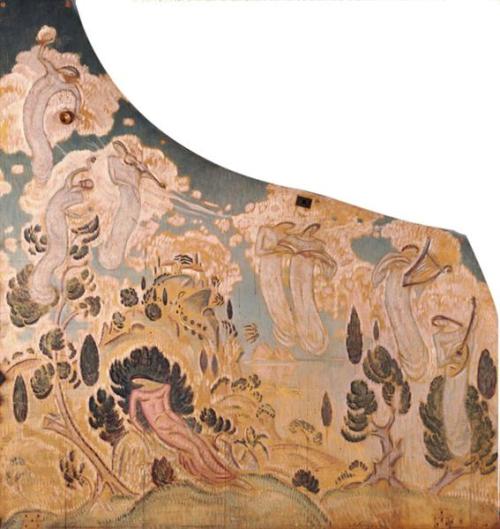
music-painting-and-decoration-of-a-piano-1920.jpg!Large.jpg

     Music (Painting and Decoration of a Piano) (1915-1920) 


          Konstantinos Parthenis


                    __________


like with Shakespeare, some of Beethoven’s

work doesn’t reach the heights I find in their 

utter masterpieces, his Fourth Piano Concerto

is, to my mind, such a piece, though it’s not at

all not impressive


my complaint is that the musical motive, the

original theme, the cluster, merely, of notes

that make up the matter of the ensuing 

harmonic explorations, in all of the three 

movements of the Fourth, is lost in his 

excessive elaborationsone is distracted by 

the soloist’s dazzling showmanship rather 

than by the work’s metaphysical magic, as 

is conversely the case rather in Beethoven’s 

sister concertos, his OneTwo, Three, and 

Five 


most notably, the Fourth‘s slow movement,

the andante con moto, slow, but not unduly,

passes by in an instant, nearly imperceptibly,

but for the conspicuousness of its plodding 

rhythm, you wonder what just happened,

what did I miss


the first movement, the allegro moderato, 

or slightly slower than allegro, begins highly

unconventionally with the soloist at the helm, 

setting up the conversation, as it were, the

subject of the matter


that an individual, a commoner, would’ve  

dared to initiate a dialogue of purported 

significance in a culture where subjects

would have known their place, like later,

for instance, a woman asserting her 

position in a patriarchal society, would’ve 

been shocking, and highly controversial


but Beethoven raps out a rhythm, four

quick notes followed by four quick notes

followed by the same four notes again,

ra ta ta tat, ra ta ta tat, ra ta ta tat, like

someone knocking at a door, however

plaintively, requiring attention, before the

orchestra responds, determinedly and

categorically, though the soloist will ever 

remain the prime, and manifest, mover


this is not a tune, this is a statement


this is also the 18th Century’s introduction 

to the Romantic Period, where individual 

voices were stating their answer to the 

question of the disintegration of the

aristocratic as well as the religious 

ideals which had prevailed throughout 

the earlier Christian centuries, when 

their controlling dogmas, however still 

entrenched, were being questioned, 

and rejected, as evidenced by both the 

constitutional dictates of the American ,

and the French Revolutions, which 

were installing, codifying for their 

progeny, their individual continents,

and for very history, the idea of Human,

as opposed to the traditionally assumed

Divine, Rights


secular voices would consequently

sprout in myriad profusion 

throughout the ensuing 19th Century 

in order to people with personalities, 

as distinct from omnipotent, whether 

secular or ecclesiastical, established 

figures, to shape the ideologies of the 

impending future, for better or for 

worse


but I digress, exponentially


the third movement of the Fourth Piano

Concerto reminds me, in all its urgency,

of the finale of Rossini’s William Tell

Overture, of which I suspect it might  

have been an inspiration, the work

better known to many of my generation

as the theme to The Lone Ranger


Lone Ranger indeed, Beethoven was

already leaving his indelible, not to

mention generative, mark on our

present, 21st Century, culture


enjoy


R ! chard


“Death and the Maiden” – Franz Schubert‏

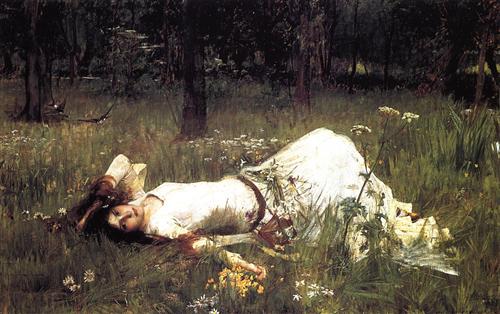
 "Ophelia" -  John William Waterhouse

Ophelia (1889)

John William Waterhouse

___________

though death is not an especially
appealing topic for many, it was
nevertheless of fundamental
consideration during the
Romantic Period

Goethe, the German poet, had
already created a sensation
with his The Sorrows of Young
Werther
, a young man,
disappointed in love, takes his
own life, a potent seed for the
new era, secularism was
overtaking theocracy, the
autocracy of the Christian
Church was giving way to the
prevalence of human rights,
a private opinion, well disputed,
was holding sway against the
rigidities of religious orthodoxies,
science and reason had been
chipping away at the very idea
of God

but with human rights there was
the question of personal
responsibility, if not an imposed
authority, then each man, woman
was in charge of his, her own

the fundamental question,
therefore, was Shakespeare’s
To be or not to be, or, for that
matter, Burt Bacharach’s and
Hal David’s What’s it all about

this is not me, this is Albert Camus
talking, who formalized the situation
in the 1940s

“There is but one truly serious
philosophical problem, and that
is suicide. Judging whether life
is or is not worth living amounts
to answering the fundamental
question of philosophy. All the
rest — whether or not the world
has three dimensions, whether
the mind has nine or twelve
categories — comes afterwards.”

after Werther, Madame Bovary followed,
Anna Karenina, suicide had become an
option, the penalty was no longer
opprobrium, castigation, as it had been
under unforgiving religious constraints

death itself, fatefully rather than
personally determined, was, of course,
no less considered when the era of
heartfelt declarations dominated,
Mendelssohn had written his
Quartet no 6 in F minor, opus 80
for his deceased sister, Beethoven
and Chopin, each his Funeral March,
either, incidentally, still iconic, and
perhaps the most poignant work
of all in this manner, Schubert’s
Death and the Maiden, a precursor
of his own much too premature
demise

this is music as if your life depended
on it

watch, listen

Richard

psst:

the Alban Berg Quartet, a group who
set the standard for several significant
string quartets in the ’80s, do no less
with this one

you’re not likely to see a better
performance of it ever, nor, for that
matter, of anything, pace even Glenn
Gould, a statement I think nearly
against my religion

you be the judge

Beethoven’s piano sonata no 29, “Hammerklavier”, revisited, as promised

upon listening to Beethoven’s 29th sonata
one doesn’t imagine its originality, having
been showered for centuries now with its
miracles and majesties, nothing would’ve
been heard like it before, so great a project,
a work of not only temporal magnitude, an
astonishing fifty minutes, but evidently of
more than just mere entertainment, a work
of philosophical, even, amplitude

Beethoven is not just trying to delight, he’s
trying to engage here, bring together, stir,
more profound human responses, evoke
thought, responsibility, compassion, a
spiritual complicity in the new
post-Revolutionary secular order, he is
establishing new metaphysical ground

the subject is existential, the audience
no longer merely aristocratic, masses
now were talking, an affluent bourgeoisie,
artists were responding to a new Romantic
Age, about rights, and what it means to be
human, both men and women, incidentally
– and I stress that newly pertinent at the time
conjunction – above and beyond those of
God, for each couldn’t both hold the
supreme, the earlier Classical, pinnacle,
the rights of Gods and, by extension,
Kings, Queens if you lived in England,
Russia

secularism was needing new oracles

see Elizabeth Barrett Browning, for
instance, for the emergence of
women

see also, of course, otherwise,
Beethoven

the difference with Beethoven is that
he achieved, ultimately, profound
wisdom, I can think of no other
comparable poet, save, of course,
Marcel Proust, both of whom proved
to be, in the same breath, philosophers,
able to stake that exalted claim, certainly
no painter, a difficult medium through
which to philosophize admittedly, to
bring logical and existential constructions
together to enunciate a transcendental
vision

then again, before Proust and Beethoven,
who’d ‘a’ thunk one could’ve transformed
words or music into very grace, mystically
transubstantiated gold, notwithstanding
the misguided alchemists

Pink Floyd did some of that in the Seventies
but retreated into historic and more personal,
less oracular, reminiscences, philosophizing
isn’t easy, see the punishment of Prometheus,
or, for that matter, John Lennon

Beethoven was completely deaf by the time
he composed the Hammerklavier“, lost in
his own isolation, like Homer, blind to,
though obviously not unaware of, his art

not lost, not unaware either, more like
having been given extrasensory, outright
extraordinary, manifestly, perception

to our utter and everlasting, both of them,
benefit

Richard

Chopin: “Études”, opus 10

if I haven’t brought up Chopin much in this series
it’s that I think of him more as a decorator than
as an innovator, he was developing a sensibility
that had been defined by the earlier Beethoven,
adding texture and style, form instead of function,
the wheel had been invented, now it remained to
be artfully applied
 
some break new ground, others decorate it, make
it enchanting, Chopin makes things enchanting 
 
he is also the first composer we think of when we
think of Romanticism, which says quite a lot about
the quality, the universality, of his gift 
 
 
here are his opus 10, “Études”, or “Studies”, 12 of
them, they are not sonatas, for not having more
than one movement, they are “études” , “studies”,
called by that name for being what they are, then
given numbers to differentiate them, also their
key, the convenience of universally attributing
titles not having quite caught on yet though a
couple of these do have them, the 5th, the
“Black Keys”, for obvious reasons, and the last,
the “Revolutionary”, again for reasons you’ll find
obvious once you’ve heard it 
 
tonality however remains, no apparent discords,
that’ll come later  
 
 
note that in comparison to Mozart the notes are
a shimmer, the same alphabet is used, the one
set up by Bach, but where Mozart made these
into narratives to follow, and even sing along to,
with Chopin the same flurry of notes becomes
a wash of sound you could never vocally keep
up with, a texture rather, an enveloping caress,
prefiguring incidentally the Impressionists, the
lush soundscapes of for instance Debussy 
 
 
though you’ll find the same prerequisite opening
musical statement as in Mozart, followed by the  
contrasting one, often these will be in altogether
constrasting rhythms as well, tempi, compared
to the single strict beat throughout of the 
foundational Classical model    
 
the tempo itself is also much more lax, some
passages surrendering formal rhythmic strictures
to greater emotional content, more self-expression,
less attention to rules, in accord with the newly
installed ideal of individual human rights 
 
hence Romanticism, the fruit of the Revolution 
 
 
note also that the musical argument is no longer
in the Mozartean playground but of a more mature
understanding, Chopin has known love 
 
 
Richard


Beethoven’s Symphony no 6, in F major, opus 68, “Pastoral”‏

symphonies are not my preferred musical form, they are
generally too broad, grand, impersonal, they are nevertheless
the other most impactful order of presentation among musical
instruments, along with the concerto
 
a symphony is a concerto without a soloist, or it might be more
appropriate to say that a concerto is a symphony accommodating
a soloist, or soloists, in either case the musical elements remain
the same, you don’t have a symphony without movements   
 
a symphony is also of course another name for that very orchestra,
just to confuse you
 
 
despite my indifference to that particular form of entertainment 
some symphonies are nevertheless still for me impressive, some
even meaningful, poignant, several of Beethoven’s, most of the
works of the transcendental Bruckner, Brahms’ magnificent Fourth,
most others you can keep, as far as I’m concerned, I need a firm
anchoring principle, not the amorphous peregrinations of an
unbridled, often cacophonous crowd 
 
 
those that I love however have touched me deeply, Beethoven’s 
Sixth for instance, wherein through its second movement a loved
one spoke to me unmistakably from heaven, there and then made
me believe in an afterlife and angels, I remember the day clearly
and cherish still that powerful metaphysical moment  
 
 
in the “Pastoral” Beethoven apotheosizes nature, the movements
themselves, of which there are an unconventional five, are named
after rural settings, like paintings
 
     
I imagine Beethoven channeling the idyllic Classical Fragonard, or
prefiguring the bucolic and more Romantic Constable, Beethoven
straddles triumphally both epochs 
 
you will hear the birds sing, the rippling of the brook, it is as fresh
as ever springtime, as profound and expansive as itself time
 
Beethoven here speaks as clearly as actual language, and thereby
suggests that music is indeed itself an expressive tongue, earlier
it had been, though moving and undeniably evocative, essentially
an entertainment, a courtly device, though often enough sublime,
see Haydn, Mozart
 
Beethoven is not courtly, he is bold, assured, and mighty, of a new
breed of colonizers of the new and exhilarating democracy, the
French Revolution had just happened and their aristocracy was
dead and gone, indeed guillotined, a new day had dawned for
the common people, the idea of human rights
 
Beethoven spoke to these as a prophet, Moses at a secular Mount,
declaring the ideals of the Age of Reason, of which we still carry
the torch, to the multitudes and to their ensuing spawn
 
 
Klemperer at first seemed slow to me, nearly tired, but little by
little established a mesmerizing solemnity
 
by the end of the piece I’d again been touched by heaven 
 
 
Richard