Richibi’s Weblog

Just another WordPress.com weblog

Tag: Horatio

“The Story of of Cadmus” (ll) – Ovid

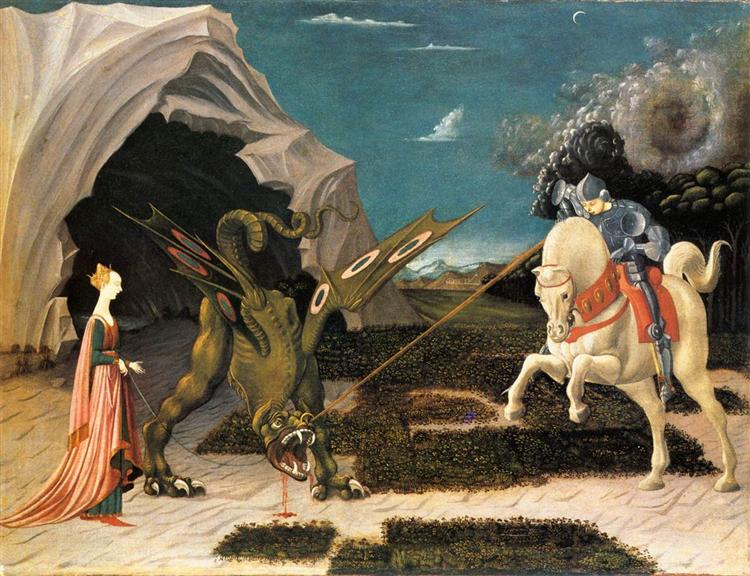
St. George and the Dragon, c.1470 - Paolo Uccello

          “St. George and the Dragon” (c.1470)


                 Paolo Uccello


                            _______


             Cadmus salutes the soil, and gladly hails

             The new-found mountains, and the nameless vales,

             And thanks the Gods, and turns about his eye

             To see his new dominions round him lye;


Cadmus, son of Agenor, brother of

Europa, has, on the advice of the

Delphick oracles, settled where

the lonely cow, / Unworn with yokes,

unbroken to the plow had stoop’d,

and couch’d amid the rising grass,

and stakes there his new appointed

home


vales, valleys


             Then sends his servants to a neighb’ring grove

             For living streams, a sacrifice to Jove.


Cadmus, a prince, would’ve had

a retinue, followers, Hamlet for

instance, his Horatio, his

Rosencrantz and Guildenstern


Jove, note, is the god who abducted

Europa, though Cadmus, according

to our story, isn’t yet supposed to 

know this, never having found his

sister, nor identified, consequently,

her ravisher, namely Jovethe god

to whom Cadmus is now about to

give sacrifice, give thanks


             O’er the wide plain there rose a shady wood

             Of aged trees; in its dark bosom stood

             A bushy thicket, pathless and unworn,

             O’er-run with brambles, and perplex’d with thorn:


perplex’d, a wonderful metaphor

here for entangled, enmeshed


             Amidst the brake a hollow den was found,

             With rocks and shelving arches vaulted round.


brake, bracken, brush


             Deep in the dreary den, conceal’d from day,

             Sacred to Mars, a mighty dragon lay,


Mars, god of War


a mighty dragon, dragons, it appears,

go back to very prehistory, perhaps

as a memory in our reptilian brain of

dinosaurs, and the like, that made its

way into our poetic imagination


see above 


             Bloated with poison to a monstrous size;

             Fire broke in flashes when he glanc’d his eyes:


glanc’d his eyes, threw glances at


             His tow’ring crest was glorious to behold,


crest, as in roosters, or reptiles


             His shoulders and his sides were scal’d with gold;


scal’d, having scales, plates,

overlapping surfaces


             Three tongues he brandish’d when he charg’d his foes;

             His teeth stood jaggy in three dreadful rowes.


rowes, rows, three dreadful ones,

one behind the other


             The Tyrians in the den for water sought,


The Tyrians, Cadmus and his men,

all originally from Tyre


             And with their urns explor’d the hollow vault:


urns, to collect from living streams

within the vault a sacrifice to Jove


             From side to side their empty urns rebound,


rebound, knock against a harder

surface repeatedly


             And rowse the sleeping serpent with the sound.


rowse, rouse


             Strait he bestirs him, and is seen to rise;


he bestirs him, he bestirs himself


             And now with dreadful hissings fills the skies,

             And darts his forky tongues, and rowles his glaring eyes.


rowles, rolls


             The Tyrians drop their vessels in the fright,


vessels, urns


             All pale and trembling at the hideous sight.

             Spire above spire uprear’d in air he stood,


Spire above spire, scale upon scale


uprear’d, reared up


he, the serpent


             And gazing round him over-look’d the wood:


overlook’d, looked over, surveyed


             Then floating on the ground in circles rowl’d;


rowl’d, rolled


             Then leap’d upon them in a mighty fold.


fold, embrace, encirclement


             Of such a bulk, and such a monstrous size

             The serpent in the polar circle lyes,

             That stretches over half the northern skies.


The serpent in the polar circle, Serpens,

a constellation in the Northern Hemisphere

in close proximity to the North Pole


lyes, lies


             In vain the Tyrians on their arms rely,


their arms, their weapons


             In vain attempt to fight, in vain to fly:
             All their endeavours and their hopes are vain;
             Some die entangled in the winding train;


the winding train, the serpent’s

tail


             Some are devour’d, or feel a loathsom death,
             Swoln up with blasts of pestilential breath.


stay tuned


R ! chard

Nemo – “Ennead I” by Plotinus (11)‏


Date: Tue, 12 Mar 2013 15:56:00 +0000
To: Richibi’s Weblog
From: comment-reply@wordpress.com
Subject: [New comment] “Ennead I” by Plotinus
 

Richard,

Forgive me for saying so, but it seems to me that your philosophy is quite incongruent with your personality, which is passionate, sensitive and kind. As far as I can tell, you’re much more gregarious than the demented Nietzsche.

If, as you wrote at the beginning, you can’t even be sure that I exist, why are you taking the trouble to have this conversation? If everything is in a flux, what is there to “grasp” and “tackle”? If all is a figment of the imaginations of beings in their separate cages, what’s the point of conversation? You’re still trapped in your own cage anyway.

Kant may be wrong about some things, but I do agree with him about the difference between noumenon and phenomenon. Our thoughts revolve around the phenomenal, and consequently, they are in flux, “peripheral” as you put it, or evolving, as some believe. But, this doesn’t negate the noumenon, the eternal and unchanging. To use an analogy in biology, when you observe the growth of a seed or an embryo, it seems to be changing constantly, and if you didn’t know what it was, you would think that everything was in flux, but all the while it remains the same substance: a human being


what’s to forgive, Nemo, I don’t mind at all being
called “passionate, sensitive and kind
 
thank you
 
 
and you are right, after a study of philosophy I
went my own way, which was what philosophy
had taught me to do, it is a conversation, I
learned, rather than an ideology, that secular
cousin of theology, either system oftentimes
flagrantly autocratic, for instance Plato, or
take your pick of religions 
 
along the way I discovered miracles, I wanted to
talk to my beloved, but somehow I’d only asked
my dad, who’d died earlier the same year, to
speak to me from beyond the grave, I’m your
son, I said, I’ll hear you, and, Nemo, I did, and
all, eventually, the others, I’ve been talking to
all of them ever since  
 
this might seem very strange, of course, but
you can tell from what I’ve written to date,
surely, that I’m not entirely demented,
conversely, maybe I’m inspired, maybe just
eccentric, who knows, take your pick, so
long as I’m not, I think, hurting anybody    
 
 
Kant, incidentally, didn’t affirm the noumenon,
he merely did not deny it, so he’s made room
for my unorthodox constructions, and miracles,
as a corollary, in general
 
this was also Descartes’ dilemma essentially,
or Shakespeare’s, There are more things in
 
also my own 
 
we cannot beyond our consciousness affirm,
we can only interpret, I am the only thing I can
affirm, the rest is what you make it, for better
or for worse, this from “the demented“, Nemo, 
Nietzsche
 
therefore Beethoven or Proust, or maybe
even me    
 
 
I believe in miracles, and so I experience them
 
I’d asked a friend on a cold winter day with
only icicles everywhere in the city, what
should we do, let’s go out and look for
beautiful things, he replied, we did, and all
the icicles consequently shimmered and
glistened, I’d found a key to finding beauty,
another valuable parable 
 
later, needing more than just beautiful things
to cheer me I asked for miracles, which, Nemo,
like the earlier beautiful things, profusely in
their turn abounded, you just have to be
ready to receive them
 
 
I believe there is a noumenon, but I’ll never
be able to prove it, though I feel it profoundly,
and judiciously sort out with the help of
wisdom and poetry, truth and beauty, all
I can muster, the information I receive 
 
I hope it might be of some service
 
 
to me there is poetry behind everything,
shimmering, glistening magic, but I’m not
sure that’s what everyone sees, nor wants
to see, I won’t try to impose my perspective,
I can only tell what I see
 
and I’ve long seen more than mere facts,
what I see, have long seen, is an inherently 
transcendental reality 
 
which suggests the probability of other
noumenal worlds
 
so, to answer your question, I do think
you indeed exist, though I can’t be
absolutely sure of it, though you might
not be a figment of my imagination you
are nevertheless to me merely my
impression of you, but who really are
you, that’s a tricky question, cause you
don’t even know
 
meanwhile there’s no harm in sharing
even a virtual, irony of ironies, 
conversation
 
   
cheers
 
Richard


Nemo – “Ennead I” by Plotinus (10)‏


Date: Fri, 8 Mar 2013 21:28:13 +0000
To: Richibi’s Weblog
From: comment-reply@wordpress.com
Subject: [New comment] “Ennead I” by Plotinus
 
Hi Richard,

Have you thought of writing or already written memoirs? I think I’d enjoy reading them.
Your second story reminded me of the Confessions by St. Augustine,
in which he grieved over the death of his beloved friend.

Descartes might say this about your “This is the census” moment: “I lisp, therefore I exist”.
But how would you interpret the “parable”?

What caused you to stop ministering at the palliative care unit after ten years?


a parable is in the eye of the beholder, Nemo,  
nearly by definition, and therefore wide in the
possible breadth of its interpretation, that wide
net, should it catch the imagination of many,
can describe a potent, though indefinable,
moral precept that even whole communities
can then propagate and follow, mysticized
fairy tales, for these last serve a similar
purpose, maybe the age of the listener,
reader, here, is the distinguishing factor,
adults have a hard time with fairy tales 
 
dimension to my lisp, if you’re asking what
moral precept I derived from that tale, it is
that something was profoundly watching,
unobtrusive, but gently ready to nudge just
enough to inspire hope, like a second wind
 
I felt, however solipsistically, that something,
someone, was listening, and that was enough,
that indeed would be, wouldn’t you think,
though the information was entirely
metaphorical and abstract 
 
but I’ve experienced too many moments of
transcendence not to subsribe to a more
than merely rational agenda, Shakespeare
again, There are more things in heaven and
earth, Horatio, / Than are dreamt of in your
philosophy.” – Hamlet, act 1, scene 5,
lines 186–187 – which I heartily second
 
no philosopher has ever admitted that but
Proust and Beethoven, which is why I’ve
somewhat put aside classic philosophy,
though I love the Moralists, after Rome
and before Christianity, Saint Augustine,
I’m afraid, however, distorted the facts,
as well as his great acuity, in order to
entrench a mythology, the dominion of
numinous, entirely male, incidentally,
Trinity, forcing Truth into a submissive,
not to say penitent, and furthermore
impotent, corner until the very Renaissance, 
specifically until Descartes, and, by the way,
until his near contemporary, Shakespeare,
1564 -1616, nearly the equal of Beethoven
and Proust in his philosophical perspicacity, 
To be, or not to beis of course the first
existential soliloquy of our era
 
Descartes, 1596 – 1650
 
 
after ten years at palliative care I had changed,
and the unit had changed, it had become more
regimented and constrictive than it had been in
its early, more companionable, and not yet so
regimented, years, I now had to go through
security to get to my station, which was not at
all the spirit in which I’d entered the service
 
I am now, I’m imagining, a poet, and live and
write accordingly, these very missives, Nemo, 
are my memoirs, at present you are my muse
 
thanks  
 
I hope you’re “enjoy[ing] reading them


Richard