Richibi’s Weblog

Just another WordPress.com weblog

Tag: Horace

“The Story of Aglauros, transform’d into a Statue” (lll) – Ovid
the-envious.jpg!Large

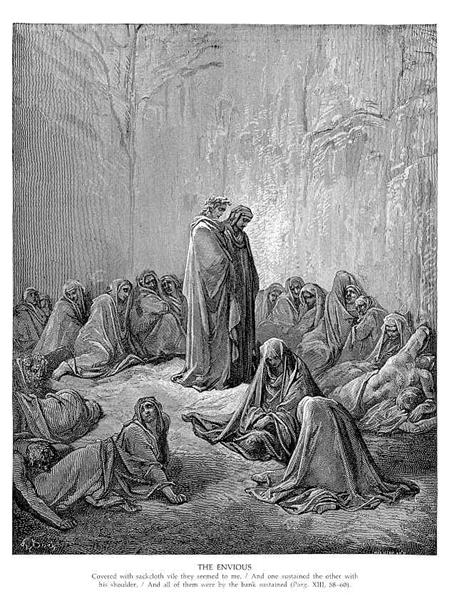
          The Envious


                  Gustave Doré


                             _______


all mythologies have their picture, their

rendition, their evocation of an afterlife,

states of either resignation, in earlier

traditions, perdition or bliss in the later

Christian view, manifest, these latter,

in Dante, his depictions of Hell,

Purgatory, and Heaven in his

Commediaare probably its most

explicit evocations


the Greek and Roman pictures of

their own representative Underworld,

available in Homer, Horace, Virgil,

notably, is less compartmentalized,

less extreme in its divisions, a gloom

pervades, but nowhere fire and

brimstone, nor the diametrically

opposed consolation of archangels

and trumpets, only an unending

sense of desolation, be one worthy

of it or not


limbo comes to mind


but Envy’s realm is actual, not

belated, in the Ancient Greek and

Roman traditions, it is of this world,

present, however horrid, a place

that lurks in the hearts of men, of

people, always, ever, accessible


Dante situates his nexus of Envy in

Purgatory, the afterlife, the nether

world, its Second Circle, of seven,

Wrath, Envy, Pride, Lust, Gluttony,

Greed, Sloth


for Ovid, you can reach Envy’s

dominion, in the nearby mountainous

areas, if only you’ll follow Minerva


the one course is transcendental,

the other, organic, note, physical,

carnate


            Directly to the cave her course she steer’d;

            Against the gates her martial lance she rear’d;

            The gates flew open, and the fiend appear’d.


the fiend, Envy herself


            A pois’nous morsel in her teeth she chew’d,

            And gorg’d the flesh of vipers for her food.


yech


             Minerva loathing turn’d away her eye;


as, incontrovertibly, would I


            The hideous monster, rising heavily,

            Came stalking forward with a sullen pace,

            And left her mangled offals on the place.

            Soon as she saw the goddess gay and bright,

            She fetch’d a groan at such a chearful sight.

            Livid and meagre were her looks, her eye

            In foul distorted glances turn’d awry;

            A hoard of gall her inward parts possess’d,

            And spread a greenness o’er her canker’d breast;

            Her teeth were brown with rust, and from her tongue,

            In dangling drops, the stringy poison hung.

            She never smiles but when the wretched weep,

            Nor lulls her malice with a moment’s sleep,

            Restless in spite: while watchful to destroy,

            She pines and sickens at another’s joy;

            Foe to her self, distressing and distrest,

            She bears her own tormentor in her breast.


the passage, without explication,

speaks for itself, I cede to its

manifest erudition


            The Goddess gave (for she abhorr’d her sight)


her sight, what she was looking

upon

 
            A short command: “To Athens speed thy flight;

            On curst Aglauros try thy utmost art,

            And fix thy rankest venoms in her heart.”


Minerva condemns, curs[es], 

Aglauros


            This said, her spear she push’d against the ground,

            And mounting from it with an active bound,

            Flew off to Heav’n:


Minerva reminds me of my own

generation’s Wonder Woman


meanwhile, the hag, Envy, with

eyes askew


            Look’d up, and mutter’d curses as she flew;

            For sore she fretted, and began to grieve

            At the success which she her self must give.


success, the humiliation of

Aglauros


            Then takes her staff, hung round with wreaths ofthorn,

            And sails along, in a black whirlwind born,


the picture of a witch on a

broomstick shouldn’t

here be unanticipated 


            O’er fields and flow’ry meadows: where she steers

            Her baneful course, a mighty blast appears,

            Mildews and blights; the meadows are defac’d,

            The fields, the flow’rs, and the whole years laidwaste:


the whole years, the yearly crops


            On mortals next, and peopled towns she falls,

            And breathes a burning plague among their walls.


the, not unfamiliar to us, season,

now, of the witch


R ! chard

on odes

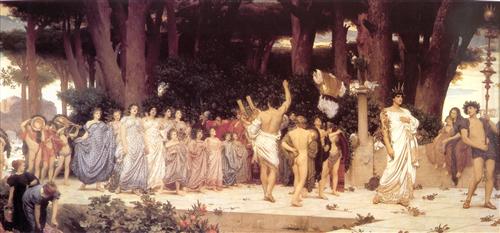
                          "The Daphnephoria" - Frederic Leighton

The Daphnephoria (c. 1875)

Frederic Leighton

________________

odes, with their suggestion of music
– despite a history of merely words
spoken in the intervening interim,
counting on meaning and rhythm
without music’s attendant tonality –
go back to the Greeks, the Seventh
Century, BCE, Sappho, for instance,
one of history’s most honoured
women poets, surely quite an
achievement for her in an age of
predominant, indeed
disenfranchising, masculinity

the ode was meant to accompany
tributes to people, events, things,
thereby acquiring an element of
acclamation and praise within its
dimensions, Pindar, ca 552 – 442
BCE, wrote odes for heroes of the
original Greek Olympics, for
instance

by the time of Horace, 65 – 8 BCE,
odes had become stylized,
independent of music, here’s one,
not inappropriately in this season’s
vernal context, to spring

odes remained spoken throughout
their resurrection in the wake of the
rediscovery of the Ancient World
during the Renaissance, onwards
through some famous Romantic
ones, Shelley, for instance, Keats,
up to even this one, by Stanislaw
Barańczak
, which I found in the
New Yorker
, April 20th, a gem, I
think, and in the very spirit of our
Age of Irony

Plywood

O plywood, second best to the real stuff,
believe me, one day I will say “Enough”

to my stooping shoulders, my slouched spine;
my sloped shape and your stiff boards will align,

and you’ll see how my backbone will unbend
and I’ll be standing straight until the end

of my makeshift but rectilinear
prayer, one stiff-backed as a chest of drawers

when we shove heavy furniture around;
I will rise from the dead, though on what ground

and which I, I don’t know; I’ll stand erect,
though my vertebrae’s hierarchic sect

won’t outlive plywood, no, it just can’t win
against that vertical eternity, so thin

and yet so sturdy in its ersatz pride;
as if the moon had shown me its dark side,

I lean, my ear glued to a cupboard’s back,
and I can hear its hollow and exact

hymn to its own cheap immortality;
no, wait, I still can straighten, still can be

square with this upright world (you knew I could),
just as plumb as four planks of real wood.

Stanisław Barańczak

(Translated, from the Polish,
by Clare Cavanagh and the author.)

__________

though you mightn’t’ve caught an “Ode”
in the title, the clue to its essence is in
the initial “O”, an acclamation

and yes, “O, Canada” is therefore also
an ode, as would be most anthems

incidentally Beethoven put the music
back into the form with his incendiary
use of Schiller’s poem for his vocal
triumph in his ninth Symphony, An
die Freude
“,
the Ode to Joy,
incomparable in this rendering for
an improbable 10,000
, yes 10,000, just
click

Richard