Richibi’s Weblog

Just another WordPress.com weblog

Tag: Hermes / Mercury – messenger of the gods

“The Story of Aglauros, transform’d into a Statue” (lV) – Ovid

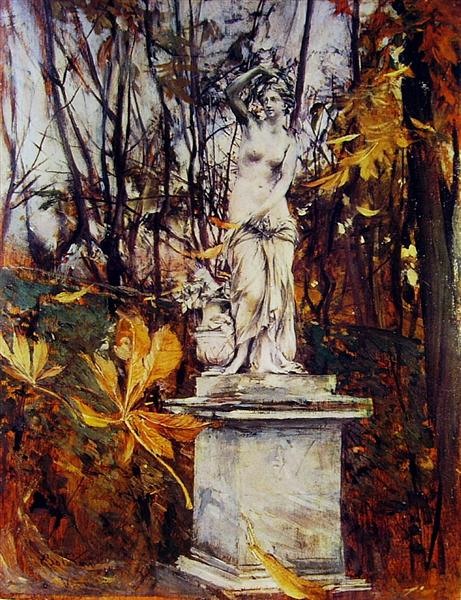
statue-in-the-park-of-versailles.jpg!Large

       Statue in the Park of Versailles


                   Giovanni Boldini


                             ________


Envy, at the instigation of Minerva,

has flown towards the site of her

commissioned mischief, to hex

Aglauros, who’s miffed her


            When Athens she beheld, for arts renown’d,

            With peace made happy, and with plenty crown’d,


Athens, its glories, architectural,

literary, political, philosophical, would

have been impressive still, despite its

intervening decline, to the mind of a

Roman poet of the later First Century,

compare, say, a contemporary poet’s

evaluation of Great Britain’s grandeur

during its 19th Century supremacy, or

of the United States’ promise before

its late-20th-Century deterioration


            Scarce could the hideous fiend from tears forbear,

            To find out nothing that deserv’d a tear.


Envy, the hideous fiend, was upset

because she couldn’t find anything

to cry about, anything that deserv’d

a tear


            Th’ apartment now she enter’d, where at rest

            Aglauros lay, with gentle sleep opprest.


with gentle sleep opprest seems

to me oxymoronic, conflicting

definitions, how could a gentle

sleep oppress, but let’s continue


            To execute Minerva’s dire command,

            She stroak’d the virgin with her canker’d hand,

            Then prickly thorns into her breast convey’d,

            That stung to madness the devoted maid:

            Her subtle venom still improves the smart,


improves the smart, accentuates

the sudden pain


            Frets in the blood, and festers in the heart.


Frets in, unsettles, the blood, festers,

rots , becomes cankerous, in the heart.


            To make the work more sure, a scene she drew,

            And plac’d before the dreaming virgin’s view

            Her sister’s marriage, and her glorious fate:

            Th’ imaginary bride appears in state;

            The bride-groom with unwonted beauty glows:

            For envy magnifies what-e’er she shows.


Aglauros is not only struck with

subtle venom, but subjected to

psychological manipulation, if

you’ll excuse the reference to

modern analytical methods, is

made to see [h]er sister’s

marriage, Herse‘s, as well as 

her glorious fate


For envy magnifies what-e’er

she shows, an observation

worth remembering


            Full of the dream, Aglauros pin’d away

            In tears all night, in darkness all the day;


the dream, though Envy might’ve

envenomed Aglauros in her sleep,

the unwanted vision continues to

plague her throughout the following

days, and nights


            Consum’d like ice, that just begins to run,

            When feebly smitten by the distant sun;

            Or like unwholsome weeds, that set on fire

            Are slowly wasted, and in smoke expire.


the slow torture in the mind of

rancour there eating away at

the psyche


            Giv’n up to envy (for in ev’ry thought

            The thorns, the venom, and the vision wrought)


The thorns, the venom, and the vision,

all three, wrought, writhing, smouldering,

in ev’ry thought


            Oft did she call on death, as oft decreed,


decreed, resolved


            Rather than see her sister’s wish succeed,

            To tell her awfull father what had past:


her awfull father, Cecrops l, founder

and first king of Athens, according to

myth


awfull, as in inspiring awe, reverence


            At length before the door her self she cast;


the door, of her chamber, where the

God Hermes / Mercury had asked

Aglauros to speak in his favour to

her sister, Herse, whom he had

wanted, if you’ll remember, to woo


cast, set herself up awaiting the

God’s return


            And, sitting on the ground with sullen pride,

            A passage to the love-sick God deny’d.


Aglauros denies the God his wish,

she will not praise him to her sister


            The God caress’d, and for admission pray’d,

            And sooth’d in softest words th’ envenom’d maid.


caress’d, used endearing words


            In vain he sooth’d: “Begone!” the maid replies,

            “Or here I keep my seat, and never rise.”


I’ll stay here till you leave, Aglauros

tells Hermes / Mercury


            “Then keep thy seat for ever,” cries the God,


the impudence of vying with a god

has its consequences


            And touch’d the door, wide op’ning to his rod.


his rod, his caduceus, his winged

staff


            Fain would she rise, and stop him,


Fain,willingly


                                                             but she found

            Her trunk too heavy to forsake the ground;

            Her joynts are all benum’d, her hands are pale,

            And marble now appears in ev’ry nail.

            As when a cancer in the body feeds,

            And gradual death from limb to limb proceeds;

            So does the chilness to each vital parte

            Spread by degrees, and creeps into her heart;

            ‘Till hard’ning ev’ry where, and speechless grown,

            She sits unmov’d, and freezes to a stone.


Aglauros has become of stone,

a statue


            But still her envious hue and sullen mien

            Are in the sedentary figure seen.


still, though Aglauros might’ve been

rendered inanimate, it’s interesting

to note that she’s nevertheless

become immortal, immortalized


see, for instance, above


R ! chard

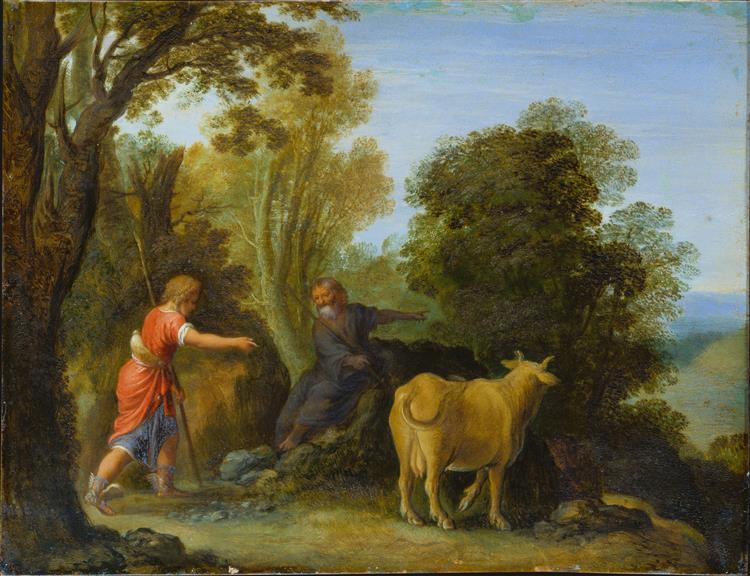
“The Transformation of Battus to a Touch Stone” – Ovid

adam-elsheimer-merkur-und-battus-1.jpg!Large

      Mercury and Battus(1610)


             Adam Elsheimer


                     _________


            Sore wept the centaur, and to Phoebus pray’d;


Phoebus, the Latin name for Apollo,

the Greek name for the same god of 

the Sun among several other things


Phoebus / Apollo was the centaur

Chiron‘s father


            But how could Phoebus give the centaur aid?
            Degraded of his pow’r by angry Jove,
            In Elis then a herd of beeves he drove;


Jove / Jupiter / Zeus, god of gods

had [d]egraded Phoebus of his

pow’r by overruling him in having

him return, however unwillingly,

to his position as Charioteer of

the Sun after having just killed

his son, Phaeton


Elis, a region still of Greece


beeves, plural of beef, however

presently obsolete, but compare

leaf, leaves, or loaf, loaves, wife,

wives, shelf, shelves for similar

etymologies


            And wielded in his hand a staff of oak,
            And o’er his shoulders threw the shepherd’s cloak;
            On sev’n compacted reeds he us’d to play,
            And on his rural pipe to waste the day.


Phoebus / Apollo was god, as well,

of Music


            As once attentive to his pipe he play’d,
            The crafty Hermes from the God convey’d
            A drove, that sep’rate from their fellows stray’d.


the grammar is here incorrect, he

in the first verse should agree with

the subject of the principal clause,

[t]he crafty Hermes, of the second,

but it refers, rather, to Phoebus /

Apollo, who’d been attentive to the

same rural pipe he’d been playing,

wast[ing] the day, in the earlier

line


Hermes, the messenger god, was

leading, convey[ing], away from

its fellows, indeed stealing, some

of the God Phoebus / Apollo‘s

beeves, his cattle


drove, a large group, singular of

droves


            The theft an old insidious peasant view’d
            (They call’d him Battus in the neighbourhood),
            Hir’d by a vealthy Pylian prince to feed
            His fav’rite mares, and watch the gen’rous breed.


Pylian, of Pylos, a town still in

Greece


vealthy, wealthy, surely a typo,

however unusual in so respected

an edition


Battus, an old insidious peasant,

had seen, view’d, Hermes, god

as well of Thieves, incidentally,

steal Phoebus / Apollo‘s beeves


            The thievish God suspected him, and took
            The hind aside, and thus in whispers spoke:


suspected, Hermes, [t]he thievish

God, supposed that Battus had

seen him stealing the cattle


            “Discover not the theft, whoe’er thou be,
            And take that milk-white heifer for thy fee.”


Discover not, don’t tell


the milk-white heifer, [t]he hind


            “Go, stranger,” cries the clown, “securely on,
            That stone shall sooner tell,” and show’d a stone.


the clown, Battus, assures Hermes

that [t]hat stone, an inanimate, and

therefore mute, thing, is more likely

to tell about the theft than he, Battus,

would be


            The God withdrew, but strait return’d again,
            In speech and habit like a country swain;


The God this time is Hermes, who

has returned disguised as a country

swain, a bumpkin


            And cries out, “Neighbour, hast thou seen a stray
            Of bullocks and of heifers pass this way?
            In the recov’ry of my cattle join,
            A bullock and a heifer shall be thine.”


help me find my cattle, Hermes asks

of Battusand I’ll reward you with 

[a] bullock and a heifer


            The peasant quick replies, “You’ll find ’em there
            In yon dark vale”; and in the vale they were.


Battus has gone back on his word to

the first stranger who’d accosted him,

and reveals the whereabouts of the

stolen herd to the second


            The double bribe had his false heart beguil’d:


double bribe, the first, the milk-white

heifer, the second, a bullock and

[another] heifer


            The God, successful in the tryal, smil’d;


tryal, trial, it’s interesting to see

here the root of the word trial


            “And dost thou thus betray my self to me?
            Me to my self dost thou betray?” says he:


Battus has in either instance

unwittingly betrayed both Hermes,

the original stranger, then Hermes

again, the country swain


            Then to a Touch stone turns the faithless spy;
            And in his name records his infamy.


Touch stone, or touchstone, a stone

used for testing the purity of precious

metals, a criterion, a basis


in his name, Battusrecords his infamy,

though unclear, this verse suggests to

me that the name Battus will always be

associated with being a faithless spy,

a betrayer


R ! chard


psst: Mercury, or Mercurius, is the

          Latin equivalent of Hermes,

          see above