Richibi’s Weblog

Just another WordPress.com weblog

Tag: Herbert von Karajan

Symphony no 12 in D minor, opus 112 (The Year of 1917) – Dmitri Shostakovich
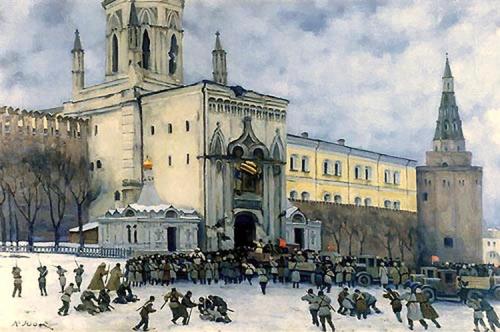
assault-on-the-kremlin-in-1917-1951.jpg!Large

 Assault on the Kremlin in 1917 (1951)

               Konstantin Yuon

                    __________

the Twelfth Symphony of Shostakovich, 
“The Year of 1917”, is a lot more of the 
Eleventh, “The Year 1905”, both 
commissioned, both celebrating 
significant events of the Russian 
Revolution, both therefore steeped in 
references that now elude many who 
aren’t Russian, and certainly those who
generations elsewhere later never lived 
through these particularly local events 

but the Twelfth is shorter by nearly 
half, thankfully, I also found it to be 
unconvincing, plastic, formulaic, 
neither original, nor enthusiastic, 
tedious and uninspired, musically 
speaking, of course

or maybe I’m just getting cranky

also a music honouring a system that 
is now defunct, debunked, discredited, 
couldn’t long survive but historically
among the works of an otherwise 
extraordinary composer, think of 
Confederate monuments still standing 
in the Southern United States, or of 
those of oppressors of First Nations, 
for instance, in our very own Canada, 
though these might’ve been  
sculpted by even Michelangelos,   
an irresolvable cultural confusion,
predicament


the works are programmatic, both 
have titles to indicate a particular
referent, and should be evocative 
of, therefore, those situations, 
music, in other words, for the 
movies, but in these instances, 
without the movie, I’ve talked 
about that before 

all the movements also have titles,
apart from the time signatures, 
adagio, presto, allegro, the like,
the Eleventh, “The Palace Square”, 
“The 9th of January”, “Eternal
Memory”, and “Tocsin”, a warning 
bell

the Twelfth, “Revolutionary Petrograd”,
“Razliv”, “Aurora”, and “The Dawn of 
Humanity”

I couldn’t help but refer to Beethoven’s
Sixth Symphony, the “Pastoral”, to
compare identical musical intentions,
his five movements are “Awakening of 
cheerful feelings upon arrival in the 
countryside“, “Scene by the brook“, 
Merry gathering of country folk“,
Thunder, Storm“, and “Shepherd’s 
song; cheerful and thankful feelings 
after the storm

compare the use of the flute, the 
oboe, the bassoon, Beethoven isn’t 
using any obbligatos yet, solos for 
particular instruments, but you still 
get the feeling of country folk 
dancing, spring taking hold


let me point out that you’ll have to be
patient with the link to the Sixth
Symphony, it’s Japanese, I think, and
will require you to push the arrow in 
the middle of the screen, then wait 
out a few movie ads, which’ll nearly
confound you, but then you’ll get the
best ever Sixth Symphony I’ve ever 
heard, Herbert von Karajan at the 
helm of the Berliner Philharmoniker,
proving why he is still Zeus among
conductors

and his thumbs, goodness, anyone 
with thumbs like that is bound to 
change history


R ! chard

psst: incidentally, Yevgeny Mravinsky 
          was the conductor, equally 
          illustrious, who premiered 
          Shostakovich’s Twelfth in 1961, 
          the same conductor as in the 
          presentation here

Beethoven’s Symphony no 6 in F major, opus 68, “Pastoral”

here is the Beethoven that made me believe if not indeed
in God at least in something more transcendental than our
mere incarnate existence

it was specifically in the second movement that I found
myself dancing in an altogether other dimension with
my very own beloved, my angel, who’d flown for much
too short a season too close, it appeared, to the ground,
the ground had become much too insubstantial to sustain
so ethereal an organism

may my beloved angel rest in infinite peace

Beethoven’s Symphony no 6 in F major, opus 68, “Pastoral” (1808)

1. Erwachen heiterer Empfindungen bei der Ankunft auf dem Lande
(Awakening of Cheerful Feelings upon Arrival in the Country):
Allegro non troppo (sprighly but not overly so)
2. Szene am Bach (Scene by the Brook):
Andante molto mosso (at a brisk walking pace)
3. Lustiges Zusammensein der Landleute (Happy Gathering of Country Folk):
Allegro (sprightly)
4. Gewitter – Sturm (Thunderstorm – Storm):
Allegro (sprightly)
5. Hirtengesang. Frohe und dankbare Gefühle nach dem Sturm
(Shepherd’s Song. Cheerful and Thankful Feelings after the Storm):
Allegretto (not quite sprightly)

the instructions for the movements actually indicate a descriptive,
which is to say a literal, account, wherein musical notes are to
become words that evoke a setting, music assumes the properties
of language, you’ll hear the birds, you’ll hear the brooks, you’ll hear
the thunder, you’ll even imagine on your very own alone the rainbows

Herbert von Karajan (1908 – 1989) conducts from the hereafter –
this is 1967 – a version that is just about definitive, certainly
mystical, magical, wonderful

with abstract camera work to make watching worth your while,
the close-ups of the maestros thumbs alone are worth the price
of admission

Richard

some Joshua Bell

in my search for another violin concerto to follow up
on my suggested commitment for a while to that
instrument, to point out that concertos can go further
afield of course than the piano, and notably have, I
was able to find an Aladdin’s cave of musical wonders
but none to fit that specific bill

these other options however have been overwhelming,
once again for me irresistible, I’m a sucker, I’m afraid,
for excellence

for instance this astounding performance I’d temporarily
put aside for being a repetition, another interpretation
of Beethoven’s Violin Concerto in D major, done already
superbly here by the resplendent Anne-Sophie Mutter
with her inimitable mentor, Herbert von Karajan, no
less, among my previous recommendations

but this rendition by Joshua Bell, an American, who’d ‘a’
thunk it midst the profusion of Asian superstars, totally
transcends, he is precise, impassioned, is carried away
incandescently by his muse

we are too

Anne-Sophie Mutter who, we wonder, though only for a
moment, she is reliably transcendent, incandescent ever
too

his glissandos made me shiver, his rallentandos hold my
breath, his cadenzas, well, gasp in veritable wonder

a cadenza is what seems like an extended solo part near
the end of a movement where the soloist gets to strut
his, her stuff, it is often enough composed independently
of the composer, but I can only suppose that’s indeed the
case here for this cadenza not sounding especially
contemporary with Beethoven, for instance the strident
atonalities, long stresses on individual notes, defying
the usually strict conditions of that master’s nearly
religious adherence to tempo, rhythm

but it magisterially works, and therefore who cares

whether by Beethoven, Joshua Bell, or anyone else, I
don’t know, and am content to leave behind here such
esoterica

there is a bit of another cadenza near the end also of
the third movement

slow movements are not likely to have one for being
inappropriate, it would be bad form to show off at a
dirge

also von Karajan is not replaced, a conductor is simply
not there, and Joshua Bell seems an unlikely stand-in
for one here since he doesn’t even often look at the
orchestra, also he looks busy enough doing, wouldn’t
you think, other things

since the timpanist, the drummer, at the outset
gives the cue, a lovely of course Asian girl, she could
conceivably be setting the beat at least for her orchestra,
though often the first violin will take up the conductor’s
cause, when not the soloist, why else would one take a
bow, as they always do at concerts, but this one appears
unsubjected to so commanding a role

they open with some recalcitrance at first, as though
not quite sure of the engine, but soon things are humming,
the orchestra is in full swing, stunning, committed, soaring,
through giddy, infinitely miraculous, air

soon enough they also transcend

Joshua Bell earns himself meanwhile for his inspired part
in this splendid presentation an estimable place in my lofty
heaven, among the other poets, painters, asteroids and
stars shining there

Richard

a couple of violin concertos‏

a violin concerto is of course the same thing as a piano
concerto with a violin however where the piano would
be, performing histrionics before an orchestra for the
length of several movements, traditionally three, usually
fast, slow, fast, for reasons of presentation psychology,
a fast, arresting introduction, then a slow, languorous
beat to forcefully display an alternative musical sensibility,
then fast again for a big, splashy, electrifying finish, leaving
no question about outsized either compositional or
interpretive capabilities, or rather, about outright,
manifest, wizardries 
 
Beethoven and Tchaikowsky give us again the big ones,
Rachmaninoff, essentially a pianist, didn’t write for the
violin, composing to be able to play himself his own works, 
superbly in fact, even definitively, his performances of his
piano concertos are matchless 
 
Anne-Sophie Mutter, one of the brightest stars in
Herbert von Karajan‘s Deutsche Grammophon galaxy,
the company that he put on the international map in
the sixties to cast, magisterially, the richness of our
musical heritage upon that unsuspecting decade, and  
beyond, still commands rapt attention internationally 
though her mentor died in 1989, leaving the world
with less charisma, I might add, less glamour and
authority, less power and panache, in his musical
wake, though other concert luminaries shine
illustriously still, only without now the power of his
charged magnetism, his inspired musical sensibility
and the consummate ability to market his own and
his artistic community’s wares to an often otherwise
distracted audience
 
here he is a divinity overseeing the motion of the sun,
the moon, the stars in a universe of his own creation,
he is extraordinary, he is composed, supremely
confident, while his eyelids reveal the reaches of his
ecstasy 
 
Anne-Sophie Mutter is impeccable, evidently a star
pupil in her master’s stable 
 
 
Sarah Chang, a mere child, is no less dazzling in her
piece, an old spirit in the guise of a sprite, she polishes
off a fiendish Tchaikowsky, an electrifying work, with
the invaluable help of her own conductor, the eminent,
Charles Dutoit, you can see it in her trusting, ever
soulful intermittent gaze 
 
be assured you will be dazzled 
 
 
the Royal Concertgebouw Orchestra, which accompanies
her, is a symphony orchestra of the Netherlands, considered
one of the very best in the world  
 
 
Richard


Beethoven piano concertos, complete‏

so that you may enjoy these masterpieces at your leisure, I’ve
compiled, for an online musical library you might easily store
among your “Folders”, the best I could find of Beethoven’s five
piano concertos on the Internet, all of them of course complete,
which is to say with all of their unabridged individual sections,
for what is a concerto by definition without its integral
movements, its parts, in Beethoven these fast, slow, fast, in
that order, fast first to draw in your attention, slow then to
signal the composer’s, the interpreters’ varied musical abilities,
versatility, then last fast again to send you off on your merry
way a happy, even exhilarated, camper, these are the
traditional, Classical, structural arrangements, this will change

there are better performances than the clutch of five here first
presented, a collaboration several years ago between a somewhat
celebrated, though inpressively able, performer, Krystian
Zimmerman – an especially European fame, which is of course not
surprising it being their very own music, which resounds for
them more than for us culturally, who only sporadically retained
some vestiges of it generally in our psyches across the pond,
we were busy building countries – and the illustrious, legendary
Leonard Bernstein, who died before finishing this august project
so that Zimerman had to continue on his own, he conducts from the
bench the 1, and the 2, having, I think, channeled his eminent
master for his conducting work sounds magnificently similar

there are better performances, I say, but there are also much,
much worse, and both Bernstein and Zimerman are entirely
worth the price of admission, only your time

the 1, in C major, opus 15 (1796/7)

the 2, in B flat major, opus 19 (1787/9)

the 3, in C minor, opus 37 (1800)

the 4, in G major, opus 58 (1805/6)

and the 5, in E flat major, the mighty, the “Emperor”, opus 73 (1809/11)

I couldn’t help adding to this compendium an alternate 2 of
great energy and enthusiasm, with younger and less austere
celebrants, Paul Lewis plays the piano with Andris Nelsons
conducting the City of Birmingham Symphony Orchestra
at
the Royal Albert Hall, London, July 29, 2010

what the old lack in dexterity, agility, they make up for in
tenderness, Alfred Brendel, another titan, sent shivers up my
spine early with the very first quiet notes he spun, delicately,
exquisitely, then intermittently again thrillingly throughout
so that I often swooned, flushed, he is led by Claudio Abbado,
whose silken sounds are never in the shadow of the great
pianist, the other equal part of that bilateral heaven

Claudio Abbado replaced Herbert von Karajan, that illustrious
luminary, at the head of the Berlin Philharmonic, with the Vienna
Philharmonic perhaps the two best orchestras then in the world,
when von Karajan died, 1989, this incidentally just after women
were being allowed in those orchestras, 1982 in Berlin, Karajan
was not amused, 1997 in Vienna, a contentious development still
over there, Vienna has only one yet, the harpist

they do a sublime, ravishing, utterly captivating Third, they are
at the Lucerne Festival with the Lucerne Festival Orchestra,
August 10, 2005

George Li is 15, Mark Churchill conducts the Symphony ProMusica,
somewhere, January 30, 2011, an intriguing curiosity, they do the
4, the enchanting unexpected encore is a piano transcription from
a flute obbligato, a required flute solo, from Glück’s wonderful
opera, “Orphée et Eurydice“, stick around

Beethoven transcends age incidentally, as well as cultures, races,
one might note, in that last production, the work, the sine qua
no
n indeed, the otherwise-there-is-none, of art

do not try to do all this at once, this is entirely for your delectation,
and further reference

Richard

psst: for the Beethoven, take out your metronome, or just
tap the beat, or nod to it, note again the rigidity of
the beat in Beethoven, you can even get up and
marvel, dance