Richibi’s Weblog

Just another WordPress.com weblog

Tag: Helios / Phoebus / Apollo – god of the Sun

Phaeton’s Sisters Transform’d into Trees – Ovid
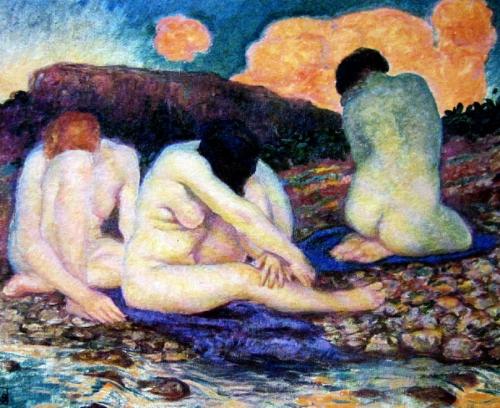
Heliades_by_Rupert_Bunny

   “Heliades (1920s) 


           Rupert Bunny


                      ______


                     The Latian nymphs came round him, 


Latian, of Latium, a region still of Italy,

which comprised, and still comprises,

Rome, the Latians, or Latins, were its

original inhabitants, whose language,

Latin, is the root of many of our 

European languages today, it is, 

notably, the language of Ovid


                                                                                                 and, amaz’d, 
                     On the dead youth, transfix’d with thunder, gaz’d; 


the dead youth, Phaeton


                     And, whilst yet smoaking from the bolt he lay, 
                     His shatter’d body to a tomb convey, 
                     And o’er the tomb an epitaph devise: 
                     “Here he, who drove the sun’s bright chariot, lies; 
                     His father’s fiery steeds he cou’d not guide, 
                     But in the glorious enterprize he dy’d.” 


though Ovid’s text, as translated by

John Dryden, among others, has

its difficulties, a good portion of it 

is easy to understand, the secret,

mostly, is in paying attention to the

punctuation, which on occasion can

be tricky


                     Apollo hid his face, and pin’d for grief, 


Apollo, Phaeton’s father


                     And, if the story may deserve belief, 
                     The space of one whole day is said to run, 
                     From morn to wonted ev’n, without a sun: 


ev’n, evening

                     The burning ruins, with a fainter ray, 
                     Supply the sun, and counterfeit a day, 

                     A day, that still did Nature’s face disclose: 
                     This comfort from the mighty mischief rose. 


though the sun did not shine that

fateful day, the glow from the 

burning debris shed a light that 

allowed one to nevertheless 

make out, disclose, Nature’s face, 

a wry comfort midst the carnage,

midst the mighty mischief


                     But Clymene, enrag’d with grief, laments, 


Clymene, Phaeton’s mother


                     And as her grief inspires, her passion vents: 
                     Wild for her son, and frantick in her woes, 
                     With hair dishevel’d round the world she goes, 
                     To seek where-e’er his body might be cast; 
                     ‘Till, on the borders of the Po, at last 
                     The name inscrib’d on the new tomb appears. 


the Po, a river in Italy


the new tomb, where the Latian 

nymphs lay to rest Phaeton’s 

remains 


                     The dear dear name she bathes in flowing tears, 
                     Hangs o’er the tomb, unable to depart, 
                     And hugs the marble to her throbbing heart. 

                     Her daughters too lament, and sigh, and mourn 
                     (A fruitless tribute to their brother’s urn), 
                     And beat their naked bosoms, and complain, 
                     And call aloud for Phaeton in vain: 
                     All the long night their mournful watch they keep, 
                     And all the day stand round the tomb, and weep. 


Her daughters, the Heliades, along

with Phaeton, were the children of

Clymene and Helios / Phoebus / 

Apollo, god of the Sun


                     Four times, revolving, the full moon return’d; 
                     So long the mother and the daughters mourn’d: 


the equivalent of, more or less, 

four months


                     When now the eldest, Phaethusa, strove 
                     To rest her weary limbs, but could not move; 
                     Lampetia wou’d have help’d her, but she found 
                     Her self with-held, and rooted to the ground: 


Phaethusa and Lampetia, both daughters 

of Helios / Phoebus / Apollo, but with 

Neaera, and not, as Ovid indeed writes 

in his Latin text, with Clymene, were 

therefore not strictly speaking Heliades

but stepsisters only of Phaeton


furthermore, Ovid has them find their

purported brother in the Eridanos, a

river only later identified as the Po

so that Dryden cannot be faulted for

this not inaccurate anachronism


in either case, I suspect either’s metre

might’ve played a poetically pertinent 

part in these divergences


                     A third in wild affliction, as she grieves, 
                     Wou’d rend her hair, but fills her hands with leaves; 
                     One sees her thighs transform’d, another views 
                     Her arms shot out, and branching into boughs. 


in one version, Helios / Phoebus / 

Apollo and Clymene had three 

daughters, Aegiale, Aegle, and 

Aetheria, in another they had five, 

Helia, Merope, Phoebe, Aetheria 

and Dioxippe, you’ll note that 

Phaethusa and Lampetia are not 

among then


                     And now their legs, and breasts, and bodies stood  
                     Crusted with bark, and hard’ning into wood; 
                     But still above were female heads display’d, 

                     And mouths, that call’d the mother to their aid. 


there’s a pattern here, a friend said 

when I spoke to her about what 

was coming up


you mean these nymphs turning 

into trees, I asked


yes, she replied


look at it the other way around, I said, 

not that the girls are turning into trees, 

but that the trees are becoming human, 

becoming our kin, we are acknowledging 

their humanity, anthropomorphically, which 

is why some of us actually hug them, the 

world in Ovid’s earlier myths is still being 

created, not just the generic tree, but 

poplars, maples, laurel, out of the share 

of the common soul we impart to them, 

not only metaphorically, as in these myths, 

but even organically, we are, after all,  

all, fundamentally, stardust


                     What cou’d, alas! the weeping mother do? 
                     From this to that with eager haste she flew, 
                     And kiss’d her sprouting daughters as they grew. 
                     She tears the bark that to each body cleaves, 
                     And from their verdant fingers strips the leaves: 
                     The blood came trickling, where she tore away 
                     The leaves and bark: 


the process is not unlike watching, 

helplessly, a daughter leave home, 

age, take on life’s tribulations


                                                 the maids were heard to say, 
                     “Forbear, mistaken parent, oh! forbear; 
                     A wounded daughter in each tree you tear; 
                     Farewell for ever.” Here the bark encreas’d, 
                     Clos’d on their faces, and their words suppress’d. 


let go, let go, the daughters cry,

holding on to us only hurts 

                     The new-made trees in tears of amber run, 
                     Which, harden’d into value by the sun, 
                     Distill for ever on the streams below: 
 

the river Eridanos was supposed to be a

river rich in amber, the resin, apparently,  

of poplar trees there having drifted to the 

nearby stream, hardened


I’m reminded of the sap of our own

indigenous maple trees becoming

a prized delicacy


                     The limpid streams their radiant treasure show, 
                     Mixt in the sand; whence the rich drops convey’d 
                     Shine in the dress of the bright Latian maid. 


Latian, or Latin, maids have been 

weaving amber into their apparel

ever since


R ! chard


The Story of Phaeton (III) – Ovid

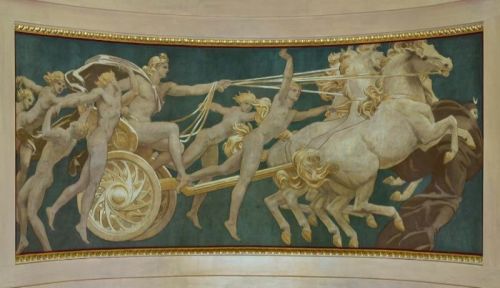
Apollo_in_His_Chariot_with_the_Hours

   Apollo in His Chariot with the Hours (1922–25) 


               John Singer Sargent


                     __________


                 The God repented of the oath he took, 


the God, Helios / Phoebus / Apollo,

father of Phaeton, with Clymene,

Phaeton’s mother


the oath, to grant Phaeton his wish

in order to prove his paternity


                 For anguish thrice his radiant head he shook;
                 “My son,” says he, “some other proof require,
                 Rash was my promise, rash is thy desire.
                 I’d fain deny this wish, which thou hast made,
                 Or, what I can’t deny, wou’d fain disswade. 


fain, willingly, gladly


what I can’t deny, his oath


disswade, dissuade


                Too vast and hazardous the task appears,
                 Nor suited to thy strength, nor to thy years.
                 Thy lot is mortal, but thy wishes fly
                 Beyond the province of mortality:


Beyond the province of mortality,

into immortality, for which Phaeton

is not equipped, being human, his

lot is mortal


                There is not one of all the Gods that dares
                 (However skill’d in other great affairs)
                 To mount the burning axle-tree, but I; 


the axle-tree, the bar that joins the 

wheels of the chariot, is burning 

because it transports the sun


                Not Jove himself, the ruler of the sky,
                 That hurles the three-fork’d thunder from above,
                 Dares try his strength: yet who so strong as Jove? 


not even Jove / Jupiter / Zeus, god of 

gods, and of Thunder, will attempt to  

mount the burning axle-tree, despite 

his immense strength, superior to

anyone’s


                The steeds climb up the first ascent with pain,
                 And when the middle firmament they gain, 


the middle firmament, noon, the

middle of the day, where the sun

reaches its zenith


                If downward from the Heav’ns my head I bow,
                 And see the Earth and Ocean hang below, 


hang, suspended in the heavens


                Ev’n I am seiz’d with horror and affright,
                 And my own heart misgives me at the sight. 


Helios / Phoebus / Apollo admits 

to fear of vertigo


                A mighty downfal steeps the ev’ning stage,
                 And steddy reins must curb the horses’ rage.
                 Tethys herself has fear’d to see me driv’n
                 Down headlong from the precipice of Heav’n. 


Tethys, a Titaness, of the race of 

Giants, who were defeated during 

the Giants’ War


what I’ve learned in the meantime 

is that the Giants, the Titans, had 

actually ruled the cosmos before 

being defeated by the Olympians

something Ovid had misrepresented

in his retelling, where he suggests 

that they were upstarts, rather, 

mortal, however gigantic, who were 

trying from the Earth, Hills pil’d on

hills, on mountains mountains … /

To make their mad approaches to

the skie, in order to unseat the 

gods of Olympus


the Titans, as it turns out, were 

immortals, who ruled the cosmos 

before being ousted by the

Olympians, Jove / Jupiter / Zeus

and his cohorts, and relegated, 

most of them, to the Underworld

though Tethys herself seems to 

have made it out, and been 

reconciled with, at least, the 

Sun god


should I point out that to try to set 

out in one, however comprehensive,

manuscript, a mythology that had 

endured for going on a thousand 

years was likely to reflect some 

inconsistencies, some inaccuracies,

not to mention the dictates of not 

only cultural, but also political 

considerations, we’ll have to 

forgive Ovid, or not, it appears,

his  transgressions 


                Besides, consider what impetuous force
                 Turns stars and planets in a diff’rent course. 


Helios / Phoebus / Apollo continues

to speak, warning his son Phaeton

of the strong, impetuous, and 

unpredictable, currents that [t]urn,

jostle, stars and planets


                I steer against their motions; 


that’s what I have to deal with,

Helios / Phoebus / Apollo

cautions, these motions,

these irascible, interplanetary,

interstellar, streams 


                                                              nor am I
                 Born back by all the current of the sky. 


neither am I born back, which is 

to say borne back, carried back, 

guided back, by any regular,

orderly, current of the sky, by any 

rhythm, of the days, for instance, 

or of the, however intransigent,

hours, that could, potentially,

redirect his path 


                But how cou’d you resist the orbs that roul
                 In adverse whirls, and stem the rapid pole? 


roul, roll, swirl


adverse whirls, of the winds, like 

ocean currents, that stem, are 

created by, are the source of, as 

in the stem of plants, the rapid 

pole, or pull, to rhyme with roul,

a bit, I think, of a poetic stretch


                But you perhaps may hope for pleasing woods,
                 And stately dooms, and cities fill’d with Gods;
                 While through a thousand snares your progress lies,
                 Where forms of starry monsters stock the skies: 


dooms, eventualities, a wonderful 

conjunction here of stately, or 

exalted, expectations, with the 

more dire threat of a thousand

snares, or starry monsters, that

the word doom would usually

suggest


                For, shou’d you hit the doubtful way aright, 


even if you stay on the right track,

even if you hit the … way aright


                The bull with stooping horns stands opposite; 


you’ll have to confront [t]he bull, 

Taurus


                Next him the bright Haemonian bow is strung, 


Haemonian, of Thessaly, a region 

still of Greece  


the Haemonian bow, representative

of Sagittarius


                And next, the lion’s grinning visage hung: 


the lion, Leo


                 The scorpion’s claws, here clasp a wide extent; 


The scorpion, Scorpio


                And here the crab’s in lesser clasps are bent. 


the crab, Cancer


an array of astrological configurations 

obstruct the sky


                Nor wou’d you find it easie to compose
                 The mettled steeds, when from their nostrils flows
                 The scorching fire, that in their entrails glows. 


mettled, spirited 


                Ev’n I their head-strong fury scarce restrain,
                 When they grow warm and restif to the rein. 


Ev’n I, Helios / Phoebus / Apollo, can 

barely, scarce, hold them back, restrain

them, when they grow … restif, restive,

unable to keep still 


                Let not my son a fatal gift require, 


don’t require of me a fatal gift, 

Phaeton’s father pleads, a gift 

that will destroy you 


                But, O! in time, recall your rash desire;
                 You ask a gift that may your parent tell, 


a gift that may your parent tell,

that is meant to determine, to 

prove, your descent


                Let these my fears your parentage reveal;
                 And learn a father from a father’s care:
                 Look on my face; or if my heart lay bare,
                 Cou’d you but look, you’d read the father there. 


were you to just look at my face, 

see my concern, you should be 

able to make out that I’m your 

father, Helios / Phoebus / Apollo

says


                Chuse out a gift from seas, or Earth, or skies, 


[c]huse, choose


                For open to your wish all Nature lies,
                 Only decline this one unequal task,
                 For ’tis a mischief, not a gift, you ask. 


unequal task, a challenge that 

is too great for Phaeton


                You ask a real mischief, Phaeton:
                 Nay hang not thus about my neck, my son: 


don’t hang about my neck, Helios

/ Phoebus / Apollo tells his son, 

you don’t need to try to cajole me


                I grant your wish, and Styx has heard my voice, 


Helios / Phoebus / Apollo has 

sworn an oath on Styx, the 

goddess, the river, an 

unshakable promise, which 

he intends to deliver


                Chuse what you will, but make a wiser choice.” 


now it’s up to you, Phaeton, for 

better or for worse, to decide


R ! chard


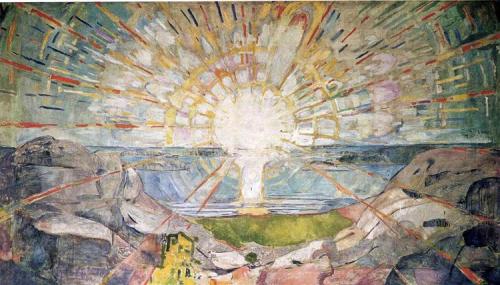
“The Story of Phaeton” (II) – Ovid

the-sun-1916.jpg!Large

   “The Sun (1911 – 1916) 


            Edvard Munch


                _______


                    The Sun’s bright palace, on high columns rais’d, 


The Sun, Helios / Phoebus / Apollo


                    With burnish’d gold and flaming jewels blaz’d;
                    The folding gates diffus’d a silver light,
                    And with a milder gleam refresh’d the sight; 


since the folding gates of the bright

palace shimmered with a silver light 

rather than with the glow of the gold 

and flaming jewels of the palace itself,

their milder gleam was easier on the 

eyes, refresh’d the sight


                    Of polish’d iv’ry was the cov’ring wrought: 


the palace was covered with polish’d

wrought ivory


                    The matter vied not with the sculptor’s thought, 


the execution of the palace was  

everything that its sculptor, its

architect, had had in mind to 

create


                    For in the portal was display’d on high
                    (The work of Vulcan) a fictitious sky


Vulcan, god of fire, metal, smiths, 

metalworkers


at the entrance to the palace, the

portal, Vulcan had painted the ceiling, 

he’d display’d on high … a fictitious 

sky, I suspect Dryden must’ve had 

Michelangelo and his ceiling of the  

Sistine Chapel in mind during his 

translation of this passage of Ovid


                    A waving sea th’ inferiour Earth embrac’d, 


inferiour, Earth, surging from under the 

greater masses of water dominating it, 

especially after the flood, is, therefore, 

beneath the waving sea, inferiour to it


                    And Gods and Goddesses the waters grac’d. 


remember that Ovid is describing a 

painting here, on the ceiling at the

entrance, the portal, to the palace 

of the god of the Sun


                    Aegeon here a mighty whale bestrode; 


Aegeon, marine god, god of storms,

note the similarity of the name with 

that of the Aegean Sea, but which 

came first, the chicken or the egg, 

the god or the expanse of water, 

remains, as far as I’ve been able 

to determine, undetermined


                    Triton, and Proteus (the deceiving God) 


Triton, another god of the Sea, you’ll 

remember him coming to the aid of 

Neptune, his father, in settling the

waters after the flood at the request 

of Jove / Jupiter / Zeus


Proteus, still another sea god, 

described as deceiving, for his 

ability to effortlessly, and 

spontaneously, change his shape, 

from which, incidentally, we get 

the adjective protean, for easily 

changeable, or versatile 


                    With Doris here were carv’d, and all her train, 


Doris, sea goddess, and all her train,

her following of nymphs, the Nereids,

her fifty daughters, if you’ll remember,

are carv’d, etched, given graphic 

representation


                    Some loosely swimming in the figur’d main, 


figur’d, painted, depicted, drawn


main, the open ocean, but, probably 

also here, the main, or central, part 

of the painting itself


                    While some on rocks their dropping hair divide, 


their hair divide, they loosen strands 

of their wet hair 


                    And some on fishes through the waters glide: 


sea gods and goddesses are often

shown riding sea creatures, dolphins, 

seahorses, even whales, see Aegeon

above

                    Tho’ various features did the sisters grace,
                    A sister’s likeness was in ev’ry face. 


the sisters, the Nereids, all have different

features, but a family resemblance, sister’s 

likeness, can always be detected in each

individual sibling’s rendering


                    On Earth a diff’rent landskip courts the eyes, 


Earth doesn’t look, court[ ] the eyes,

at all like what’s painted on the 

palace’s ceiling


landskip, landscape


                    Men, towns, and beasts in distant prospects rise, 


distant prospects, from a distance, one 

can see [m]en, towns, and beasts 

appear, rise, arise


                    And nymphs, and streams, and woods, and rural deities. 


nymphs, consigned, it appears, to 

earthly duties, streams, and woods, 

are not a feature of the Sun god’s 

palace


                    O’er all, the Heav’n’s refulgent image shines; 


the Heav’n’s refulgent, brightly shining,

image, expression, is manifest [o]’er all,

everywhere, the rays of the sun cast a

light on everything


                    On either gate were six engraven signs. 


again I’m reminded of a Renaissance

wonder, Lorenzo Ghiberti‘s gilded bronze 

doors for the Florence Baptistery, which 

Michelangelo himself called the Gates of

Paradise, a work nearly as famous, then 

and now, as his own Sistine Chapel ceiling   


Ovid would never have known of these 

masterworks, of course, having lived 

over a millenium earlier, but I suspect 

John Dryden, a cultured man, a couple 

of hundred years later than these 

cultural icons, would no doubt have 

been fully aware of them, much as we, 

however disinterested we might be, 

can’t help but have heard of, say, 

RembrandtChopinCharles Dickens,

for instance, though they be, similarly, 

centuries separated from us 


my point is that, without knowledge of 

the original Latin, Dryden‘s cultural

heritage must’ve slipped, I think, 

consciously or not, into his 

translation, for better, or for worse


it should be remembered, however,

that Dryden was writing for an early 

18th Century audience, much as I 

am presently doing myself with 

Dryden for a 21st, and maybe also

similarly skewing his idiom to better 

adapt it to our own time, for better, 

also, or for worse 


                    Here Phaeton still gaining on th’ ascent, 


gaining on th’ ascent, going faster 

and faster, climbing higher and 

higher


                    To his suspected father’s palace went


suspected father, Phaeton doesn’t

yet know if Helios / Phoebus / Apollo

is indeed his father


                    ‘Till pressing forward through the bright abode,
                    He saw at distance the illustrious God:
                    He saw at distance, or the dazling light
                    Had flash’d too strongly on his aking sight. 


had Phaeton not been as far, at

distance, from what he was seeing,

the illustrious God, the dazling, or 

dazzling, light would’ve hurt his 

eyes, hurt his aking, or aching, 

sight


                     The God sits high, exalted on a throne
                    Of blazing gems, with purple garments on; 


Tyrian, surely, purple, a hue we’ve 

seen here before, indicative of 

stature, of imperial, if not even

divine, as in this instance, 

pedigree


                     The Hours, in order rang’d on either hand,
                    And Days, and Months, and Years, and Ages stand.
                    Here Spring appears with flow’ry chaplets bound;
                    Here Summer in her wheaten garland crown’d;
                    Here Autumn the rich trodden grapes besmear;
                    And hoary Winter shivers in the reer. 


this is no longer a picture, but the 

real thing, Phoebus / Apollo / Helios

sits high, exalted on a throne /  Of 

blazing gems, with purple garments 

on, while Time and all of the Seasons 

hold court around him


                     Phoebus beheld the youth from off his throne;
                    That eye, which looks on all, was fix’d in one. 


Phoebus, who sees everything, who 

looks on all, beholds, fixes his eye on, 

his son


                     He saw the boy’s confusion in his face,
                    Surpriz’d at all the wonders of the place;
                    And cries aloud, “What wants my son? for know
                    My son thou art, and I must call thee so.” 


Phaeton, according to Phoebus / 

Apollo / Helios‘ forthright admission,

is truly his son


                     “Light of the world,” the trembling youth replies,
                    “Illustrious parent! since you don’t despise
                    The parent’s name, 


despise, refute


                                                some certain token give,
                    That I may Clymene’s proud boast believe,
                    Nor longer under false reproaches grieve.” 


your word is good, Phaeton allows,

but incontrovertibly, now, prove it, 

some certain token give, he 

challenges 


                     The tender sire was touch’d with what he said,
                    And flung the blaze of glories from his head, 


flung the blaze of glories from his head, 

reduced the intensity of his presence,

the impact of his charisma, took off 

his dazling crown, if only, maybe,

metaphorically, to be father to his son


                    And bid the youth advance: “My son,” said he,
                    “Come to thy father’s arms! for Clymene
                    Has told thee true; a parent’s name I own,
                    And deem thee worthy to be called my son.
                    As a sure proof, make some request, and I,
                    Whate’er it be, with that request comply;
                    By Styx I swear, whose waves are hid in night,
                    And roul impervious to my piercing sight.” 


an oath upon Styx is incontrovertible, 

like swearing on a Bible, as earlier 

noted


                     The youth transported, asks, without delay,
                    To guide the sun’s bright chariot for a day. 


Phaeton wants to drive his father’s 

car, the sun’s bright chariot, how 

contemporary, how immediate, 

how timeless 


stay tuned


R ! chard