Richibi’s Weblog

Just another WordPress.com weblog

Tag: Helios / Phoebus / Apollo

“The Story of Coronis, and Birth of Aesculapius” – Ovid
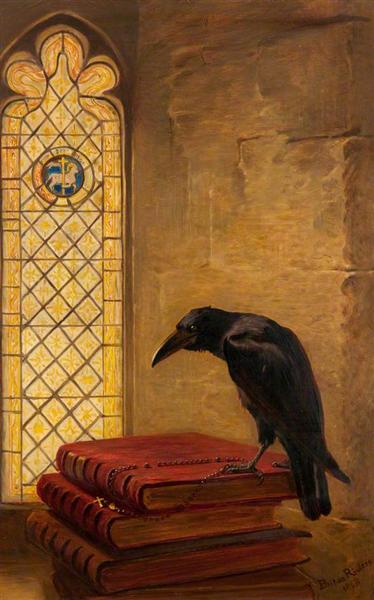
a-saint-from-the-jackdaw-of-rheims-1868(1).jpg!Large

   “A Saint, from ‘The Jackdaw of Rheims’ (1868) 


           Briton Rivière


              _______


             The raven once in snowy plumes was drest, 
             White as the whitest dove’s unsully’d breast, 
             Fair as the guardian of the Capitol, 
             Soft as the swan; a large and lovely fowl; 
             His tongue, his prating tongue had chang’d him quite 
             To sooty blackness, from the purest white. 


the Capitol, the Temple of Jupiter, only 

portions of which remain, on exhibit in

the Capitoline Museums, on the 

Capitoline Hill, one of the Seven Hills 

of Rome


the guardian of the Capitol, the Vestalis

Maxima, or the greatest of the Vestals,

who were charged with ensuring the 

security of the city


the raven was white once, Ovid says, 

[f]air as the guardian of the Capitol, 

[s]oft as the swan, but it seems his 

prating tongue got him in trouble


prating, chattering, tattling


here’s what happened


            In Thessaly there liv’d a nymph of old, 
             Coronis nam’d; a peerless maid she shin’d, 
             Confest the fairest of the fairer kind. 
             Apollo lov’d her, ’till her guilt he knew, 
             While true she was, or whilst he thought her true. 


Thessaly, a region of Greece


contrary to what’s taken place in

these myths till now, Coronis, a 

nymph, in name only, it appears,

was found out to be untrue to 

Apollowho lov’d her


                   his own bird the raven chanc’d to find 
             The false one with a secret rival joyn’d. 
             Coronis begg’d him to suppress the tale, 
             But could not with repeated pray’rs prevail. 


the raven, Apollo‘s own bird, was not 

going to not tell his master about his 

mistress’ indiscretion, despite [t]he 

false one’s pray’rs not to


              His milk-white pinions to the God he ply’d;


pinion, the outer part of a bird’s wing,

including the flight feathers


             [A] busy daw flew with him, side by side, 


daw, jackdaw, a black bird related to 

the crow


             And by a thousand teizing questions drew
             Th’ important secret from him as they 
flew. 


teizing, teasing


             The daw gave honest counsel, 
tho’ despis’d, 


tho’ despis’d, though the honest

counsel would be unpleasant to 

hear


              And, tedious in her tattle, thus advis’d: 


listen, said the daw, cautioning

the raven 


              “Stay, silly bird, th’ ill-natur’d task refuse, 


silly bird, the raven 


              Nor be the bearer of unwelcome news. 
             Be warn’d by my example: 


pay attention, the daw insists, be 

wary, [b]e warn’d


                                                         you discern 
             What now I am, and what I was shall learn. 
             My foolish honesty was all my crime; 
             Then hear my story.


here’s what happened to me,

says the pitch black bird


                                             Once upon a time, 


to follow


R ! chard


psst: The Jackdaw of Reims, by

            Richard Harris Barham


The Story of Phaeton (VI) – Ovid

mountain-fire.jpg!Large

    Mountain Fire (c.1903 – c.1908)


              John Singer Sargent


                       _________


because Phaeton was light, nor cou’d 

he fill the seat, the horses he would’ve

controlled forsake / Their stated course, 

and leave the beaten track


                What cou’d he do? his eyes, if backward cast,
                Find a long path he had already past;
                If forward, still a longer path they find:
                Both he compares, and measures in his mind;
                And sometimes casts an eye upon the east,
                And sometimes looks on the forbidden west, 


note the description of the movement 

of the eyes, backward, forward, east

and west, uncontrolled, erratic, nearing 

madness, despite attempts, however 

futile, to remain rational, steady, his 

very mind, comparing, measuring, is 

quickly losing its bearings


forbidden, once again, this should 

probably read forbidding


                The horses’ names he knew not in the fright,
                Nor wou’d he loose the reins, nor cou’d he hold ’em right. 


“Now, Dasher! Now, Dancer! Now, 

Prancer, and Vixen! / “On, Comet! 

On, Cupid! On, Donner and Blitzen!,

who drove another of the very few 

famous chariots in our Western 

cultural history


couldn’t help it


the only other one I could think of 

is that of the Four Horsemen of 

the Apocalypse, red, white, black, 

and pale horses, which I won’t get 

into, but to say that they have no 

names


the horses who drove the Chariot of

the Sun, meanwhile, were called

Phlegon, Aeos, Aethon, and Pyrios, 

though I fully admit that I had to 

look those up, then again I’ve never 

had to ride the Chariot of the Sun


it appears that Helios / Phoebus / 

Apollo had other steeds in his stable 

as well, for a rainy day, but they don’t 

feature in this particular story


                Now all the horrors of the Heav’ns he spies,
                And monstrous shadows of prodigious size,
                That, deck’d with stars, lye scatter’d o’er the skies. 


lye, lie


                There is a place above, where Scorpio bent
                In tail and arms surrounds a vast extent; 


Scorpio, the constellation Scorpius

visible only in the Southern hemisphere


Scorpio, represented by a scorpion,

thus has eight legs, or arms, and a 

highly distinctive tail


                In a wide circuit of the Heav’ns he shines,
                And fills the space of two coelestial signs. 


coelestial, celestial


                Soon as the youth beheld him vex’d with heat
                Brandish his sting, and in his poison sweat,
                Half dead with sudden fear he dropt the reins; 


vex’d with heat, from the wayward 

chariot, Scorpio [b]randish[es]

his sting


poison sweat, Scorpio, under the 

influence of the heat, sweat[s],

exudes, produces, characteristically, 

poison


                The horses felt ’em loose upon their mains, 


mains, manes, long hair


                And, flying out through all the plains above,
                Ran uncontroul’d where-e’re their fury drove;
                Rush’d on the stars, and through a pathless way
                Of unknown regions hurry’d on the day. 


hurry’d on the day, kept the day going

at its usual, however presently pathless, 

or uncharted, pace


                And now above, and now below they flew,
                And near the Earth the burning chariot drew. 


ever, and increasingly, ominously

                The clouds disperse in fumes, the wond’ring Moon
                Beholds her brother’s steeds beneath her own; 


wond’ring, confused, puzzled


Brother Sun, Sister Moon


                The highlands smoak, cleft by the piercing rays,
                Or, clad with woods, in their own fewel blaze. 


smoak, smoke


fewel, fuel


where the highlands are clad with 

woods, they blaze in the fires 

consuming their own trees


                Next o’er the plains, where ripen’d harvests grow,
                The running conflagration spreads below.
                But these are trivial ills: whole cities burn,
                And peopled kingdoms into ashes turn. 


an apocalypse

                The mountains kindle as the car draws near, 


the car, the chariot


                Athos and Tmolus red with fires appear; 


Athos, Mount Athos, Tmolus, Mount

Tmolus, both mountains in Greece,

both named after mountain gods


                Oeagrian Haemus (then a single name) 


Haemus Mons, an early name for 

the Balkan Mountains


Oeagria, Agria, a town in Greece


                And virgin Helicon increase the flame; 


Helicon, Mount Helicon, notable for

being the home of the Muses


                Taurus and Oete glare amid the sky, 


Taurus, the Taurus Mountains, a 

mountain range in southern Turkey 


Oete, Mount Oeta, a mountain in

Central Greece


                And Ida, spight of all her fountains, dry.
                Eryx and Othrys, and Cithaeron, glow,
                And Rhodope, no longer cloath’d in snow;
                High Pindus, Mimas, and Parnassus, sweat,
                And Aetna rages with redoubled heat. 


spight, in spite

Ida, Eryx, Othrys, CithaeronRhodope

Pindus, and the more familiar Parnassus

and Aetna, or Etna, are all mountains, or 

ranges, in the Mediterranean, Mimas, an 

island there, which is to say, a partially 

submerged mountain, all of them

sweltering


see above


                Ev’n Scythia, through her hoary regions warm’d, 


Scythia, a region northeast of Ancient 

Greece, barbarian to the more cultured 

people of Greek Antiquity, coarse 

forebears of the Cossacks 


hoary, sullied white, tired, withered 


                In vain with all her native frost was arm’d. 


even so frosty a region as Scythia

was not immune to, arm’d against, 

the running conflagration


                Cover’d with flames the tow’ring Appennine,
                And Caucasus, and proud Olympus, shine;
                And, where the long-extended Alpes aspire,
                Now stands a huge continu’d range of fire. 


the AppennineCaucasusOlympus

and Alpes, or Alps, are all mountain 

ranges throughout Europe, the 

representative part then of the 

known world


               Th’ astonisht youth, where-e’er his eyes cou’d turn,
                Beheld the universe around him burn:
                The world was in a blaze; nor cou’d he bear
                The sultry vapours and the scorching air,
                Which from below, as from a furnace, flow’d;
                And now the axle-tree beneath him glow’d:
                Lost in the whirling clouds that round him broke,
                And white with ashes, hov’ring in the smoke.
                He flew where-e’er the horses drove, nor knew
                Whither the horses drove, or where he flew. 


R ! chard


The Story of Phaeton (IV) – Ovid

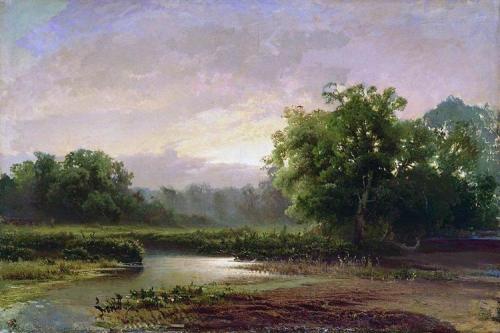
dawn.jpg!Large

    “Dawn (1873) 


           Fyodor Vasilyev


                     _______


                Thus did the God th’ unwary youth advise; 


Helios / Phoebus / Apollo tells his

son Phaeton, th’ unwary youth, 

that he shouldn’t try to ride the 

Chariot of the Sun himself


                But he still longs to travel through the skies. 


Phaeton, however, is inclined to

disregard his father’s advice


                When the fond father (for in vain he pleads)
                At length to the Vulcanian Chariot leads. 


Vulcanian, of Vulcan, god of fire,

metal, metalworkers


Vulcan, according to Ovid here, 

built the Chariot of the Sun 


                A golden axle did the work uphold, 


the axle is the principal part, the 

beam between the wheels, that 

holds the chariot together, that 

did the work, which is to say

the chariot, uphold


                Gold was the beam, the wheels were orb’d with gold.
                The spokes in rows of silver pleas’d the sight,
                The seat with party-colour’d gems was bright; 


the chariot was made of precious 

metals and gems, was therefore 

bright, resplendent


                Apollo shin’d amid the glare of light. 


Apollo, Sun god, would surely, as 

well as the chariot, be radiant, 

glowing


note that the Sun god is called 

Apollo here, where earlier he’d

been called Phoebus, the Latin 

name replacing the Greek, but

upon further investigation I found

that it was Dryden who’d made 

the switch, Ovid had called the 

Sun god Phoebus in the original

Latin text


                The youth with secret joy the work surveys, 


Phaeton is beside himself, eager 

with anticipation


                When now the moon disclos’d her purple rays; 


purple rays, tinged with the colours 

of dawn


see above


                The stars were fled, for Lucifer had chased
                The stars away, and fled himself at last. 


Lucifer, the Morning Star, the

planet Venus, as it appears in 

the East before sunrise


having suspected Dryden of having

replaced with Lucifer another name 

from the original Latin text, I was 

surprised to discover that Lucifer

had been indeed translated faithfully 

from Ovid’s poem, which means that 

the Christian name we’re familiar 

with as another name for Satan has 

to have been adopted from the 

Ancients and modified to fit the new 

Christian mythology, the biblical

narrative 


Lucifer, a god in his own right in

Antiquity, had been the son of 

Aurora, goddess of the Dawn


do you love it


                Soon as the father saw the rosy morn,
                And the moon shining with a blunter horn, 


blunter, less incandescent, dulled

by the advancing light


horn, a lesser phase of the moon, 

when it is either waxing or waning, 

thus resembling a horn


                He bid the nimble Hours, without delay,
                Bring forth the steeds; the nimble Hours obey: 


the Hours, or Horae, goddesses 

of the Seasons, horae is the 

Greek word for seasons


                From their full racks the gen’rous steeds retire, 


retire, come away, from their stalls

in the stables


                Dropping ambrosial foams, and snorting fire. 


ambrosial, especially fragrant, or

tasty


                Still anxious for his son, the God of day,
                To make him proof against the burning ray,
                His temples with celestial ointment wet,
                Of sov’reign virtue to repel the heat; 


celestial ointment, ambrosia,

elixir of the gods


sov’reign virtue, exceedingly effective

attribute


                Then fix’d the beamy circle on his head, 


beamy circle, radiant halo of

solar rays


                And fetch’d a deep foreboding sigh, and said,
                “Take this at least, this last advice, my son,
                Keep a stiff rein, and move but gently on:
                The coursers of themselves will run too fast,
                Your art must be to moderate their haste.
                Drive ’em not on directly through the skies,
                But where the Zodiac’s winding circle lies,
                Along the midmost Zone; but sally forth
                Nor to the distant south, nor stormy north.
                The horses’ hoofs a beaten track will show,
                But neither mount too high, nor sink too low.
                That no new fires, or Heav’n or Earth infest;
                Keep the mid way, the middle way is best.
                Nor, where in radiant folds the serpent twines,
                Direct your course, nor where the altar shines. 


serpent twines, serpentine, tortuous

entanglements


altar, probably alter, or other, light 

sources, the moon, for instance,

the Morning Star, do not be 

distracted by bright lights, 

Phoebus / Apollo advises


                Shun both extreams; the rest let Fortune guide, 
                And better for thee than thy self provide! 


Fortune, or Fortuna, goddess of Fate,

will be of greater help to you, Phoebus 

/ Apollo tells his son, than you, thy self,

can provide for yourself 


compare this last fatherly advice,

incidentally, to that of Polonius to

Laertes, his own son, act I, scene 

3, lines 55 to 81 in Shakespeare’s 

Hamlet, proof that Shakespeare 

was not only well acquainted 

with Ovid, but also much 

admired him


                See, while I speak, the shades disperse away,
                Aurora gives the promise of a day; 


Aurora, goddess of the Dawn


                I’m call’d, nor can I make a longer stay. 


I’m call’d, the time has come to 

mount the Chariot of the Sun, 

the morning breaks, I must, or

you must, in my stead, go


                Snatch up the reins; or still th’ attempt forsake,
                And not my chariot, but my counsel, take,
                While yet securely on the Earth you stand;
                Nor touch the horses with too rash a hand.
                Let me alone to light the world, while you
                Enjoy those beams which you may safely view.” 


should you choose to my counsel, take, 

from the Earth you may safely view my 

beams while I alone … light the world, 

Phoebus / Apollo implores his son


                He spoke in vain; the youth with active heat
                And sprightly vigour vaults into the seat;
                And joys to hold the reins, and fondly gives
                Those thanks his father with remorse receives.


for better, or for worse


stay tuned


R ! chard


“The Story of Phaeton” – Ovid

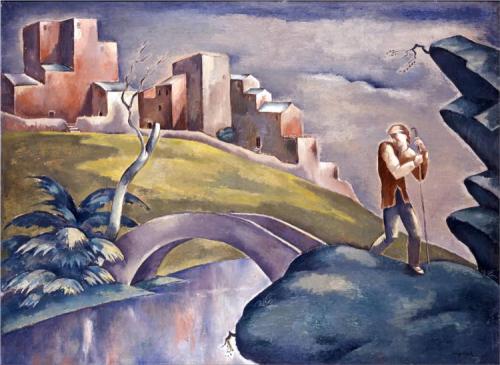
landscape-with-a-palace-1916.jpg!Large

   Landscape with a Palace (1916) 


             Eugeniusz Zak


                  ________


               Her son was Epaphus, at length believ’d
               The son of Jove, and as a God receiv’d; 


without proof, it could not have been 

absolutely determined, during this 

ancient mythological era, that  

Epaphus, son of Io become Isis, was 

indeed the son of Jove / Jupiter / Zeus

though that’s what at length, eventually, 

came to be believed


and as such Epaphus was


               With sacrifice ador’d, and publick pray’rs,
               He common temples with his mother shares. 


both Isis and Epaphus are worshipped

in common, in the same places, and 

with a similar degree of devotion


               Equal in years, and rival in renown
               With Epaphus, the youthful Phaeton
               Like honour claims; 


Phaeton, another youth, [e]qual in 

years to Epaphus, and in renown,

as famous, [l]ike honour claims, 

puts forward, his own illustrious 

heritage


                                      and boasts his sire the sun. 


the sun, Phoebus / Apollo, god,

among a number of other things,

of that very orb


               His haughty looks, and his assuming air,
               The son of Isis could no longer bear:
               Thou tak’st thy mother’s word too far, said he,
               And hast usurp’d thy boasted pedigree. 


Epaphus, son of Isis, challenges 

Phaeton, says that his mother’s 

claim that her consort was the 

god of the Sun is false, and that 

he, Epaphus, is only promoting 

the fabricated story of his high, 

his boasted, pedigree, ancestry 


               Go, base pretender to a borrow’d name. 


Epaphus delivers a double whammy, 

base pretender, borrow’d name, ouch


               Thus tax’d, he blush’d with anger, and with shame;
               But shame repress’d his rage: 


tax’d, confronted


repress’d his rage, Phaeton didn’t 

slug Epaphus


                                                            the daunted youth
               Soon seeks his mother, and enquires the truth: 


is he truly the son of the god of the 

Sun, Phaeton asks his mother, nearly 

intolerable drama must surely follow, 

turning on this burning question 


               Mother, said he, this infamy was thrown
               By Epaphus on you, and me your son.
               He spoke in publick, told it to my face;
               Nor durst I vindicate the dire disgrace:
               Even I, the bold, the sensible of wrong, 


Even I, Phaeton asserts, the sensible 

of wrong, as he describes himself, the 

impatient of improprieties, however 

bold, quick to respond, impetuous, 

might he be, durst not, dared not, 

vindicate, validate, the dire disgrace, 

Epaphus‘ profoundly distressing insult    


               Restrain’d by shame, was forc’d to hold my tongue. 


I was unable, Phaeton says, too 

[r]estrain’d by shame, humiliated, 

to even answer


               To hear an open slander, is a curse:
               But not to find an answer, is a worse. 


a worse, we would say just worse, 

but note that worse, here, is not a

noun, but the adjective for curse,

which has been elided, left out, 

worse curse, which, included, 

would’ve altered, however, the 

metre, the pentameter, and thus, 

the poetry, style having trumped, 

for better or for worse, in this

instance, the substance 


a, incidentally, is the first beat of the 

iamb, which is to say, the weak beat,

while worse, is the second, the one 

with the accent, the determining 

thump, worse, da, dum, an iamb 


Dryden didn’t have, in other words, 

much choice, were he wanting to 

be a poet, but to deftly press his, 

surely masterful, grammar, to fit 

his meaning to his, however

constricting, verse


               If I am Heav’n-begot, assert your son
               By some sure sign; 


assert your son, acknowledge him,

[b]y some sure sign, Phaeton 

demands of his mother 


                                      and make my father known, 


at the same time, make … known, 

identify, Phaeton continues, point

him out, my father 


              To right my honour, and redeem your own.
               He said, 


it is the honour[able] thing to do,

the required thing to do, [h]e said, 

to restore, [t]o right, our reputations


                                   and saying cast his arms about
               Her neck, and beg’d her to resolve the doubt. 


a son imploring his mother, can 

anything be more poignant


               ‘Tis hard to judge if Clymene were mov’d
               More by his pray’r, whom she so dearly lov’d, 


Clymene, wife of Helios, or Phoebus / 

Apollo, sun god, mother of Phaeton 


               Or more with fury fir’d, to find her name
               Traduc’d, and made the sport of common fame. 


Traduc’d, translated, transmitted


common fame, the casual, everyday

sport, entertainment, however 

inappropriate, however malicious,
of many


               She stretch’d her arms to Heav’n, and fix’d her eyes
               On that fair planet that adorns the skies; 


that fair planet that adorns the skies, 

the sun, though Dryden must’ve 

known the sun wasn’t a planet, nor 

Ovid, for that matter, literary licence

having given style, here again, sway 

over substance, for better, it’ll be up 

to you to say, or for worse


literary licence, where style 

overtakes substance


               Now by those beams, said she, whose holy fires
               Consume my breast, and kindle my desires; 


girlfriend, I have to here interject, your 

temperature is, ahem, showing, you’re 

sounding, however uncharacteristically, 

awfully intemperate, aroused, [c]onsume 

my breast indeed, kindle, you audaciously 

request, my desires


               By him, who sees us both, and clears our sight,
               By him, the publick minister of light,
               I swear that Sun begot thee; 


Clymene swears an oath upon the 

very sun, her sire, the publick minister 

of light, the very priest of illumination, 

of clarity, for everyone, the sun’s 

manifest incarnation


                                                                if I lye,
               Let him his chearful influence deny: 


don’t shine on me, Helios / Phoebus /

Apollo, him, Helios / Phoebus / Apollo

himself, Clymene cries, if I lye, lie, if I

tell an untruth


               Let him no more this perjur’d creature see; 


Let him, let yourself, Helios / Phoebus /

Apollo, be unable any longer to see me,

perjur’d creature that I, Clymene, am 


               And shine on all the world but only me. 


obliterate me, she defies, from your

purview, let the world receive your 

rays, but not myself


               If still you doubt your mother’s innocence,
               His eastern mansion is not far from hence;
               With little pains you to his Leve go,
               And from himself your parentage may know. 


Leve, where Helios / Phoebus / 

Apollo lives


               With joy th’ ambitious youth his mother heard,
               And eager, for the journey soon prepar’d. 


Phaeton is off on his mission


               He longs the world beneath him to survey; 


he wants to see the world from the 

perspective of the sun, an astronaut,

a dreamer, pulsing with ambition


               To guide the chariot; and to give the day: 


to drive his father’s car, chariot, how 

contemporary, how immediate


               From Meroe’s burning sands he bends his course, 


Meroe, a city on the Nile, you’ll 

remember that we’re still in Egypt, 

where Io / Isis prevails, with Epaphus

her son, the one who started all this  


               Nor less in India feels his father’s force: 


the sun, his father’s force, is no less 

vigorous in India than it is, he, Helios

/ Phoebus / Apollo, is, in Egypt


               His travel urging, till he came in sight; 


His travel urging, impatient to speed 

up his pace, hastening his metaphorical

horses


               And saw the palace by the purple light. 


purple light, evening, though purple 

is also, since antiquity, the colour of 

royaltyPhaeton is perhaps seeing 

both, the palace, at evening  


see above


R ! chard