Richibi’s Weblog

Just another WordPress.com weblog

Tag: Goethe

Piano Concerto no 1 in D minor, opus 15 – Brahms
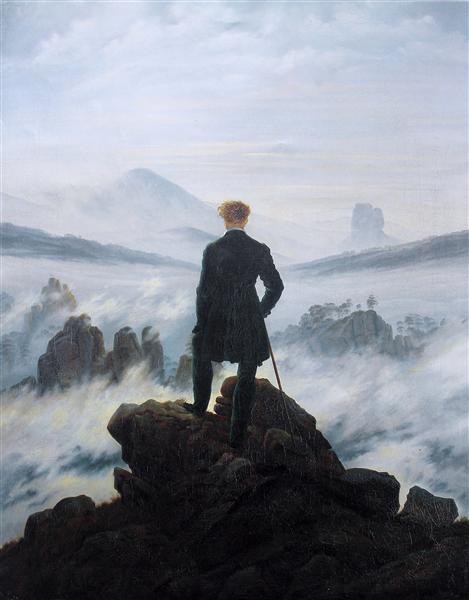
the-wanderer-above-the-sea-of-fog.jpg!Large

    “The Wanderer above the Sea of Fog (1818)

         Caspar David Friedrich

                  _____________

if Beethoven built the Church, along 
with Goethe maybe, of Romanticism, 
and be assured Romanticism is an 
ideology, a moral outlook, a 
motivational perspective, much like 
the economy is nowadays, 
supplanting any more humanistic 
imperatives, Brahms put up one of its 
Cathedrals, just listen, the First Piano
Concerto is a monument, as mighty 
as the Cologne Cathedral musically,
right next to Bonn, incidentally,  
Brahms‘ birthplace

with the disintegration of the 
supremacy of the Catholic deity 
at the onset of the Protestant 
Reformation, Luther, Calvin
Henry Vlll and all that, bolstered
by new discoveries in scientific
speculation, that the earth wasn’t 
flat, for instance, that it revolved 
around the sun rather than the 
other way around, contradictory, 
though convincing, voices began 
to abound, excite question  

in the 18th Century, the Age of 
Reason, the Christian Deity fell,
never effectively to be put back 
together again, see for Its final
sundering, Nietzsche

in France, after the Revolution
the Church was officially removed 
from political consideration, 
countermanding its centuries of 
morally heinous depredations, 
the United States had already at 
its own Revolution separated it 
from State  

Romanticism was an answer to 
a world wherein there might not 
be a God, a world with, however,  
a spiritual dimension, to respond 
to the clockwork universe 
envisioned by the earlier epoch,
the Enlightenmenta world where 
everything could be categorized,
analyzed, predicted

Romanticism called for the 
inclusion of inspiration in the mix,
there are more things in heaven 
and earth, Horatio, than are 
dreamt of in your philosophy, 
as Shakespeare would, for 
instance, have it – “Hamlet”,
1.5.167-8 
 
poets became prophets thereby, 
if they could manage it, very 
oracles, the world was blessed 
with, at that very moment, 
Beethoven, far outstripping the 
likes of, later, for example, Billy
Graham, or other such, however
galvanizing, proselytizers, 
whose messages would’ve been 
too, to my mind,  literal

for music cannot lie, obfuscate, 
prevaricate, music cannot be 
fake  

and then there was Schubert
and Chopin, TolstoyDickens
Elizabeth Barrett Browning
Roberther husband, 
TchaikovskyCaspar David
Friedrich, the Johann Strausses,  
ByronShelley, Keats, whose 
artworks, all, are as profoundly 
in our blood, our cultural system,
as, if not more so than, our 
present information about the 
details of our Christian myths, 
despite superfluity of them 
even, throughout the long 
indeed Middle Ages, and right 
up to, and including, the still 
fervent then Renaissancefor 
better or for worse still, for us

what Romanticism did, and 
specifically through the work 
of these seminal artists, was 
give each of us a chance, 
show us how to come 
through trial and tribulation,
what a faith does, any faith

it said, here, this is my dilemma, 
and this is how I deal with it

for me, Beethoven’s 32nd
Piano Sonata is, soundly, the 
epitome of that, but listen to 
Brahms put a stamp on it
with undaunted authority

we might be ultimately of no 
consequence in an indifferent 
universe, they say, but, hey, 
this is what we can do, and 
do gloriously, while we are 
at it

Woody Allen picks up the 
purpose in our own recent 
20th Century, following in 
the earnest footsteps of his 
Existential mentor, the much 
too dour, think, Ingmar 
Bergman  

but that’s another story
entirely 


meanwhile, listen

also watch, the conductor here
complete delight, is right out 
of Alice in Wonderland“, 
promise you’ll love it


R ! chard 

“Death and the Maiden” – Franz Schubert‏

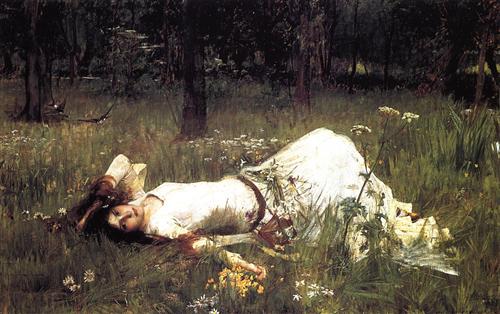
 "Ophelia" -  John William Waterhouse

Ophelia (1889)

John William Waterhouse

___________

though death is not an especially
appealing topic for many, it was
nevertheless of fundamental
consideration during the
Romantic Period

Goethe, the German poet, had
already created a sensation
with his The Sorrows of Young
Werther
, a young man,
disappointed in love, takes his
own life, a potent seed for the
new era, secularism was
overtaking theocracy, the
autocracy of the Christian
Church was giving way to the
prevalence of human rights,
a private opinion, well disputed,
was holding sway against the
rigidities of religious orthodoxies,
science and reason had been
chipping away at the very idea
of God

but with human rights there was
the question of personal
responsibility, if not an imposed
authority, then each man, woman
was in charge of his, her own

the fundamental question,
therefore, was Shakespeare’s
To be or not to be, or, for that
matter, Burt Bacharach’s and
Hal David’s What’s it all about

this is not me, this is Albert Camus
talking, who formalized the situation
in the 1940s

“There is but one truly serious
philosophical problem, and that
is suicide. Judging whether life
is or is not worth living amounts
to answering the fundamental
question of philosophy. All the
rest — whether or not the world
has three dimensions, whether
the mind has nine or twelve
categories — comes afterwards.”

after Werther, Madame Bovary followed,
Anna Karenina, suicide had become an
option, the penalty was no longer
opprobrium, castigation, as it had been
under unforgiving religious constraints

death itself, fatefully rather than
personally determined, was, of course,
no less considered when the era of
heartfelt declarations dominated,
Mendelssohn had written his
Quartet no 6 in F minor, opus 80
for his deceased sister, Beethoven
and Chopin, each his Funeral March,
either, incidentally, still iconic, and
perhaps the most poignant work
of all in this manner, Schubert’s
Death and the Maiden, a precursor
of his own much too premature
demise

this is music as if your life depended
on it

watch, listen

Richard

psst:

the Alban Berg Quartet, a group who
set the standard for several significant
string quartets in the ’80s, do no less
with this one

you’re not likely to see a better
performance of it ever, nor, for that
matter, of anything, pace even Glenn
Gould, a statement I think nearly
against my religion

you be the judge

“Winter Mood” – Leonid Afremov


                                                                                                                                                                                                                                      “Winter Mood
                                                                                                                                                                                                                             
Leonid Afremov 
 
     _____________
 

the thick application of paint in this painting, impasto,
and the disorder of acid colours in the foreground leaves, 
bring to mind Cézanne for me, 
and by inference, I guess, the more appealing, I think, Van Gogh
  
but the Belarusian Afremov, you might find interesting to know,
is from Vitebsk, the birthplace of Chagall,
studied at the school Chagall founded there,
as did incidentally in their times Malevich and Kandinsky also  
  
but the poetry of solitude by which this work touches me so
I find most reminiscent of Friedrich Caspar David‘s “The Wanderer“,
no less iconic a Romantic figure in art than Byron, Shelley, Keats became,
not to mention in Germany Goethe‘s tragic “Werther“, or in France, Victor Hugo 
  
in Spain the much earlier Don Quixote, inspired much later his compatriot Picasso,
whose own lonely horseman is to my mind recalled here, 
and in film more recent lonesome cowboys ride instead of on an open range
an empty street through a park in Paris maybe, Dresden, or Toronto
  
as on life’s journey they find, and we, each our road to follow 
  
                                                                                                                                                                                                                                      thought I’d pass it along  
 
Richard


yesterday – December 28,2006

           Girl Reading a Letter at an Open Window, 1657

                                Johannes Vermeer

                                    (1632-1675)

             ______________________________________

these earlier “back tracks“, of which the following is one example, are pieces I consider still to be worth your while
please enjoy 
             
                       _______________________
December 28, 2006
                                                                                                                                                                  yesterday for the first time it snowed, as I left the apartment a light but steady moisture began to fall that I suspected might be more than rain, sure enough by the time I´d walked the several minutes to the number 8 which would take me to the Old Masters Picture Gallery, the Gemäldegalerie Alte Meister, in the Zwinger, snowflakes swirled about us like whirling dervishes, light in the flustered air and as merry and playful as the season 
I hopped the Strassenbahn, the tram, which sleekly sailed us along to, then a short length of, the river, which was shrouded there by thickets of trees, but as we turned onto the bridge, the Augustusbrücke, the stately steeples and spires of the Altstadt appeared magically transformed into the enchanted setting of a fairy tale, sprinkled with the dancing fairy dust of the very Brothers Grimm
I got off beside the Catholic Cathedral, St Trinitatis, built in 1738 to 1755, heavy with age, light with spirit, its saints and significant clergy standing watch along the balustrade that lined and determined its roof, surely the bells were ringing but I can´t say for certain, the music was all in my eyes
across the cobblestone square before the Semperoper – the Opera House that Gottfried Semper built between 1838 and 1841, rebuilt from 1871 to 1878 by his son after it burned down in ´69 – people were scurrying about, taking pictures, catching their own trains, while flanking the building´s entrance Goethe and Schiller stood watch, impervious and staunch, beneath the steady and playful flakes, they bore the white frost upon their shoulders and pates with patience and resignation
further along the walls but protected by the shelter of each their private stone niche, Sophocles and Shakespeare to one side, Euripides and Molière on the other, sat soberly watching, unruffled, the snow fall
next door the Zwinger warmly awaited, I checked my coat and scarves with the hat check girl I´ve befriended there, she eagerly announced to the others that I was her friend, I´m sure I smiled and blushed, then made my way to the section I was exploring that day
of the many paintings in a room I always choose the one that I would like to take away more than any of the others, that way I need to examine them all, sometimes even closely
yesterday I quickly passed on a Cornelis Corneliszoon van Haarlem, “Venus, Bacchus and Ceres”, all heavy-haunched and cornucopian, a bird concert complete with sheet music in the trees by a Melchior de Hondecoeter no less, I spent some time with Mathias Stom´s “Old lady with a Candle”, which seemed to owe a lot to Rembrandt or he to him, with Jakob Isaacksz Ruisdael´s “The Hunt”, a dark but stirring landscape with a huge tree dominating the centre and reflected subtly in a river that rippled at its root, a deer was trying to flee across the foreground hunters approaching
a couple of Vermeers were of consequence, one, “The Procuress”, a madam in other words, accepting guilders from a group of men, one of them being so bold as to fondle her breast, left me surprised at so untypical a work of his, but another of a girl reading a letter at a window, replete with his tapestries and textures and a more modest and composed young woman intent on the message that she held, was nearly my first choice, her soft reflection in the open latticed windowpane was genius
 
but a Salomon de Bray, a name unknown to me, had painted in the mid sixteen-hundreds a young man with a crown, but of black roses, the youth could not have been very old, an open mouth spoke of being still eager and curious, age shuts men up and makes them open up only to declare, propound, pontificate
he´d turned to one side so that his neck was lithe and swift, probably alert to a sudden sound, a staff he held in strong but still supple hands suggested he was a wanderer or a shepherd
a white undershirt was mostly buttoned up but a string had not been tied at its neck, its either ends hung loose above another darker red shirt, equally not quite fully buttoned, there was no suggestion of a breast but only the soft spread of the clavicles
I would´ve taken him home
the crown of roses of course sported thorns in fresh, clean, but unguarded hair, the reference was unmistakable
                                                                                                                                                                    from a window I watched the thick snow still fall, the ground was covered, but left were the precise lines of the pristine architecture under the icing that outlined its edges
the sages and the deities at the Zwingers own many parapets looked timelessly, unswervingly, on
                 __________________________________________                                                                                 
though the Old Masters Picture Gallery, die Gemäldegalerie Alte Meister, will not allow transfer of their artworks to personal blogs, their entire collection is available through their own website, which I’ve linked you to here, click “Online-Gallery” at the home page, there under Gemäldegalerie Alte Meister click “motivliste anzeigen“, “show collection“, make your way through the 64 “Seiten, “pages“, of masterworks
thoroughly enjoy
                                                                                                                                                                  yours in timeless art                                                                                                                                                                   richibi
                                                                                                                   __________________________________