Richibi’s Weblog

Just another WordPress.com weblog

Tag: Gene Kelly

Aristotle on poetry

aristotle-jpglarge

      Aristotle” (1653)

        Luca Giordano

          ___________

so what’s a poem

in an attempt to get a clearer picture 
of what a poem should be, rather 
than trust only my own, however 
informed perhaps, opinion – though 
it must be added that we all bring 
something to that word’s definition, 
mine no less worthy than yours, 
yours no less worthy than mine – 
thought I’d go back to authoritative 
sources to see what they might 
have said

and it doesn’t get any earlier and 
authoritative than Aristotlewriting 
in 350 B.C.E., at the height of 
Ancient Greek preeminence, 
dissecting the term in his 
penetrating and perspicacious, 
ahem, Poetics” 

I propose to treat of Poetry in itself and of its various kinds,
noting the essential quality of each, to inquire into the
structure of the plot as requisite to a good poem; into the
number and nature of the parts of which a poem is
composed; and similarly into whatever else falls within
the same inquiry.“, he says in Part 1 of his 
magisterial treatise

and proceeds to declare the parameters 
of “Poetry” for the ages  

Poetry in general seems to have sprung from two causes“, 
he proceeds, imitation and rhythm 

by imitation I think it best to think of 
representation, which is another way, 
anyway, of saying imitation, but 
much more evocative in this instance,
more attuned to our sense of his word 

a poem is a representation then, a 
reproduction of something other than 
itself 

while its rhythm is what George
Gershwin‘s got, and by extension, as  
you can see from this videoGene Kelly

and yes, that means that “Epic poetry and Tragedy, Comedy also
and Dithyrambic poetry, and the music of the flute and of the lyre in
most of their forms, are all in their general conception modes of
imitation.” 

so, according to Aristotle, is dance 

all, therefore, poems

an interesting elaboration about “Tragedy” 
states that it should have the three unities 
that I grew up with during my French 
Canadian upbringing, the unity of time, of
space, and of action the famous French 
Classical dramatists, Racine and Corneille,
applied under the aegis of Louis XlV

not to mention Tragedy’s use of iambic 
pentameter, Shakespeare’s ubiquitous 
beat, a beat that persevered into the very 
Nineteenth Century, in France with 
Rostand‘s Cyrano de Bergerac“, for 
instance, and into the Twentieth Century 
with Eliot‘s Murder in the Cathedral“, 
about the assassination of Archbishop
Thomas Becket at Canterbury in 1170 
under Henry the Second‘s own aegis,
all written as poetry 

the most famous play to follow the 
three unities in the modern era is 
Who’s Afraid of Virginia Woolf?“,
the play which I think defines the 
Twentieth Century, which takes 
place overnight somewhere in 
New England college town, mid-
century, at George and Martha’s 

though followed closely by O’Neill‘s 
Long Day’s Journey int Night“, 
which transpires from morning, one 
day in August, 1912, till midnight, at 
the home ofunity of space, note, 
the dysfunctional Tyrones

so it appears not much has changed
about poetry, Aristotle got a lot of 
mileage out of his early definition, 
nearly 2500 years 

makes you wonder  why so much 
attention was paid instead to 
Platohis contemporary, the 
mystic, who would’ve banned
poetry, he thought it was 
subversive
 
Richard

psst: for a modern day application
          of the three unities, watch 
          In Treatment“, a television
          series, which takes place 
          in a psychotherapist’s office,
          each episode a session,  
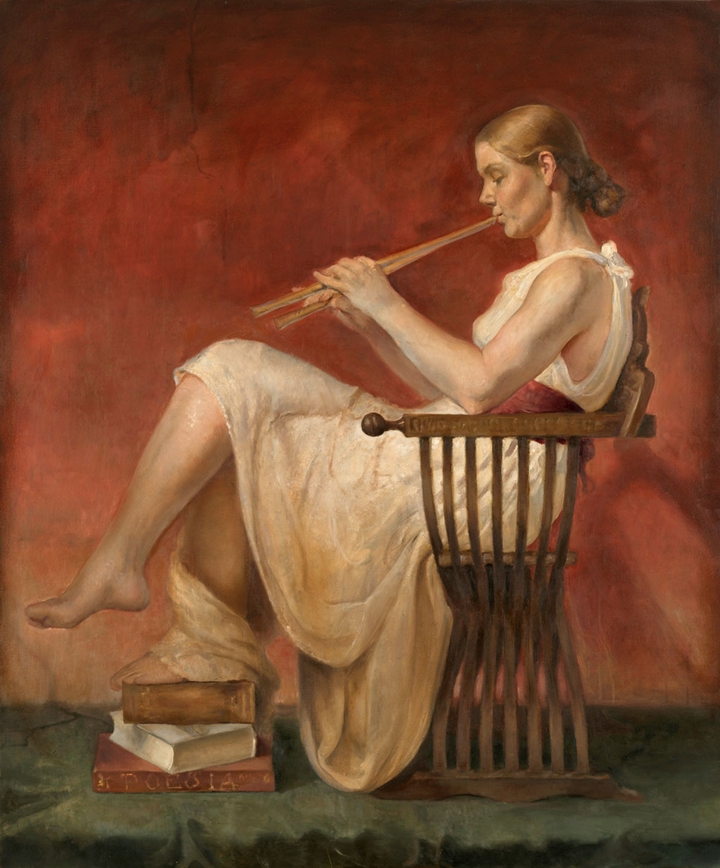
   

Beethoven – piano sonata no 7, in D major, opus 10, no 3‏

Euterpe - Apollo and the Muses - Helene Knoop 1979 - Norwegian Figurative painter - Tutt'Art@

EuterpeApollo and the Muses (2008 – 9)

Helene Knoop

________

if the piano sonata no 4 of Beethoven,
in E flat, opus 7, was academic, an
exercise, a display of technical
dexterity and some, admittedly,
even mighty, compositional verve,
it lacked, in my estimation, a centre,
a convincing motivating factor, a muse,
though ever ardent, ever entertaining,
it is ultimately arid, I think, trite, I’m
not, one is not, keen on returning to it

but in the piano sonata no 7, in D major,
opus 10, no 3
, Beethoven hits, I submit,
his stride, this sonata is enchanting

note the similarities of structure
between the two, the order of the
movements with identical, essentially,
tempo patterns, notably the middle
slow movement, in the first a largo,
con gran expressione,
slow with
great expression, in the latter, a
largo e mesta, slow with sadness,
where Beethoven plumbs, evidently,
the limits of pacing, the time lapse
between two notes, the capacity for
silence of this new instrument, the
pianoforte, of which he’ll look into
also, and even vigorously, its
capacity for volume, the crashing
introduction to his celebrated 8th,
for instance, to establish the
instrument’s new perimeters

you’ll note you can listen to the later
largo, the opus 10, no 3, forever, you
can get lost in its aural world, I can’t
think of anywhere else right now a
more profound largo

the other movements are dazzling
in their thrilling prestidigitation, all
organically sound, and, crucially,
motivationally centred, I think, this
is indeed music, magisterial music,
Beethoven’s not just kidding
anymore, he’s hitched onto his
proper inspirational deity, his own
private Euterpe, music’s muse, and
we’re in for something, from here
on, of a ride

note the cool riff closing off the last
movement, Beethoven in the guise
of Gene Kelly stepping in for a
breezy good-bye, prefiguring, of
course, XXth-Century music, and
the serendipitous extrapolations
of jazz

Richard

psst: incidentally, the headings, largo,
con gran expressione, largo e
mesta,
are entirely Romantic
musical notions, notations,
Classical composers would’ve
been too sedate, formal, courtly,
for such flagrant sentiment

Beethoven piano sonata no 7, revisited‏

let me say a few words more about Beethoven’s
piano sonata no 7, opus 10, no 3, which I left in a
blur of other sonatas in my last set of opinions, it
is a wonder, and entirely worth a second visit, it
can neatly expose the new Romantic expression
midst the still Classical impositions
 
simply stated the elements of beat, tonality, and
repetition lay out the grid of Classical musical
composition, the blue print, like a house would
have a kitchen, bedroom, bathroom, and
variations on a communal social space 
 
Beethoven adheres to all of these elements but
does so eccentrically, beat itself is moderately
altered here and there, relaxed somewhat, mostly
at the end of musical phrases, an outcome
incidentally of the piano’s hold pedal, which
allows the reverberation of any note played
beyond its being played 
 
but you can nearly identify Beethoven by the
fact that he is always off the stated beat, which
is to say that his accent is always on the wrong
syllable, off what the time signature requires, the 
template along with key notations indicated
at
the front of each set of bars of a musical text
 
this is already a significant peculiarity, and
consistent, endemic, he is fundamentally out of
synch, innately rebellious, which makes for nervy,
edgy music, bristling and electric, electrifying  
 
none of it you can sing, though the tonalities are
still entirely melodic
 
 
as far as repetition is concerned, Beethoven is still
repeating religiously, albeit with extended, and
ever so complex, elaborations, leaving you awed
ever, might as well say soulfully levitated, and 
mesmerized
  
 
the first movement, the presto, for “very fast”, takes
place on hot coals, brisk and electric
 
the second movement, the enchanted largo e mesto,
“very slowly with sadness”, is not only in marked
contrast with the first, a required condition for any
new movement, though here rendered flagrantly
extreme, it also tests the limits of effective pace,
again an innovation of the new piano, this time
coming out, despite the absolutely funereal
constraints undertaken here, instead of stultifying  
unquestionably and incontrovertibly transcendental
 
in the last movement, the menuetto (allegro), a
(jaunty) minuet, his parentheses, after an equally
exuberant third, the rondo (allegro), a (jaunty), his
parentheses again, rondo, a musical form akin to
what a sonnet would be to a poem, you can already
hear intimations even of jazz in the free and easy
tickle of the ivories, casual, debonair and apparently
improvisational, like Gene Kelly himself in dance,
toes twinkling with fresh and candid effervescence
and exhilaration  
 
now how unClassical is that    
 
 
Richard