Richibi’s Weblog

Just another WordPress.com weblog

Tag: Friedrich Nietzsche

String Quartet no 15 in A minor, opus 132 – Beethoven
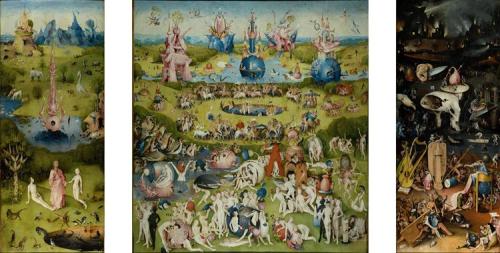
the-garden-of-earthly-delights-1515-7.jpg!Large

   “The Garden of Earthly Delights (1510 – 1515) 

          Hieronymus Bosch

               ____________

if I’ve been spending a lot of time on
Beethoven, it’s that, apart from 
besides him Napoleon, no one else 
dominates in the public imagination 
the early 19th Century, there is no 
one else of such comparable 
importance 

let me also point out that when 
Nietzsche identified his model for  
the Übermensch, Superman, it was  
not the French General, the French 
Emperor, however formidable, 
however illustrious, he named, but 
Beethoven 

Nietzsche had already understood 
that in the future, a future where the
idea of God had been put into question,
an issue which had begun irreversibly 
with the splintering of the Catholic 
supremacy, when the several 
Protestantisms, Lutheran, Calvinist
Anglican then, presented differing 
opinions of each their vehemently
defended deity, the eventual 
resolution would be inescapably up 
for metaphysical grabs, which set 
philosophers, scientists, poets in 
search of answers, which by 
definition must be as varied as 
there are voices

the outcome was the eventual 
declaration of human rights before
the court of international opinion 
as the ruling moral consideration
above the demands of any one 
faith

Nietzsche‘s pronouncement was that
a powerful opinion could therefore 
sway very populations towards its 
vision, however ultimately 
sometimes dire, Nietzsche was 
therefore blamed for predicting, 
for instance, Hitler, as though 
Nietzsche were himself responsible, 
rather than prescient 

one of his books, indeed, entitled 
Beyond Good and Evil“, illustrates
the breakdown of the traditional, 
which is to say Christian, moral
order, powerful people will take us 
where they want to, for better or 
for worse, he prophesied

therefore, note, the very present

but there is also Beethoven, the 
incandescent prophet, Charles 
Darwin, the biologist, who 
changed the way we understand 
ourselves, Sigmund Freud, who 
pushed that understanding even 
further, Albert Einstein, who gave 
us an alternate picture of the 
universe, John Lennon, who 
called upon us all to Imagine“, 
Princess Diana, who demonstrated 
what it was to be good in a world 
that was losing its compass, each 
shaping by force of personality 
our present age, their future
 
all was not, by their examples, 
lost, in other words, some of our 
leaders would be benevolent, 
verily even inspiring, despite the 
prevalence in their midst, the 
existential threat of, nefarious, 
indeed ruthless, and, too often, 
appalling, despots, a category 
too long to even begin to list

here’s, however, Beethoven doing 
again his stuff to inform the tenor
of his time, his 15th String Quartet
another forceful and foundational 
step towards the world that lay,
before him, ahead, our world, for 
better or for worse


R ! chard
to Socrates – on monotheism‏

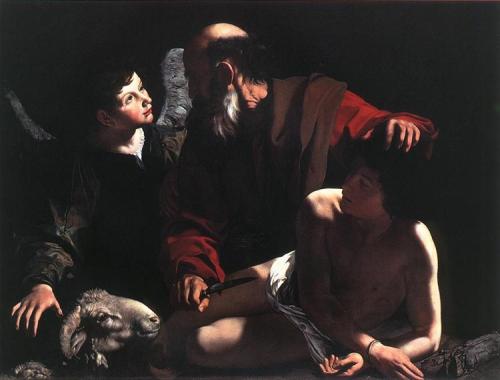
sacrifice-of-isaac(1).jpg!Large

      “The Sacrifice of Isaac (1598)

                        Caravaggio

                               ________

by very definition, the inevitable
result of monotheism, Socrates,  
is war, if there is one authority it  
will eventually be opposed by a 
contrary, however picayune, 
however trivial, opinion, see the 
Protestant Reformationsee Islam, 
for instance, now
 
after which there is disintegration
 
before Christianity, there were gods, 
a pantheon of them symbolically
alive among the rivers, the trees, 
the mountains, read Ovid for an
exhilarating description, wars were 
waged for territory, not conscience  
 
Judaism, the religion of the Jews,
evolved for their own existence a
deity, Yahweh, who was their one 
god, disdainful of foreign others,
an uncharacteristic attitude among 
other religions then, becoming one 
of the very first monotheistic, and
consequently existentially 
compromised faiths, if not the 
first
 
the intent was to rally ideological 
support among its adherents so 
that they could protect the lands 
of Israel and Judahtheir ancestral 
homesas they would have it, a 
sanctification of the territorial 
principle
 
their Bible, the Torah, a vengeful 
work, and the basis for the 
Christian Old Testament, 
demanded of its followers 
unblinking and cruel allegiance,
the sacrifice of Isaacfor instance,
a father required to sacrifice his 
own son, however might it ‘ve
been at the last minute averted by 
the intercession of an angel sent 
by that very Lord
 
Christ came along to turn the other
cheek
 
which didn’t last long 
 
indeed Montesquieu, an early 
philosopher of the French
Enlightenment, tells of the 
King’s librarian of Chinese 
texts, who had been converted 
to Catholicism in China, but 
who was nonplussed upon his 
arrival in Christian France to find 
that the French did not do onto 
others as they would have them 
do unto themselves, nor did they, 
more catastrophically, turn the  
other cheek
 
for that matter see what Christian 
Europe did to the Americans
 
Christ’s own followers, once they’d 
achieved political prominence, after, 
admittedly, 300 years of persecution 
by the prevailing Roman authorities, 
set their own deity, God, on high, 
indeed beyond the rivers, the 
mountains, the trees into the very 
ineffable, the inscrutable abstract, 
and squelched any opposition for  
the next thousand and some years,
the philosophical underpinnings of 
which was the work of your 
contemporary, Plato, Socrates, his 
ideal of the Ideal
 
Augustine signed those recalibrated 
papers with his City of God“, it took 
the Renaissance to make a dent in its 
armour, and another several centuries 
to declare the Christian God dead, 
Time magazine in the ’60s, on the 
heels of Nietzsche‘s nihilistic  
pronouncement some 70 years earlier, 
that God had exited history
 
what we are left with, Socrates, is every 
wo/man for hirself, therefore the Age of 
Human Rights, for better or for worse
otherwise many of us would’ve been 
guillotined, burnt at the stake, stoned 
to death, by now
 
what do you think
 
I’ll bet I can tell, you think that every 
wo/man owes allegiance to what s/he 
believes in, even to inexorable death, 
however impractical, unfortunate, or 
fateful, if your exemplary life has  
anything to say about it 
 
 
cheers
 
Richard

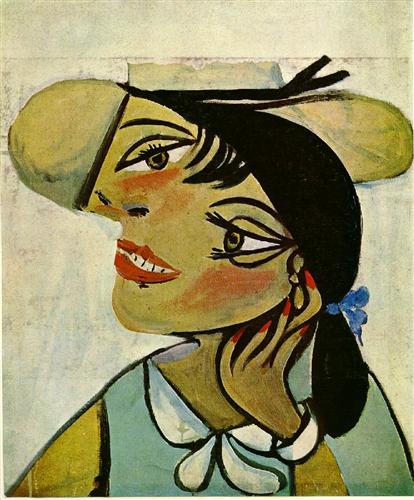
Pablo Picasso/Gertrude Stein

Pablo Picasso - "Untitled" (1923)

Untitled (1923)

Pablo Picasso

________

Gertrude Stein was a friend of Pablo Picasso,
you can see it in her prose, a disordering of
traditional practices, perspectives and
proportions

in loving repeating she writes

As I was saying loving repeating being is in a way earthly being. In some it is repeating that gives to them always a solid feeling of being. In some children there is more feeling and in repeating eating and playing, in some in story-telling and their feeling. More and more in living as growing young men and women and grown men and women and men and women in their middle living, more and more there comes to be in them differences in loving repeating in different kinds of men and women, there comes to be in some more and in some less loving repeating. Loving repeating in some is a going on always in them of earthly being, in some it is the way to completed understanding. Loving repeating then in some is their natural way of complete being. This is now some description of one.

Gertrude Stein

_________________

in my poetry course the Modernists keep on
coming, quite a few I’ve found impenetrable
and obtuse, I can see their points, but find
them pedantic and trivial

similar sentiments greeted the Impressionists
when they came out, so I’m watching myself

it’s easy to digest Picasso‘s painting now,
but even when I was a boy he was
controversial, now everyone admires him

Gertrude Stein not so much, writing is not
painting

they are both, I believe, returning to the
language of innocence, putting together
their world as children do, getting their
information in overlapping concepts,
trying to make their way through the
muddle

a five-year-old would talk like that, a
five-year-old would paint like that,
both are sorting out their new world,
the world that had been so profoundly
disturbed, disjointed

they were returning to the disarray,
and consequent irregular grammar,
of children, making their own kind
of common sense, trying to get their
bearings, after all, even God had
died, see Nietzsche on that

and, for better or worse, finally,
they’ll leave you behind, the children,
whose world, then, is it worth attending

Richard

psst: as a boy I asked my dad, while
interminably, I thought, fishing,
how long it would take the
minnow to grow into the
required fish, how’s that for
not illogical observation

“Man at the Window” – Gustave Caillebotte‏

             Man at the Window - Gustave Caillebotte

                                  “Man at the Window”  (1875)
 
                                            Gustave Caillebotte  

                                                                  __________ 
 
 
it’s hard not to think of Caspar David Friedrich (1818) or
Norman Rockwell (1962) upon viewing now this painting,
which came up today in a lecture I was viewing on the
Impressionist Gustave Caillebotte1848-1894, halfway
between both 
 
they are, all three of course, all about contemplation,
but all explore a different aspect of that phenomenon
 
let me suggest that Friedrich‘s concerns are patently
metaphysical, he casts his eyes, which we do not see,
incidentally, upon a horizon that looks like destiny,
ours by extension, murky yet imbued with possibility,
even the improbable
  
or maybe this is just what I see
 
 
Rockwell‘s perspective is instead aesthetic, a view
of the world as expressed by others, the capacity to
understand and relate to other voices, opinions, within 
our social construct, allegorized here by the exhibition
room
 
it is a closed speculation, circumscribed by the limited
dimensions, physical or conceptual, of any other
counterpart, contained therefore metaphorically, and
concisely, within a frame  
 
that frame represents the physical limits imposed on
a painter, but also the conceptual limitations of the
viewer him- or herself, it works both ways, for some
this will be a man merely looking out a window, for
others an opening on an epoch
  
 
Caillebotte1848-1894, looks inward to his isolation,
alienation, from his luxurious interior, black as a cave,
upon a confined avenue where nothing but an impossible
communication, with the lone woman crossing the
street, surely a furtive eye, gives way necessarily to
resignation, and a kind of existential yield to ineluctable
fate, a sensibility beginning to burgeon at the time, see
Nietzsche, 1844-1900, and nihilism  
 
then again this is only my impression, this is what I got
 
and a picture is worth, we say, a thousand words
 
 
Richard