Richibi’s Weblog

Just another WordPress.com weblog

Tag: Freud

November / Month of the Sonata – 12

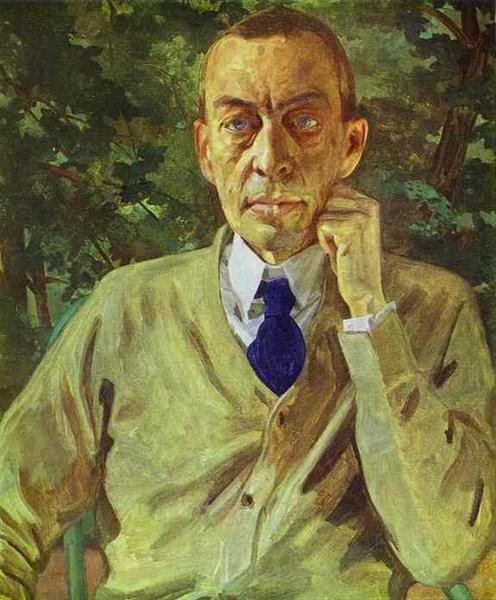
Portrait of the composer Sergei Rachmaninov, 1925 - Konstantin Somov

      Portrait of the Composer Sergei Rachmaninov (1925) 


              Konstantin Somov


                     __________


Rachmaninov, late Romantic, early

Impressionist, yanked, despite his 

modern bent, Romanticism, solidly,

into the Twentieth Century, we 

heard him in movies, and 

consequently on TV, back then, on 

long-play albums, 78s at the time, 

that were flooding the market, first 

movement on the one side, the next 

two on the other, that’s how we used 

to listen


later, we’d hear Sergeant Pepper’s 

Lonely Heart’s Club Band doing the 

same, in the late ’60s, before discs


Rachmaninov doesn’t sound like 

Chopin, Beethoven, Schubert, but

you can hear their roots, their blood 

running through his compositions


but here, in his Piano Sonata no. 2,

Opus 36, he elaborates, a sure sign

of Impressionism, intellectual rather

than emotional appeal, something 

had become tiresome after half a

century of Romantic dramatization,

how many Anna Karenina‘s can you 

take


the culture was returning to objective,

rather than emotional, Charles Dickens,

Victor Hugo, and the like, bleeding-heart,

considerations, and seeking out more 

rational answers to our psychological

stresses, consequently Freud, music

had to keep up


later, I’ll tell you a story about how 

music changes the world


meanwhile, here’s Rachmaninov’s

Piano Sonata no 2


enjoy


R ! chard

“Années de pèlerinage”, 2nd Year – Liszt

petrarch.jpg!Large

     “Petrarch (c.1450) 


           Andrea del Castagno


                     ___________


                                    for John, who would’ve 

                                                       been 60 today


though the suite might’ve started with

Bach’s string of dance pieces in the 

early 18th Centuryit becomes evident 

during the 19th Century, after a lapse 

of nearly 100 years, while it fell into 

disfavour, that its resurrection as a 

valid musical form might’ve kept the 

original structure, which is to say its 

several separate parts to make up a 

whole, its movements, but that it 

now was serving different purpose 


where music had, through to the early

Romantic Period, followed dance 

rhythms, or variations of tempo,

adagio, andante, allegro, and the like,

it now presented itself as a background

for settings, be it ballets, as in

Tchaikovsky’s, plays, as in Edvard

Grieg’s celebrated , Peer Gynt Suite“,

after Ibsen‘s eponymous play,

specific locations, as in Debussy’s

Children’s Corner“, or more  

expansively, both geographically

and in its compositional length,

these very “Années de pèlerinage” 

of Liszt


this is in keeping with the exploration

of consciousness of that era, which 

would lead to not only Impressionism, 

but to Freud, and the others, and the 

development of psychoanalysis


you’ll note that music seems much 

more improvisational in Liszt than in

Chopin, or Beethoven, prefiguring

already even jazz, more evocative,

less emotional, more personal, not

generalized, idiosyncratic, a direct

development of the newly acquired

concept of democracy, one man, at

the time, one vote, one, indeed, 

voice, however individual, however 

even controversial 


listen, for instance, to Liszt’s “Années

de pèlerinage”, 2nd Year, Italy 


   1. Sposalizio

   2. Il penseroso

   3. Canzonetta del Salvator Rosa 

   4. Sonetto 47 del Petrarca 

   5. Sonetto 104 del Petrarca 

   6. Sonetto 123 del Petrarca 

   7. Après une lecture de Dante: Fantasia Quasi Sonata 


today you can listen to suites 

from famous films, for instance 

Blade Runner“, the beat, in 

other words, goes on


but note the renovations, find them, 

dare you, you’ll be surprised at 

your unsuspected perspicacity


listen


R ! chard  

Debussy Preludes, Books 1 & 2‏

if Debussy composed not only Études, in the manner 
of Chopin but Préludes” as well, Book 1 and Book 2,
with only twelve preludes apiece however, but for an
equal number of 24, to cover likewise all the keys, it
might be that his piano teacher, Mme de Fleurville, a
student of Chopin, she claimed, would have had him
duly practice her master’s musical methods, manner 
and propositions, accounting for the similar textures,
colours and even templates the diligent acolyte uses,
devout responses in effect to his mentor’s mentor
 
but time and temperament get in the way of an exact
of course replication 
 
Chopin follows the narrative line of melody, whereas
Debussy evokes a more nebulous mood, the line of
Romantic heroism has given way to the more abstract
investigation of the amorphous psyche or, if you like,
the suprarational soul, after Freud’s most recent
uncovering and elaboration of consciousness  
 
listening to Debussy therefore is more like looking at
a painting than reading a book, you are moved by the
evocative aspects of the composition, colour, texture,
tone, rather than by the chronological tale it no longer
tells  
 
unbending truth has given way to perspective, stream of
consciousness has superseded the narrator’s traditional
linear omnipresence, for better or for worse 
 
 
Richard
 
psst: Europe, as I was informed by a friend of mine, is
         celebrating Debussy‘s 150th birthday this year,
         he was born August 22, 1862
 
         may he live forever 
 
 
         thanks, Lajla


Debussy’s “Études”

 Man with a Guitar - Georges Braque
 
                    Man with a Guitar (1914)
 
                               Georges Braque 
 
                                       ______
 
 
while we’re on the subject of études, listening to 
hundred years later, 1830s to 1915, would prove
instructive, I deemed 
 
picture me deeming, August 3, 2012, my brow
just slightly pensively constricting 
 
 
if the basis of music as defined by the Classical
period depended on beat, tonality, and the repetition
of the tune, usually of both musical statements, these
apparently essential components of course would be
the first places to bear the scrutiny of probing musical
minds, seeking to find, seeking to set more expansive,
more profound dimensions to the areas of their quest,
that’s what artists do 
 
and this of course is exactly what happened starting
with Beethoven, by the time of Chopin music had
relaxed its stricter Classical rhythmic precision,
allowing great expansive gestures in the more
malleable tempi, tempos, producing the effect of
more compassion and soulful examination than
the earlier less indulgent, more disciplined code
 
the fact of having musical tapestries, sound patches,
take the place of melody, narrative, in the musical
presentation of Chopin also suggests a more
diversified, dare I say prismatic, telling, than the 
linear account of for instance Mozart‘s solitary
tuneful wanderer
 
it also evokes incidentally the vagaries of the
inconstant heart rather than its unflinching
condemnation, a repudiation of atavistic
Christian ecclesiastical intolerance 
 
 
by the time the old order was about to be extinguished,
in 1915, at the onset of the First World War, Debussy’s
Études, like Chopin 12 of them per set, had seen
social injustice – see Charles Dickens, see Émile Zola,
see Karl Marx – the improbable discoveries of science –
Darwin, Freud, Einstein – the car, the airplane,
photography were changing everything, the old
paradigms no longer applied, were irrelevant, even
harmful, in this new context, the First World War 
would prove all that 
 
in the language of music, tempo, melody, repetition
would be inevitably subverted
 
Debussy produces erratic tempi, foregoes melody for
harmonic exploration, combining incidentally the
musical patches of Chopin with the intellectually
driven investigations of Beethoven for a more
cerebral understanding of music, a music for the
head, with expert displays of pianistic skill, indeed
prestidigitation, for, along with the intellectual
rigour, spectacle  
 
is this then still music 
 
is Post-Impressionist painting still art  
 
what would 1915 have said
 
 
above is Georges Braque‘s nearly contemporary, 1914,  
 
man with a guitar, who’d a thunk it
 
 
Richard