Richibi’s Weblog

Just another WordPress.com weblog

Tag: French Revolution

Piano Concerto no 4, Opus 58 – Beethoven
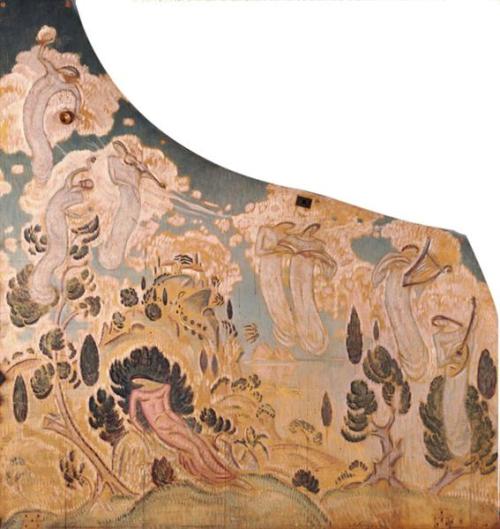
music-painting-and-decoration-of-a-piano-1920.jpg!Large.jpg

     Music (Painting and Decoration of a Piano) (1915-1920) 


          Konstantinos Parthenis


                    __________


like with Shakespeare, some of Beethoven’s

work doesn’t reach the heights I find in their 

utter masterpieces, his Fourth Piano Concerto

is, to my mind, such a piece, though it’s not at

all not impressive


my complaint is that the musical motive, the

original theme, the cluster, merely, of notes

that make up the matter of the ensuing 

harmonic explorations, in all of the three 

movements of the Fourth, is lost in his 

excessive elaborationsone is distracted by 

the soloist’s dazzling showmanship rather 

than by the work’s metaphysical magic, as 

is conversely the case rather in Beethoven’s 

sister concertos, his OneTwo, Three, and 

Five 


most notably, the Fourth‘s slow movement,

the andante con moto, slow, but not unduly,

passes by in an instant, nearly imperceptibly,

but for the conspicuousness of its plodding 

rhythm, you wonder what just happened,

what did I miss


the first movement, the allegro moderato, 

or slightly slower than allegro, begins highly

unconventionally with the soloist at the helm, 

setting up the conversation, as it were, the

subject of the matter


that an individual, a commoner, would’ve  

dared to initiate a dialogue of purported 

significance in a culture where subjects

would have known their place, like later,

for instance, a woman asserting her 

position in a patriarchal society, would’ve 

been shocking, and highly controversial


but Beethoven raps out a rhythm, four

quick notes followed by four quick notes

followed by the same four notes again,

ra ta ta tat, ra ta ta tat, ra ta ta tat, like

someone knocking at a door, however

plaintively, requiring attention, before the

orchestra responds, determinedly and

categorically, though the soloist will ever 

remain the prime, and manifest, mover


this is not a tune, this is a statement


this is also the 18th Century’s introduction 

to the Romantic Period, where individual 

voices were stating their answer to the 

question of the disintegration of the

aristocratic as well as the religious 

ideals which had prevailed throughout 

the earlier Christian centuries, when 

their controlling dogmas, however still 

entrenched, were being questioned, 

and rejected, as evidenced by both the 

constitutional dictates of the American ,

and the French Revolutions, which 

were installing, codifying for their 

progeny, their individual continents,

and for very history, the idea of Human,

as opposed to the traditionally assumed

Divine, Rights


secular voices would consequently

sprout in myriad profusion 

throughout the ensuing 19th Century 

in order to people with personalities, 

as distinct from omnipotent, whether 

secular or ecclesiastical, established 

figures, to shape the ideologies of the 

impending future, for better or for 

worse


but I digress, exponentially


the third movement of the Fourth Piano

Concerto reminds me, in all its urgency,

of the finale of Rossini’s William Tell

Overture, of which I suspect it might  

have been an inspiration, the work

better known to many of my generation

as the theme to The Lone Ranger


Lone Ranger indeed, Beethoven was

already leaving his indelible, not to

mention generative, mark on our

present, 21st Century, culture


enjoy


R ! chard


Minuets in G – Bach / Mozart / Beethoven

not_detected_236478.jpg

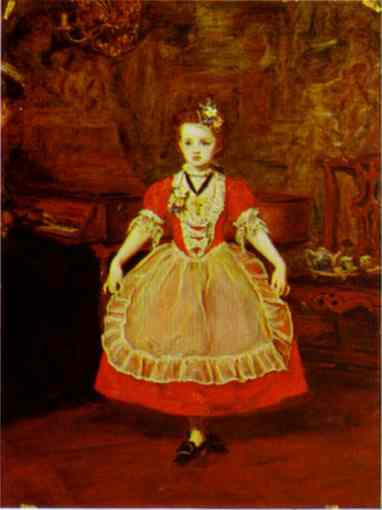
    The Minuet (1866) 

          John Everett Millais

                  _________

having pointed out that the minuet 
and the waltz were historically 
related, let me somewhat 
extrapolate

they are both in 3/4 time, which is 
to say, three quarter-notes to the 
bar, which means that when 
you’re dancing, your beat is one,
two, three, one two three, with 
the accent, usually, on the first 
note

so what happened, how could two
identical frameworks turn out so 
differently 

here’s Bach, 1725, his Minuet in G
the first thing you’ll think is, o, so
that’s what that is, it is an iconic 
number written on our collective
consciousness

the second thing you’ll notice is
that it is choppy, however delightful, 
that it is written for a harpsichord,
and that it’s probably not ready, 
despite it’s 3/4 time, to be a waltz,
too many curtsies

here’s Mozart, 1762, his Minuet in G
though you might not want to admit 
it, I suspect this number is much
more present in your subconscious
than you’d think, see if you don’t 
find yourself later on humming it

but it’s still way too polite to be a
waltz, you can easily imagine the 
partners, hands held high together
around their imaginary maypole,
courting, but there’s a touch more 
fluidity in the progression of the
notes, it is written for a fortepiano,
an instrument that has added the
hold, or the sustain, pedal to the 
harpsichord to increase a note’s
resonance, a loosening of the 
earlier constraints of that 
quintessentially Baroque 
instrument, a cannily apt 
metaphor, take into account, for 
the unfolding cultural r/evolution

here’s Beethoven, 1796, his Minuet 
in Gyou’ve heard this one too

the Revolution has taken place, 
but entrenched in the music of an
earlier era, the beat remains the 
same, this is not a waltz, despite 
it’s 3/4 progression

you’ll note, however, more spin 
to the cadences, more give, more
elasticity, much of this has to do 
with the development of the 
central instrument, which was 
about to become a pianoforte,
instead of a fortepiano, but 
‘nough said about that, I’ll let 
you feel it

here’s Chopin, 1833, his Grande 
valse brillante, Opus 18, written
for itself, the piano, it is indeed 
a waltz, the difference is in the 
piano’s ever evolving flexibility, 
again a metaphorical expression 
of, or an avatar for, the unleashing 
of personal freedom, an idea spun 
ineradicably from the lessons of
the French, and the, incidentally, 
nearly simultaneous, 1776, 1789, 
American Revolutions

for better or for worse 


R ! chard
String Quartet no 19 in C major, K465 (“Dissonance”) – Mozart

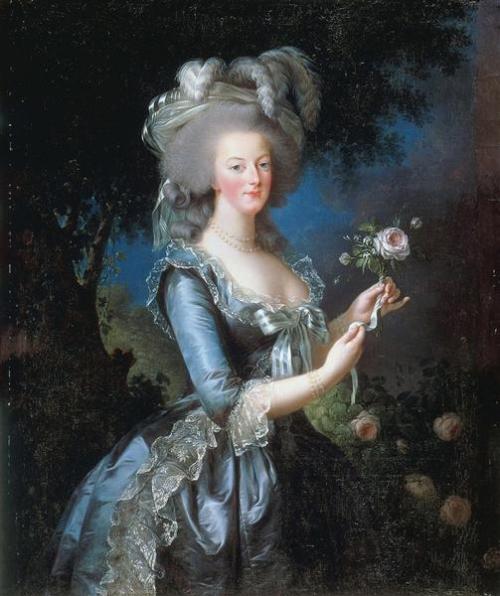
queen-marie-antoinette-of-france-1783.jpg!Large

                    “Queen Marie Antoinette of France (1783)  

                              Louise Elisabeth Vigee Le Brun

                                           ______________

if Mozart’s 19th String Quartetthe last of 
his Haydn Quartets, the six he indeed 
dedicated  to Haydn, sounds less 
deferential than one would have thought 
for the period, it should be remembered 
that the American Revolution had just
taken place, in 1776, the French one was 
about to, in 1789, and even the more 
aristocratic houses in Europe would not
have been unaffected, Mozart was young,
29, and astir with confidence and bravura,
it was 1785

Haydn had had his moment earlier, his
Opus 20, which went on to revolutionize 
music if not countries, but had retreated 
to a less emboldened political stance 
as he grew older, while concentrating 
rather on his more important muse, and 
refining his ear for precise, pure music,
which is to say devoid of any but polite
sentiments, delight and lyrical 
melancholy only

in Mozart’s 19th String Quartet, even the 
minuet is peremptory, not something 
you’d especially want to dance to,
however musically accomplished

he starts the first movement with, of all 
things, an adagio, however briefly, which 
could’ve been disastrous, you need to 
know what you’re doing when you open
with a lament

incidentally, all the instruments in the
opening adagio are playing in different 
keys, resolved when the allegro kicks 
in, this is why it’s called “Dissonance”,
something in and of itself of a 
rebellious act 

the 19th is also twice the length of 
Haydn’s nearest earlier one, his Opus 42,
expansive rather than terse, for whatever
that might mean, the point is to keep us
throughout interested, which he does, 
they do

Mozart is prefiguring hereincidentally,
Beethoven, with his audacity, his 
sense of an ideological mission, and  
he’s mightily impressive

listen


R ! chard

Paganini’s 24 “Caprices”‏

having heard one Caprice of Paganini it’s not
much of a stretch to want to hear them all, and 
to my delight and utter astonishment they are
available presently on the Internet in a
presentation so extraordinary it seems 
accorded by the very gods, the violinist, an
unchastened Prometheus this one, Alexander
Markov, delivers unadulterated fire, he is, it is, 
astounding, nothing short of outright Olympian
 
you’ve already heard him play the 24th, here are
 
 
the Capricesare for Paganini what the
“Études”, opus 10, opus 25were for Chopin,
each was exploring the intricacies of his own
particular instrument, which results to date
remain the standard, the Everest to be
conquered, of either by any aspirant
 
how do you keep your knees from knocking,
first of all, up there, in those headlights, I
would wonder of the performing artist, the
rest being of course, I’m aware, pure but
metaphysical merely physics, moderately
only incomprehensible  
 
 
Alexander Markov is fully at home in these
pieces, making them electric but for a picayune
quibble, being of Russian extraction he is not
the Paganini I would want him to be, sensuous
and seductive instead of the more Nordic
commanding and fiery, the Mediterranean
Paganini was famously, after all, a Lothario,
a Casanova, with an especially lubricious,  
apparently, fiddle
  
 
Paganini, incidentally, wrote the Caprices 
between 1805 and 1809, smack in the middle
of the Romantic Period, you can hear the altered
audience in the distant concert hall, surely not
the aristocrats who would’ve found this music
presumptuous, impudent, in their privileged
salons, but throngs of the newly franchised –
note the French root in the word “franchised”,
probably stemming from the very French
Revolution – who were looking towards their
bold and liberated future
 
 
the music is strictly rhythmic, which is to say,
still Classical, keys don’t change within the
individual pieces, the harmonies are still
sufficiently tonal not to distract, though the
melodies are not simple to follow, the stage
is being set for more abstract stuff, Beethoven,
for instance, writing at the same time, being
much less eccentric, and again maybe less
Mediterranean in his own always nevertheless
beguiling flights of Romanticism  
 
 
Richard
  
psst: the performance takes place at the
          in, I believe, 1989, for your info 
 
          note, incidentally, the white tie and tails,
          an aristocratic, which is to say, atavistic, 
          even then, notion
 
          we will always, all of us, conspire to 
          seem noble


Beethoven’s Symphony no 6, in F major, opus 68, “Pastoral”‏

symphonies are not my preferred musical form, they are
generally too broad, grand, impersonal, they are nevertheless
the other most impactful order of presentation among musical
instruments, along with the concerto
 
a symphony is a concerto without a soloist, or it might be more
appropriate to say that a concerto is a symphony accommodating
a soloist, or soloists, in either case the musical elements remain
the same, you don’t have a symphony without movements   
 
a symphony is also of course another name for that very orchestra,
just to confuse you
 
 
despite my indifference to that particular form of entertainment 
some symphonies are nevertheless still for me impressive, some
even meaningful, poignant, several of Beethoven’s, most of the
works of the transcendental Bruckner, Brahms’ magnificent Fourth,
most others you can keep, as far as I’m concerned, I need a firm
anchoring principle, not the amorphous peregrinations of an
unbridled, often cacophonous crowd 
 
 
those that I love however have touched me deeply, Beethoven’s 
Sixth for instance, wherein through its second movement a loved
one spoke to me unmistakably from heaven, there and then made
me believe in an afterlife and angels, I remember the day clearly
and cherish still that powerful metaphysical moment  
 
 
in the “Pastoral” Beethoven apotheosizes nature, the movements
themselves, of which there are an unconventional five, are named
after rural settings, like paintings
 
     
I imagine Beethoven channeling the idyllic Classical Fragonard, or
prefiguring the bucolic and more Romantic Constable, Beethoven
straddles triumphally both epochs 
 
you will hear the birds sing, the rippling of the brook, it is as fresh
as ever springtime, as profound and expansive as itself time
 
Beethoven here speaks as clearly as actual language, and thereby
suggests that music is indeed itself an expressive tongue, earlier
it had been, though moving and undeniably evocative, essentially
an entertainment, a courtly device, though often enough sublime,
see Haydn, Mozart
 
Beethoven is not courtly, he is bold, assured, and mighty, of a new
breed of colonizers of the new and exhilarating democracy, the
French Revolution had just happened and their aristocracy was
dead and gone, indeed guillotined, a new day had dawned for
the common people, the idea of human rights
 
Beethoven spoke to these as a prophet, Moses at a secular Mount,
declaring the ideals of the Age of Reason, of which we still carry
the torch, to the multitudes and to their ensuing spawn
 
 
Klemperer at first seemed slow to me, nearly tired, but little by
little established a mesmerizing solemnity
 
by the end of the piece I’d again been touched by heaven 
 
 
Richard