Richibi’s Weblog

Just another WordPress.com weblog

Tag: fortepiano

how to listen to music if you don’t know your Beethoven from your Bach, cont.

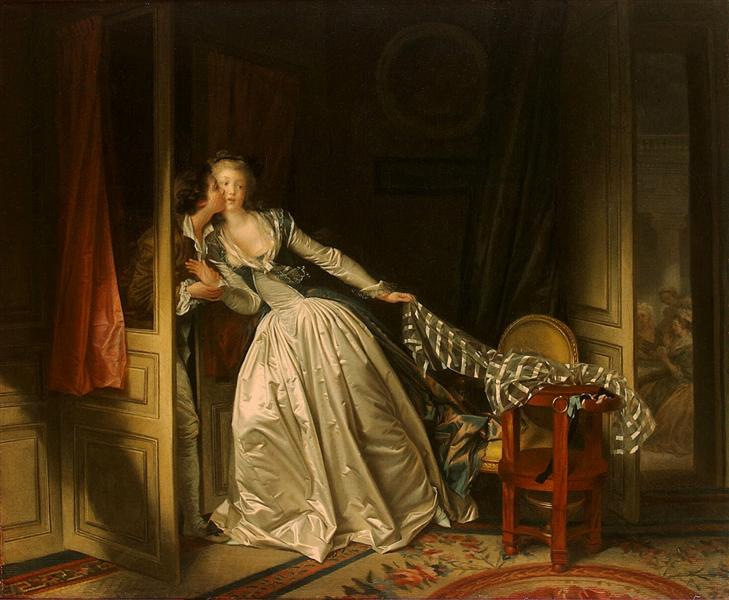
The Stolen Kiss, 1788 - Jean-Honore Fragonard


        The Stolen Kiss (1788)


       Jean-Honoré Fragonard


               _____________


if you listened to the couple of pieces I

recommended in my last commentary,

you would’ve indeed recognized, if

even only subconsciously, that the

first work wasn’t composed by the

composer of the other, that different

spirits infused either


a visual representation of the same

thing might be to juxtapose a

contemporary painting of the one

epoch with a corresponding painting

of the other


over a hundred years had passed

between Mozart and Prokofiev,

Mozart’s Piano Sonata no 18, K576

– his last piano sonata, incidentally,

he died a short two years later –

was written in 1789, the year of the

French Revolution, a still safe

distance from Vienna, where

Mozart could still cater to an,

however endangered, species


Jean-Honoré Fragonard, a contemporary

painter, 1732 – 1806, had been doing the

same thing, The Stolen Kiss, 1788, for

instance, a mere year earlier, see above


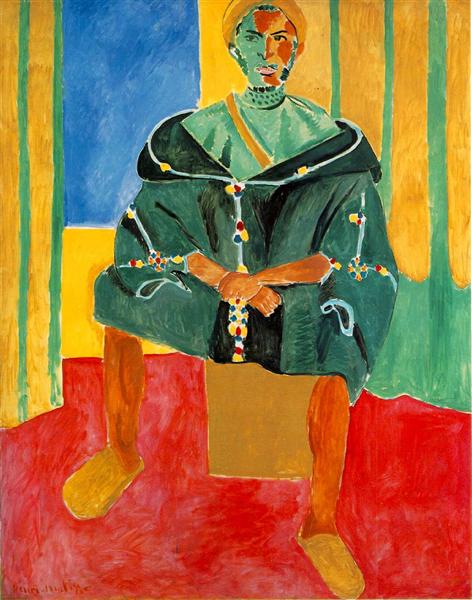
meanwhile, over a hundred years later,

inches only away from the First World

War, Matisse is doing in art what

Prokofiev is doing in music, taking the

temperature of his own time, Seated

Riffian (1911 –1912) – a Riffian, a Berber,

a North African tribesman – see below,

to corroborate Prokofiev’s equally

emblematic vision of their shared era


you can hear this in the music


mostly through the difference in the use

of volume, languorous softs, thunderous

louds, but also in the more expansive use

of pace, fast, slow, the rapidity of some

notes, the embrace, the extended caress,

of others, in the later composition


which, in a word, follows the development

of the piano from harpsichord to the

instrument we’re used to today


Mozart still had the harpsichord in his ear,

he was writing for the fortepiano, which

evolved, through the pianoforte, to the

piano we know of today, no flexibility of

pace, no flexibility of volume then, listen,

hearyou can hear it in the juxtaposition


we hear a lot more than we think we

hear


R ! chard


                  __________


Seated Riffian, 1912 - 1913 - Henri Matisse


        Seated Riffian (1911 – 1912)


                Henri Matisse


                  __________

Mozart – Clarinet Quintet in A major, K581

there are several reasons for which Classical music
is called Classical, the word itself suggests a standard – 
austere, concise, clear, rigorously authoritative – nearly
like mathematics 
 
and such is the music of Mozart, and most others, even
into Romanticism
 
despite the flurry of iridescent notes filling vaults of
effervescent atmosphere, like the apparent serendipity
of so many flights of birds that describe music for us in
our own heavens, you’ll hear a tune, then another
constrasting one, then you’ll hear both of them all over
again, not much different from a song’s refrain and verse,
except that the verse is not new but like the refrain a
repetition 
 
both repetitions usually will have some embellishments,
and sometimes the repetitions are in a divergent order,
but the idea remains the same, you’ll always hear again
what you heard at the beginning no matter how far away
you’ve strayed
 
this foursquare structure is at the basis of music
 
nearly like mathematics
 
 
beat remains also essential, a peremptory component of
what it means to be music in the Classical Age, despite
the leeway now given by a revolutionary it would turn
out fortepiano  
 
Mozart doesn’t sway from the tempo he imposes on a
movement, does so even categorically, otherwise would
be louche, disruptive, in an age of order 
 
 
in the last movement of his Clarinet Quintet in A major,
however, K581, he has his way with that proscription by
making the movement a set of variations, which allow
him, of course, to on a theme display an array of melodic
options, irrelevant of coherence of pace, to test the
boundaries of what it means to be within the larger
musical structure one of its movements 
 
a path is thereby forged to a new understanding
 
 
he gives us also here another new invention, the
addition of a clarinet to the usually set quartet – two
violins, a viola and a cello – that was then the staple
of chamber music essentially 
 
nor can I think of an earlier Clarinet Quintet 
 
you’ll find this unassuming, usually more reclusive, 
wind instrument to be an utterly inspired addition
to even the most vaunted sounds of even this most
silken string quartet
 
 
Richard