Richibi’s Weblog

Just another WordPress.com weblog

Tag: fantasia

how to listen to music if you don’t know your Beethoven from your Bach, XV – what’s a rhapsody

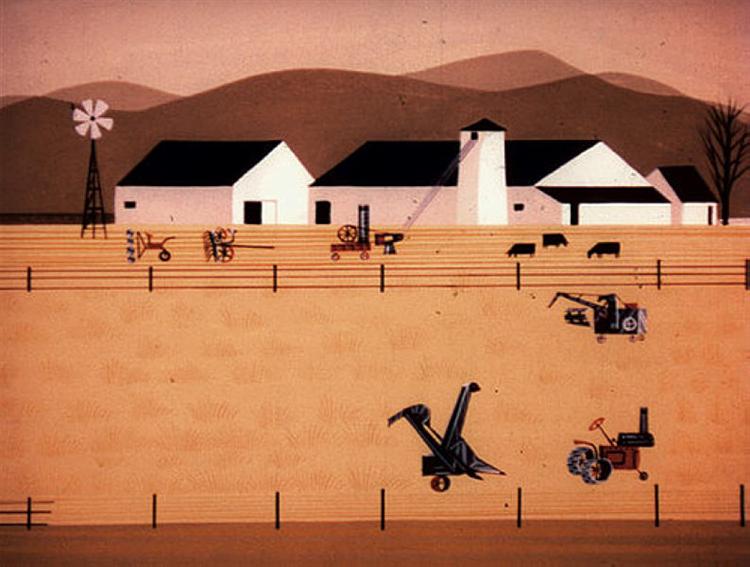
Rhapsody of Steel, 1959 - Eyvind Earle

        Rhapsody of Steel (1959)

                   Eyvind Earle

                       ________

so what’s a rhapsody

if you’ve been following at all my 

musical adventure, you’ll have 

heard by now several rhapsodies 


at first, I suggested that the rhapsody

was an evolution from the fantasia,

a piece of music in one movement

that allowed for any internal 

construction, but that, after the

Classical Period, became imbued  

with Romanticism, passion became 

a condition of music, mere technical

ability was no longer enough  


note that the audience was different,

rather than nobles who commissioned

artists to decorate their salons, the

burgeoning Middle Class was hungry 

for them to entertain, performers were

becoming the main attraction, not just

the background, see, for instance, 

Beethoven


but not only did rhapsodies spread 

from just one player to an entire

orchestra – see Brahms, then 

see Gershwin – but its essential 

structure, one movement, was 

challenged, see Ravel here, or 

Rachmaninov, whose rhapsodies 

are both composed of distinct 

movements, Rachmaninov even 

further refining his movements 

into variations, for years, I 

referred to his Rhapsody on a 

Theme of Paganini as his 

Variations


all this to say that a rhapsody is 

turning out to be not identified 

by its structure, its technical

parts, but rather by its intention,

a rhapsody is in the eye of its 

composer, like a nocturne, or 

a ballade


I’d thought that rhapsodies had 

been relegated to the Romantic 

Era, with the occasional later 

tribute


who, I wondered, could be

writing rhapsodies anymore


but here’s something, however

unexpectedly, you’ll be familiar

with, from 1975, Queen’s Bohemian

Rhapsodyin several movements 

– intro, ballad, opera, hard rock, 

outro – and including in all of them,

note, voice


all of which speaks of tradition

being a lot closer than one would 

think, ancestral, residual, but

defining, traces, like genes, 

however updated, however

posthumously interpreted,

pervade, infiltrate, pursue,

inexorably


rhapsodies are in our DNA, it

would appear, for better or for 

worse, ever


here’s to them


R ! chard


Chopin: “Études”, opus 10

if I haven’t brought up Chopin much in this series
it’s that I think of him more as a decorator than
as an innovator, he was developing a sensibility
that had been defined by the earlier Beethoven,
adding texture and style, form instead of function,
the wheel had been invented, now it remained to
be artfully applied
 
some break new ground, others decorate it, make
it enchanting, Chopin makes things enchanting 
 
he is also the first composer we think of when we
think of Romanticism, which says quite a lot about
the quality, the universality, of his gift 
 
 
here are his opus 10, “Études”, or “Studies”, 12 of
them, they are not sonatas, for not having more
than one movement, they are “études” , “studies”,
called by that name for being what they are, then
given numbers to differentiate them, also their
key, the convenience of universally attributing
titles not having quite caught on yet though a
couple of these do have them, the 5th, the
“Black Keys”, for obvious reasons, and the last,
the “Revolutionary”, again for reasons you’ll find
obvious once you’ve heard it 
 
tonality however remains, no apparent discords,
that’ll come later  
 
 
note that in comparison to Mozart the notes are
a shimmer, the same alphabet is used, the one
set up by Bach, but where Mozart made these
into narratives to follow, and even sing along to,
with Chopin the same flurry of notes becomes
a wash of sound you could never vocally keep
up with, a texture rather, an enveloping caress,
prefiguring incidentally the Impressionists, the
lush soundscapes of for instance Debussy 
 
 
though you’ll find the same prerequisite opening
musical statement as in Mozart, followed by the  
contrasting one, often these will be in altogether
constrasting rhythms as well, tempi, compared
to the single strict beat throughout of the 
foundational Classical model    
 
the tempo itself is also much more lax, some
passages surrendering formal rhythmic strictures
to greater emotional content, more self-expression,
less attention to rules, in accord with the newly
installed ideal of individual human rights 
 
hence Romanticism, the fruit of the Revolution 
 
 
note also that the musical argument is no longer
in the Mozartean playground but of a more mature
understanding, Chopin has known love 
 
 
Richard