Richibi’s Weblog

Just another WordPress.com weblog

Tag: Euterpe

Hesiod on poets, and, for that matter, kings

1280px-1807_Thorvaldsen_Tanz_der_Musen_auf_dem_Helikon_anagoria.JPG

The Dance of the Muses at Mount Helicon (1807)  

Bertel Thorvaldsen

________

though Zeus may preside over kings,
none other than Apollo and the Muses
preside over poets, according to
Hesiod

Kalliope, foremost of the nine Muses
who tends specifically to kings, and 
to those being born of kings, in the
company of her sisters, Kleo and 
Euterpe, Thaleia and Melpomene, 
Terpsichore and Erato and Polymnia 
and Ourania, will pour a dew sweeter 
than honey upon such a one’s tongue, 
and his words become soothing, 
palliative, placating

“far shooting Apollo, however, 
presides at the inspiration of poets,
lending the lyrical notes from his 
representative lyre, not to mention 
his lyrics, derivative both terms of 
that etymological “lyre”, incidentally,  
so far has Apollo “shot”, dare I say,  
his spirit into our collective 
unconscious
 
“From the Muses and far-shooting Apollo
are singers and guitar-players across the earth, 
but kings are from Zeus. Blessed is he whom the Muses
love. From his mouth the streams flow sweeter than honey.
If anyone holds sorrow in his spirit from fresh grief and
is dried out in his heart from grieving, the singer,
servant of the Muses, hymns the deeds of men of the past  

and the blessed gods who hold Olympus, and
right away he forgets his troubles and does not remember
a single care. Quickly do the gifts of the goddess divert him.” 
 
                                                    Theogony (lines 94 – 103)
                                                                     Hesiod

therefore poets 

Richard 

psst: a friend has just passed on,
 it is a time for poets
Beethoven – piano sonata no 7, in D major, opus 10, no 3‏

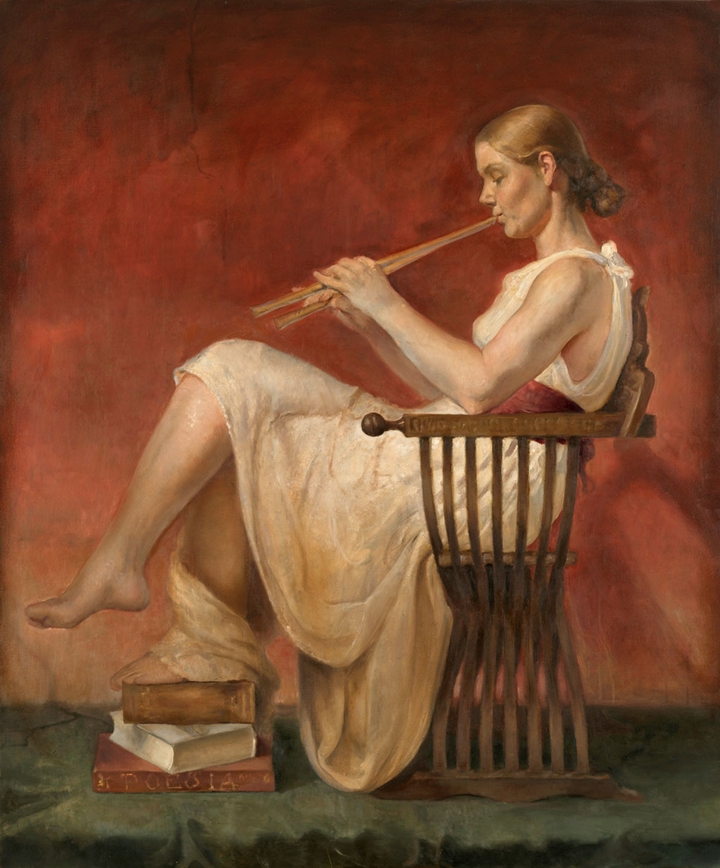
Euterpe - Apollo and the Muses - Helene Knoop 1979 - Norwegian Figurative painter - Tutt'Art@

EuterpeApollo and the Muses (2008 – 9)

Helene Knoop

________

if the piano sonata no 4 of Beethoven,
in E flat, opus 7, was academic, an
exercise, a display of technical
dexterity and some, admittedly,
even mighty, compositional verve,
it lacked, in my estimation, a centre,
a convincing motivating factor, a muse,
though ever ardent, ever entertaining,
it is ultimately arid, I think, trite, I’m
not, one is not, keen on returning to it

but in the piano sonata no 7, in D major,
opus 10, no 3
, Beethoven hits, I submit,
his stride, this sonata is enchanting

note the similarities of structure
between the two, the order of the
movements with identical, essentially,
tempo patterns, notably the middle
slow movement, in the first a largo,
con gran expressione,
slow with
great expression, in the latter, a
largo e mesta, slow with sadness,
where Beethoven plumbs, evidently,
the limits of pacing, the time lapse
between two notes, the capacity for
silence of this new instrument, the
pianoforte, of which he’ll look into
also, and even vigorously, its
capacity for volume, the crashing
introduction to his celebrated 8th,
for instance, to establish the
instrument’s new perimeters

you’ll note you can listen to the later
largo, the opus 10, no 3, forever, you
can get lost in its aural world, I can’t
think of anywhere else right now a
more profound largo

the other movements are dazzling
in their thrilling prestidigitation, all
organically sound, and, crucially,
motivationally centred, I think, this
is indeed music, magisterial music,
Beethoven’s not just kidding
anymore, he’s hitched onto his
proper inspirational deity, his own
private Euterpe, music’s muse, and
we’re in for something, from here
on, of a ride

note the cool riff closing off the last
movement, Beethoven in the guise
of Gene Kelly stepping in for a
breezy good-bye, prefiguring, of
course, XXth-Century music, and
the serendipitous extrapolations
of jazz

Richard

psst: incidentally, the headings, largo,
con gran expressione, largo e
mesta,
are entirely Romantic
musical notions, notations,
Classical composers would’ve
been too sedate, formal, courtly,
for such flagrant sentiment