Richibi’s Weblog

Just another WordPress.com weblog

Tag: Euripides

at the movies – “Phaedra”

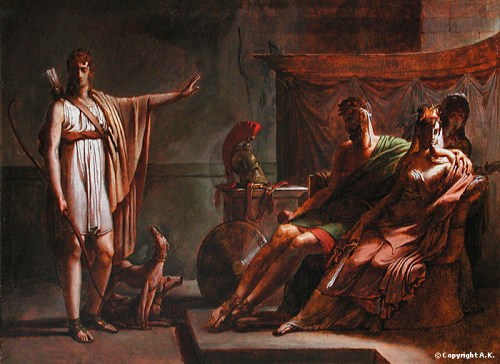
phaedra-and-hippolytus-1802.jpg

     “Phaedra and Hippolytus (1802) 

            Pierre-Narcisse Guérin

                   _____________

Phaedra, according to Greek myth, fell
in love with her stepson, and, of course,
ruined, for everyone, everything 

she’s been represented in music by
composers from, at least, Rameau,
1733, to, here, now, Benjamin Britten,  
1976by way of even Tangerine
Dream, 1973, however peripherally, 
and the hits just keep on coming

in literature, the story goes back to 
Euripides, 480 – 406 BCE, through
Jean Racine, 1639 – 1699, poet at 
the court of Louis XlV, the version 
that I studied in French Literature,
along with, in English, Shakespeare,
who was doing courtiers, rather, 
and royalty there, then, incidentally, 
instead of the Continent’s iconic 
Mediterranean figures – it remains 
my favourite play in my mother 
tongue, next to, for me, its only 
other equal, Cyrano de Bergerac

but I’d never seen a production of 
Phaedra until this searing, 
modern, rendition, set in, relatively 
contemporary, Greece, London, 
and Paris, with the irrepressible, 
the irresistible, Melina Mercouri
torrid temptress, the very goddess 
Herahereand Anthony Perkins
perfect as her suitor, a youth still, 
pulsing with a young man’s 
unbridled intentions

sparks fly, from moment to 
incendiary moment – I had often 
to pause to catch my breath – 
portents of an inescapable, and 
eventually epic, indeed mythic, 
apocalypse

watch, if you dare


R ! chard

“The Trojan Women” – Euripides

the purpose of any art essentially is to either
inform or entertain, preferably both together,
therefore comedy would be associated with
entertaining whereas tragedy with informing
and, as such, this last would be perhaps more
intellectually demanding, so be it 
 
the strength nevertheless of great tragedy is in
its level of delivering immediacy and fascination,
which is to say entertainment, of great comedy
its obverse, insight  
 
The Trojan Women” was written in 415 BC by
Euripides, a tragedian at the very summit still,
2400 years later, count them, of remarkable 
historical achievement 
 
the war with Troy had taken place a full 800
hundred years earlier, Homer had written the
alternate Bible to our Western civilization,
The Iliad“, still with Proust to my mind the
very summit of our Occidental accomplishment,  
resonating across the ages as powerfully as
even the pyramids, extraordinary to read,
from about, again count them, astounding
millennia, nearly unimaginable centuries, 
850 BC  
 
 
Helen had been abducted from Sparta, according
to that side of the story, by Paris, the son of King
Priam of Troy, she had been whisked away not
unwillingly according to that prince of that city,
from where she became known to us as Helen of
Troy, rather than of her original Sparta
 
the Trojan War ensued
 
 
the Trojans were creamed by the Achaeans, the
Greeks, the Spartans, interchangeable terms,
under Menelaus, king of Sparta, and his brother,
Agamemnon, older brother, and king of Mycenae,
the greater incorporating kingdom   
 
the Trojan women remain to pay the price of
war, after so many centuries still their horror is
vivid, nor do we need to look far for equivalent
modern instances, they were all slaughtered or
enslaved, ‘nough, or maybe not ‘nough, said 
 
 
here we get perhaps the best interpretation
we’ll ever see, with a cast we’ll probably not
in a long while again put together – Katharine
Hepburn in perhaps her greatest role – “Once
I was queen in Troy”, she says, and you will
profoundly believe her – Vanessa Redgrave
doesn’t get ever much better as she reaches
chthonically, which is to say from the very
entrails of her earth, her soul, for a cry of
anguish you are not likely to ever forget – 
Geneviève Bujold, a mad Cassandra, and
Irene Papas, the very incarnation of the
most beautiful woman in the world
 
all tear up the screen in their moments,
leaving you breathless and helpless before
their art and evocative power, only Helen,
because of her beauty, insidiously manages
in the story to reasonably comfortably
survive, making mincemeat meanwhile
out of her big bad, he would have it, 
Menelaus
 
Helen had been the gift to Paris, who’d had
to choose among the goddesses, Hera, Athena,
Aphrodite, which of these was the most
beautiful, but only when Aphrodite had bribed
him with the gift of the most beautiful woman
in the world instead of from either other deity
power and glory, had he chosen Helen
 
the other two of course reponded with the
devastation at Troy, Olympians were not prone
to be easy, Christian mercy would find in that
pagan unequivalency propitious ground 
 
  
wonderful rendering of the traditional Greek
chorus – the Greek version of back-up girls,
“doo-wop, doo-wop” or “she loves him, she
loves him” – commenting on the tempestuous
story     
 
one of my favourite ever films   


Richard


yesterday – December 28,2006

           Girl Reading a Letter at an Open Window, 1657

                                Johannes Vermeer

                                    (1632-1675)

             ______________________________________

these earlier “back tracks“, of which the following is one example, are pieces I consider still to be worth your while
please enjoy 
             
                       _______________________
December 28, 2006
                                                                                                                                                                  yesterday for the first time it snowed, as I left the apartment a light but steady moisture began to fall that I suspected might be more than rain, sure enough by the time I´d walked the several minutes to the number 8 which would take me to the Old Masters Picture Gallery, the Gemäldegalerie Alte Meister, in the Zwinger, snowflakes swirled about us like whirling dervishes, light in the flustered air and as merry and playful as the season 
I hopped the Strassenbahn, the tram, which sleekly sailed us along to, then a short length of, the river, which was shrouded there by thickets of trees, but as we turned onto the bridge, the Augustusbrücke, the stately steeples and spires of the Altstadt appeared magically transformed into the enchanted setting of a fairy tale, sprinkled with the dancing fairy dust of the very Brothers Grimm
I got off beside the Catholic Cathedral, St Trinitatis, built in 1738 to 1755, heavy with age, light with spirit, its saints and significant clergy standing watch along the balustrade that lined and determined its roof, surely the bells were ringing but I can´t say for certain, the music was all in my eyes
across the cobblestone square before the Semperoper – the Opera House that Gottfried Semper built between 1838 and 1841, rebuilt from 1871 to 1878 by his son after it burned down in ´69 – people were scurrying about, taking pictures, catching their own trains, while flanking the building´s entrance Goethe and Schiller stood watch, impervious and staunch, beneath the steady and playful flakes, they bore the white frost upon their shoulders and pates with patience and resignation
further along the walls but protected by the shelter of each their private stone niche, Sophocles and Shakespeare to one side, Euripides and Molière on the other, sat soberly watching, unruffled, the snow fall
next door the Zwinger warmly awaited, I checked my coat and scarves with the hat check girl I´ve befriended there, she eagerly announced to the others that I was her friend, I´m sure I smiled and blushed, then made my way to the section I was exploring that day
of the many paintings in a room I always choose the one that I would like to take away more than any of the others, that way I need to examine them all, sometimes even closely
yesterday I quickly passed on a Cornelis Corneliszoon van Haarlem, “Venus, Bacchus and Ceres”, all heavy-haunched and cornucopian, a bird concert complete with sheet music in the trees by a Melchior de Hondecoeter no less, I spent some time with Mathias Stom´s “Old lady with a Candle”, which seemed to owe a lot to Rembrandt or he to him, with Jakob Isaacksz Ruisdael´s “The Hunt”, a dark but stirring landscape with a huge tree dominating the centre and reflected subtly in a river that rippled at its root, a deer was trying to flee across the foreground hunters approaching
a couple of Vermeers were of consequence, one, “The Procuress”, a madam in other words, accepting guilders from a group of men, one of them being so bold as to fondle her breast, left me surprised at so untypical a work of his, but another of a girl reading a letter at a window, replete with his tapestries and textures and a more modest and composed young woman intent on the message that she held, was nearly my first choice, her soft reflection in the open latticed windowpane was genius
 
but a Salomon de Bray, a name unknown to me, had painted in the mid sixteen-hundreds a young man with a crown, but of black roses, the youth could not have been very old, an open mouth spoke of being still eager and curious, age shuts men up and makes them open up only to declare, propound, pontificate
he´d turned to one side so that his neck was lithe and swift, probably alert to a sudden sound, a staff he held in strong but still supple hands suggested he was a wanderer or a shepherd
a white undershirt was mostly buttoned up but a string had not been tied at its neck, its either ends hung loose above another darker red shirt, equally not quite fully buttoned, there was no suggestion of a breast but only the soft spread of the clavicles
I would´ve taken him home
the crown of roses of course sported thorns in fresh, clean, but unguarded hair, the reference was unmistakable
                                                                                                                                                                    from a window I watched the thick snow still fall, the ground was covered, but left were the precise lines of the pristine architecture under the icing that outlined its edges
the sages and the deities at the Zwingers own many parapets looked timelessly, unswervingly, on
                 __________________________________________                                                                                 
though the Old Masters Picture Gallery, die Gemäldegalerie Alte Meister, will not allow transfer of their artworks to personal blogs, their entire collection is available through their own website, which I’ve linked you to here, click “Online-Gallery” at the home page, there under Gemäldegalerie Alte Meister click “motivliste anzeigen“, “show collection“, make your way through the 64 “Seiten, “pages“, of masterworks
thoroughly enjoy
                                                                                                                                                                  yours in timeless art                                                                                                                                                                   richibi
                                                                                                                   __________________________________