up my idiosyncrasies – Plato
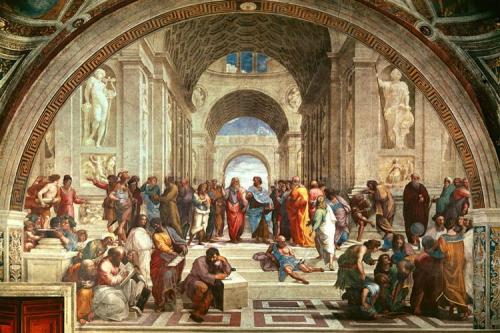

“In the morning when thou risest unwillingly, let this thought be present – I am rising to the work of a human being. Why then am I dissatisfied if I am going to do the things for which I exist and for which I was brought into the world? Or have I been made for this, to lie in the bed-clothes and keep myself warm? – But this is more pleasant. – Dost thou exist then to take thy pleasure, and not at all for action or exertion? Dost thou not see the little plants, the little birds, the ants, the spiders, the bees working together to put in order their several parts of the universe? And art thou unwilling to do the work of a human being, and dost thou not make haste to do that which is according to thy nature? – But it is necessary to take rest also. – It is necessary: however nature has fixed bounds to this too: she has fixed bounds both to eating and drinking, and yet thou goest beyond these bounds, beyond what is sufficient; yet in thy acts it is not so, but thou stoppest short of what thou canst do. So thou lovest not thyself, for if thou didst, thou wouldst love thy nature and her will. But those who love their several arts exhaust themselves in working at them unwashed and without food; but thou valuest thy own own nature less than the turner values the turning art, or the dancer the dancing art, or the lover of money values his money, or the vainglorious man his little glory. And such men, when they have a violent affection to a thing, choose neither to eat nor to sleep rather than to perfect the things which they care for. But are the acts which concern society more vile in thy eyes and less worthy of thy labour?”
“Meditations“, Book 5, 1
___________
though Marcus Aurelius produces
a seemingly logical argument in the
first paragraph of his fifth book of
meditations, his premises are not
air-tight
are we meant to “work”, a notion
already roundly infiltrating Christian
ideology, by the “sweat of its brow”,
as it were, at the time of Marcus
Aurelius, with those roots already in
early Stoicism, with Zeno of Citium,
a good 350 years before Christ
this notion is alive and well, indeed
thriving still, in the Protestant Ethic,
where very salvation is achieved
through labour, a consequence of
the Fall, which is to say, the expulsion
from the Garden of Eden
and Utilitarianism, where effort, which
is to say, work, is required to maximize
happiness, minimize suffering
these are profound pathways based
on faith, not necessarily ineluctable,
Epicureanism, an opposite philosophy,
of savouring the moment, though less
purported, less proclaimed, appears
ever flourishing nevertheless in our
voluptuous 21st Century
Marcus Aurelius brings up another
issue tangentially here, though he
expounds on it in later passages,
that of the primacy of either the
person or the community, a central
question of our times, socialism
versus democracy
he favours community, after Plato,
so, incidentally, does Jesus
these are not easy questions to
answer, what, essentially, are the
conditions required before one
starts to smell the flowers, is
smelling the flowers an abomination
when people are cruelly suffering,
dying
how can I help, should I, and when
do I say no to myself
therefore philosophy
your life, indeed your very next step,
depend on it
cheers
Richard
“If thou workest at that which is before thee, following right reason seriously, vigorously, calmly, without allowing anything else to distract thee, but keeping thy divine part pure, as if thou shouldst be bound to give it back immediately; if thou holdest to this, expecting nothing, fearing nothing, but satisfied with thy present activity according to nature, and with heroic truth in every word and sound which thou utterest, thou wilt live happy. And there is no man who is able to prevent this.”
“Meditations“, Book 3, 12
_________
the idea of the virtuous man, or the
interpretation of Marcus Aurelius of
such a person, goes back of course to
Socrates by way of Plato, 427 – 347
B.C., who’s ideal was primarily
political, what to achieve within a
political order, rather than a private
meditation, an advice rather than
a contemplation as in Marcus
Aurelius, 121 – 180 A.D., 550,
not inconsequential, years later
other moral perspectives meanwhile
applied, Epicureanism, for instance,
notably, after which the stranglehold
of Christianity produced not philosophy
but dogma, for a subservient and,
biblically labeled, fallen people,
nearly fifteen hundred years spent
trying to figure out how many angels
fit through the eye of a needle,
essentially, how many irrationalities
could prove the existence, and
authority, of a mandated God
René Descartes inadvertently in this
very quest, but not before 1637, put
an end to that, introduced a new, and
revolutionary, perspective, “I think,
therefore I am“, which put the individual
instead of the Church in the driver’s seat,
this, if it didn’t bring on the Renaissance,
at least gave it a significant push
but because of his famous scientific
method, studies afterwards in what
we now know as the humanities
became more empirical than
specifically moral, how do we
perceive rather than how do we live
according to what is right or wrong,
Nietzsche‘s “Beyond Good and Evil“,
1886, reoriented that investigation,
as it happened, ominously, in an age
where any kind of god had become
irrelevant, Beethoven would be
transformed into a Hitler, an
uncomfortably fateful Übermensch,
Superman
now philosophy is concerned with
language, what do we mean when
we say what do we mean, and can
anybody understand that
our closest moralist, our modern day
Marcus Aurelius, is at present Miss
Manners, whom I wholeheartedly
recommend
as well as, of course, Marcus Aurelius
Richard
psst: Miss Manners‘ question and answer
format, incidentally, is not at all unlike
what Plato does in his Socratic dialogues,
she just has a larger, more flip audience
in the movie “Never on Sunday” Homer Thrace, an American moralist and armchair philosopher, objects to the libertine ways of the modern Greeks, Ilya especially, a whore, disconcerts him, she likes her job, so do the dockworkers, and the other women who ply her trade at the port of Piraeus, near Athens
Homer Thrace accuses them all righteously of pursuing the Stoic and Epicurean philosophies that came out of the fall of Greece, instead of the true and noble ideals of the more upstanding Socrates, Plato, and Aristotle, who believed that the greatest happiness comes from the joy of understanding
when he tells Taki, who plays the bouzouki, that he can never be a true musician because he can’t read music, Taki, who is too old now to learn, hides in the bathroom forlornly, and says he will never play again
Ilya, Melina Mercouri, in a star turn, tells him composers need his music to be able to write his notes down, what would composers do without him, if birds can’t read music, she asks, should they stop singing
Taki comes out of the bathroom
so had I
Richard
______________________________