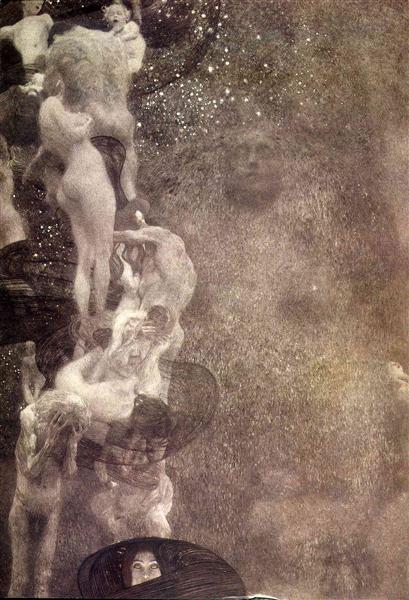
“Philosophy (Final State)“ (1899-1907)
Gustav Klimt
______
at lunch recently, a friend was telling
me about taking her family, kids,
grandkids, to Hawaii
I hope we have a good time, she said
what do you mean, I hope, I asked
I’ve been worrying a lot lately, I wake
up in the middle of the night, I worry
about sharks, for instance, off the
coast of Maui
I know what you mean, I answered, I
worry about an earthquake hitting
while I’m asleep, the whole city does
in fact, I confirmed, those here who
worry
when I was going to Munich in December
and January with my mother, I continued,
and people were saying it’d be cold, I
determined that we’d have a wonderful
time despite whatever obstacles we might
encounter, I meant it as a gift to my mother,
after all it was for the magic of the C***mas
and New Year’s Eve festivities there we
were going, kind of like your Hawaiian
beaches, I pointed out
there was the uncomfortable flight over,
the usual stomach upsets, cold and
snow, which I hadn’t experienced in
several years, an unruly Internet
connection, but they were the price of
admission to the wonderland I’d
determined to fashion out of the
elements that we’d find there, and did
there were neither sharks nor earthquakes
eventually, nor even the terrorist attacks
that had threatened, but that no amount of
worrying anyway could’ve done anything
about
and I just read something out of the New
Yorker, I continued, that put me back on
track, put everything back together again
before any great existential fall
it’s all in your head, it said, or rather it
quoted Epictetus, Epictetus, the Stoic
philosopher I’ve always profoundly
admired, I said, I’ll send it to you, the
article, Stoicism was a way of facing
the world bravely and seeing it as a
condition of your worth
is still a way, I extrapolated
also I’ve found that focussing on what
you’ve been worrying about, and
thinking about what you can do about
it, helps
about sharks, for instance, what would
you do – don’t go in the water – after
which there isn’t much else to think
about but go on to the next problem
meanwhile, you’re not worrying, but
actually being productive, and reducing
everything to what you can indeed do,
which ends up being most often not
much
pray for grace, I’ve been telling myself
for the longest while, and make sure
your tie ‘s on right, that’s all you
can ever do, I repeat to myself, and to
anyone who’ll listen, like an incantation,
a refrain
but still I take my anti-depressants just
in case, I said
we drank to Stoicism
afterwards we saw a new play about
Queen Elizabeth
Richard
psst: the New Yorker article
How To Be a Stoic
The Stoic philosopher Epictetus was born a slave, around 55 A.D., in the Greco-Roman spa town of Hierapolis—present-day Pamukkale, Turkey. I first encountered his teachings in 2011, shortly after moving from San Francisco to Istanbul. I lived alone on a university campus in a forest. In the midst of a troubled long-distance relationship, I sometimes went days without talking to anyone but my boyfriend’s disembodied head on Skype. I was demoralized by Turkish politics, which made both secularists and religious people feel like victims. If you were a woman, no matter what you were wearing—décolleté or a head scarf—someone would give you a dirty look.
The first line of Epictetus’ manual of ethical advice, the Enchiridion—“Some things are in our control and others not”—made me feel that a weight was being lifted off my chest. For Epictetus, the only thing we can totally control, and therefore the only thing we should ever worry about, is our own judgment about what is good. If we desire money, health, sex, or reputation, we will inevitably be unhappy. If we genuinely wish to avoid poverty, sickness, loneliness, and obscurity, we will live in constant anxiety and frustration. Of course, fear and desire are unavoidable. Everyone feels those flashes of dread or anticipation. Being a Stoic means interrogating those flashes: asking whether they apply to things outside your control and, if they do, being “ready with the reaction ‘Then it’s none of my concern.’ ”
Reading Epictetus, I realized that most of the pain in my life came not from any actual privations or insults but, rather, from the shame of thinking that they could have been avoided. Wasn’t it my fault that I lived in such isolation, that meaning continued to elude me, that my love life was a shambles? When I read that nobody should ever feel ashamed to be alone or to be in a crowd, I realized that I often felt ashamed of both of those things. Epictetus’ advice: when alone, “call it peace and liberty, and consider yourself the gods’ equal”; in a crowd, think of yourself as a guest at an enormous party, and celebrate the best you can.
Epictetus also won me over with his tone, which was that of an enraged athletics coach. If you want to become a Stoic, he said, “you will dislocate your wrist, sprain your ankle, swallow quantities of sand,” and you will still suffer losses and humiliations. And yet, for you, every setback is an advantage, an opportunity for learning and glory. When a difficulty comes your way, you should feel proud and excited, like “a wrestler whom God, like a trainer, has paired with a tough young buck.” In other words, think of every unreasonable asshole you have to deal with as part of God’s attempt to “turn you into Olympic-class material.” This is a very powerful trick.
Much of Epictetus’ advice is about not getting angry at slaves. At first, I thought I could skip those parts. But I soon realized that I had the same self-recriminatory and illogical thoughts in my interactions with small-business owners and service professionals. When a cabdriver lied about a route, or a shopkeeper shortchanged me, I felt that it was my fault, for speaking Turkish with an accent, or for being part of an élite. And, if I pretended not to notice these slights, wasn’t I proving that I really was a disengaged, privileged oppressor? Epictetus shook me from these thoughts with this simple exercise: “Starting with things of little value—a bit of spilled oil, a little stolen wine—repeat to yourself: ‘For such a small price, I buy tranquillity.’ ”
Born nearly two thousand years before Darwin and Freud, Epictetus seems to have anticipated a way out of their prisons. The sense of doom and delight that is programmed into the human body? It can be overridden by the mind. The eternal war between subconscious desires and the demands of civilization? It can be won. In the nineteen-fifties, the American psychotherapist Albert Ellis came up with an early form of cognitive-behavioral therapy, based largely on Epictetus’ claim that “it is not events that disturb people, it is their judgments concerning them.” If you practice Stoic philosophy long enough, Epictetus says, you stop being mistaken about what’s good even in your dreams.
Elif Batuman
 Richibi's Weblog