November / Month of the Sonata – 26
__________
for Barbara, who died recently,
she would’ve loved this
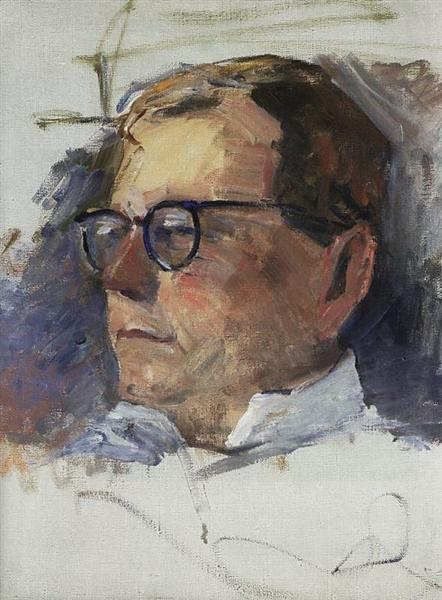
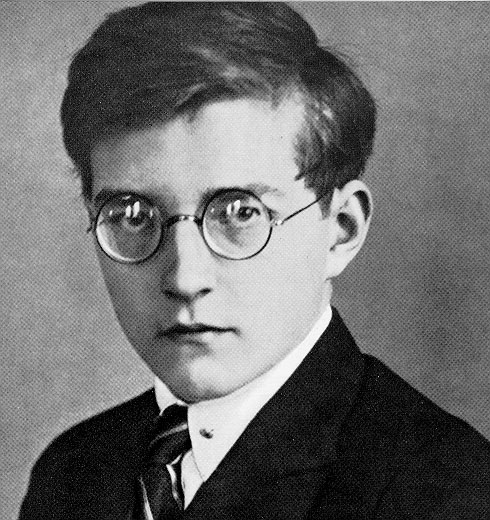
Shostakovich was just nineteen when
his Symphony No.1, opus 10 was
first performed – it had been his
graduation piece the previous year
from the Petrograd Conservatory –
by, then, which is to say 1926, the
Leningrad Philharmonic, renamed the
Saint Petersburg after the fall of the
U.S.S.R., the name it had held before
the Bolshevik Revolution, the oldest
philharmonic orchestra, therefore,
incidentally, in our Russia, going
back to 1882
the work was a complete success, not
surprisingly, if you’ll consider its scope,
its power, and its novel musical
interpolations, I mean a piano as an
integral orchestral instrument rather
than as a distinct, however interrelated,
component, a pas de 40 instead of a
pas de deux, something I can’t remember
anywhere else having seen for piano
not to mention the drum roll between
the last two movements, drums making
a splash in an orchestral setting, who’d
‘a’ thunk it, though Richard Strauss had
done just that in his extraordinary
“Burleske” several decades earlier,
another youthful work, Strauss only 21
but meanwhile back in Russia, before
I too seriously digress, Shostakovich
was immediately compared to another
earlier young prodigy there, Alexander
Glazunov, who’d himself put out his
own First Symphony, the “Slavonic“,
at age 16, introducing, incidentally, his
own instrumental novelty then, an oboe
obbligato, which by very definition is
lovely
Glazunov also mentored, by the way,
Shostakovich at the Petrograd, proved
to be instrumental indeed in his
progress
it’s interesting to put these last two
together, to compare, the Glazunov, 1881,
follows the traditional Romantic
imperatives, tempo, tonality and
repetition, but with more bombast, to my
mind, than its European counterparts,
its fields are the Russian steppes with
troikas, horse-drawn carriages, flying
across vast unhampered vistas of the
Russian snow-covered, therefore
pristine, tundra, to whet the unbridled
Russian spirit, the Europeans, Brahms,
Mendelssohn, Mahler, conversely,
are confined to the hunt, however ever
glorious, but with shrubs, copses,
thickets, if not veritable forests, to blur
the sonic arena, inspire dreams,
consequently, less far-reaching than
those of Johnny Appleseed even, of
the North American Prairies poets,
their own far-flung, boundless
imaginations, inspiration, you can
hear it all, blatantly, in the resonance
of the horns
you’ll note the movements follow
essentially the same rhythmic order
in either symphony, the first two fast
enough, then a third that’s somewhat
slower, a variation from the strictly
Classical order of fast, slow, fast, then
a last, eclectic, movement
but Shostakovich is more atonal,
melodically divergent, an eccentricity
he’ll later polish to a degree of
politically subversive brilliance
for not submitting, however, to the rule
of repetition, which is manifest, though,
in Glazunov, Shostakovich, I find, leaves
us trying to find our bearings as his music
rolls along, kind of like in biographical
movies, when you start looking at your
watch to determine how many life
incidents remain in this particular,
however significant, existential drama
as spectacle – and it must be noted that
symphonic displays were at the time
indeed spectacles – there was no
phonographic, photographic
equipment to transmit such
experiences, the symphony itself was
the show, it had, right there, itself, to
wow the audience
in all of these cases, all of them did
Shostakovich, however, of all of them
remained eventually potently
pertinent, powerfully paramount,
watch
R ! chard
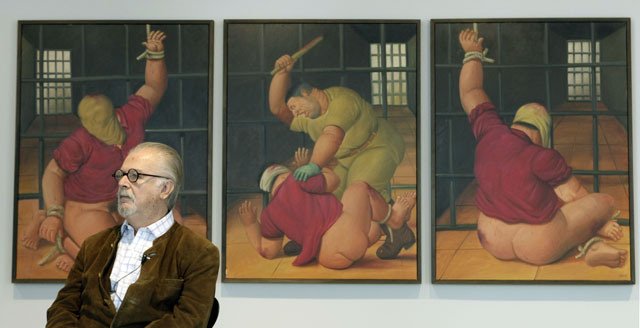
Fernando Botero standing before three of over 80 of his stylized
depictions of atrocities committed at Abu Ghraib
____________
the role of art has always been to bring
attention to injustice, Goya, for instance,
famously, Picasso’s “Guernica“, without
which Guernica would be forgotten, in
literature the servile position of women
and those marginalized by industrialization
in the works of Charles Dickens, Henrik
Ibsen, Émile Zola, in music the strident
strains of Shostakovich indelibly
imprinting the cruel depredations
of the Soviet system in his searing
compositions, just click
Botero, as the others, has given here
impermeability to what had been merely
news items, something tragic but lost
amongst so many other tragedies, by
giving it ideological breadth, depth and
substance, giving it the modern postion
of an altarpiece, a place of ardent
contemplation
we have after all no more churches,
only malls, we rely on potent images
for our moral guidance
therefore art
Richard
several years ago when an angel I knew passed away
I read at his commemoration something I had written
for him, adagios, I said, always remind me of John
only a few days later, after I’d spoken, an adagio in
the distance was weaving its magic spell as I
abstractedly washed perennial dishes, a pivotal
spot, it would appear, for me, in my mystic
wanderings, my spiritual peregrinations
gradually I recognized the presence I’d apparently
inadvertently evoked with my unsuspecting but
thoughtful and caring script, opening a key, like
Ali Baba, it would transpire, to the very undiluted
infinite, something I’d wished for from my dad,
who’d died just a few months earlier, promising
me he’d speak to me if he could, though by then
I hadn’t yet heard from him
later when I was browsing for music to get into
to while away my pensive hours I happened upon
some Shostakovich in a nearby record store, I’d
recently been exploring his stuff, having reached
forward from the Romantics and even the
Impressionists, and looked to a relatively more
recent touch, the early Twentieth Century
which is to say the atonalists, Schoenberg, Berg,
Stravinsky and so forth, of which Shostakovich,
I would argue, has proven to be the most
significant voice, his music being that of a
desperate, nearly broken people enduring
the atrocities under Stalin
he is the most important composer of the
Twentieth Century, I think, along with Olivier
Messiaen, who survived a German prisoner of
war camp, two tough, even heroic, spirits
and here were not one, not two, not even three,
but six adagios in his 15th String Quartet, when
anything faster was too much for me to bear,
otherwise it would have to have been silence,
I was elated
I was not let down, Shostakovich’s 15th String
Quartet, opus 144, is a masterpiece, and helped
me through my rigorous Calvary with compassion,
grace, and ultimately golden hope, to health and
resignation
it is not an easy piece, you might find it
overwhelming, but it is the last word in adagios,
and for me it means the world, I couldn’t leave
it out
I found the distribution awkward however, I
haven’t found the quartet complete anywhere
on the Internet, you’ll have to access the movements
separately, pee breaks are therefore allowed, there
are six movements, not usual but we’ve seen
Beethoven do five already for his Sixth Symphony,
so not entirely unexpected
the first movement, Elegy (Adagio), is played by the
Rubio Quartet, but with only an image of war torn
Leningrad to inspire visually
the second, Serenade (Adagio), by the Borodin String
Quartet, perhaps Shostakovich’s best interpreters, are
also presented visuals inert
the third, fourth, and fifth – Intermezzo (Adagio),
Nocturne (Adagio), and Funeral March (Adagio molto) –
in that order, are played live by the Shostakovich
Quartet, named of course in the composer’s honour
and the sixth, Epilogue (Adagio), again by the Borodin
may you be granted the poise and profound grace
of the adagio
Richard


 Richibi's Weblog