Richibi’s Weblog

Just another WordPress.com weblog

Tag: “Different Trains” – Steve Reich

Cello Suite no 5 in C minor – J.S. Bach
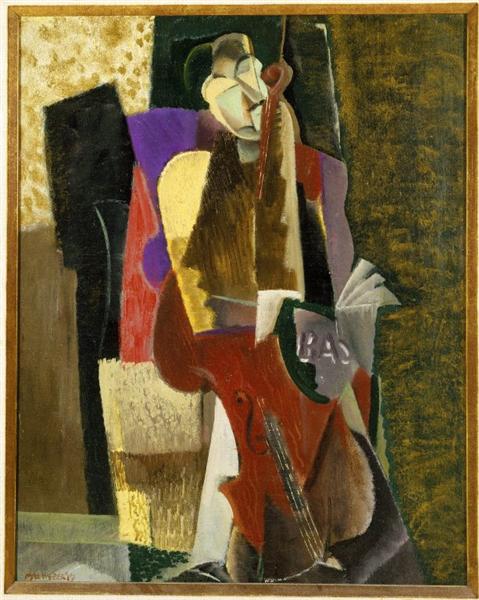
the-cellist.jpg!Large

        The Cellist (c.1917) 

              Max Weber

                 ______

what struck me immediately upon hearing
the bow’s very first strokes on the violin in 
this Fifth Cello Suite of Bach was that the 
mood was not only brashly Romantic, but 
quite specifically Russian Romantic, right 
up there with Dostoyevskyand Fiddler 
on the Roof, dark brooding colours at 
first, followed by long plaintive musical 
phrases, you can even hear the sound of 
the steppes, I thought, stretching out into 
the endless distance, this performance,  
surmised, is not, other than 
compositionally, Baroque, not to mention 
not even German 

yet as played by Mischa Maisky, it’s one 
of the best versions of the Fifth I’ve ever 
heard, and if it works, who’s to complain

but more context – Bach never gave not 
only textural indications, but not even 
tempos to his pieces, apart from the 
very dance terms that identify the 
movements, so what, therefore, is the 
specific pace, you’ll ask, of a courante, 
for instance, you tell me, I’ll reply

in other words, the modular terms were 
significantly looser in the early 18th 
Century than later, when metronome 
markings would begin to demand more
accurate replication of the artist’s 
explicit specifications – Beethoven 
especially made sure of that, by 
requiring accurate renderings of his   
mood or pace indications, largo,  
allegro, andante, for instance, still less  
strict than the stipulation later for exact 
musical beats per minute – trying to 
keep pace with a prerecorded tape, for 
example, as in again the industrially 
driven, which is to say emotionally 
indifferent, context of the seismic 
Different Trains“, masterpiece of a 
more technically conditioned era

I don’t think that Bach would at all have
been disappointed that the heirs of his 
fervent, though more genteelcreations 
might’ve morphed into something 
profound for other groups, be they 
national, or of a class, or of even a 
generation, of people, which is to say 
that these works have superseded 
their merely regional intent, and have 
reached beyond space and time, the 
very purview of music, to speak a 
common and cooperative, indeed a
binding, language

I said to my mom the other day that if
we all sang together, we could save
the world


R ! chard

psst: Maisky’s encore,, incidentally, is from  
          the Bourrée” of Bach’s Third Cello  
          Suitenote this contrastingmore  
          courtly – more refinement, more 
      reserve – rendition, you can even 
          hear, not to mention see, in this
          particular instance, not Russian 
          steppes, but European trees on 
          their baronial estates, if you lend  
          an attentive ear

Cello Suite no 3, in C major – Bach

narcissus(1)-1.jpg!Large.jpg

        “Narcissus (c.1599)

                Caravaggio

                     ______

what struck me about this most extraordinary
performance of Bach’s Third Cello Suite was 
nothing to do with the Suite itself, but with 
the work of the camera, right out of 
Caravaggio, I thought, a bona fide Baroque
artist also, what could the cameraman have 
known

stark contrasts, an absolute focus on the 
subject without much set decoration, no
consideration for extraneous, though 
perhaps effective, decorative elements 
to cloud the pictorial issue 

this is not at all Bach, incidentally, who 
relies on accompaniment, feeder notes, 
to shed light on the essential melody, 
often even nearly indistinguishable 
from the main statement 

both are considered Baroque, Bach,
Caravaggio, but I won’t be getting into 
it right nowit’s a long, and tortuous 
story

otherwise note, indeed, in Bach, the 
reiteration of clusters of music, forward 
propulsions, with incremental tonal 
variations, moving the melody forward, 
something lost during the later, more 
frivolous, Classical Period, but recovered 
eventually, two generations down, by 
Beethoven, kind of like children resemble 
their grandparents much more than they 
do their actual folks

eventually that becomes Minimalism, see,
for instance, Steve, Different Trains“, 
Reich


R ! chard

different trains – Reich / Bach

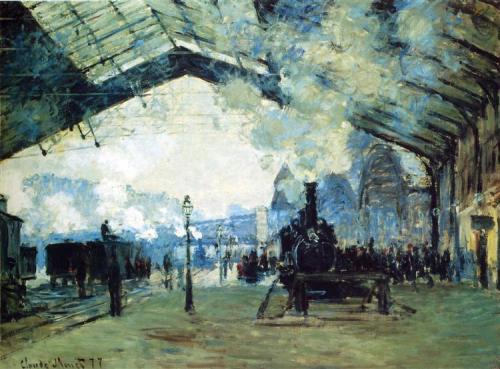
saint-lazare-gare-normandy-train.jpg!Large   

     “Saint-Lazare Gare, Normandy Train (1887) 

            Claude Monet

                   ________

since I’m on the subject of trains, let me
once again highlight a piece that, to my 
mind, is one of the most significant 
works of the 20th Century, Steve Reich’s
Different Trains“, an extraordinary 
homage to the victims of the Holocaust 

it is in three movements, America – 
Before the War”, “Europe – During the 
War“, andAfter the War“, Reich
recounts his impressions of train trips
that marked him throughout, therefore
this is an autobiographical work, as 
well as being an historical document,
and add to that a profoundly moving 
musical meditation on a pivotal 
moment in our history

I used to say that if you’re going to 
open your mouth, you should be 
either entertaining or informative,
preferably both, otherwise keep 
your mouth shut, many took 
offense, I must’ve been 
insufferable

but, I would opine, life is short, 
you’ll have to, I’m afraid, deal 
with your own shortcomings

Reich here has no shortcomings,
though at first you think this might 
be a long trip, with so many 
repeated musical clusters, not to 
mention the strident atonality, it  
soon becomes evident that this  
piece is amazing, a personal and
powerful evocation of a particular 
transformational event seen 
through the eyes of an innocent,
an American child, a poet, 
experiencing, however 
metaphorically, the horror of this
defining moment

style and content, information and 
entertainment, indissolubly gel to 
deliver an unforgettable experience, 
my own such pivotal moment 
would’ve been the Cold War air raid 
shelters, the nuclear threat

Reich holds on to Classical 
conditions by a mere thread, tempo, 
however variable, is solid throughout 
as a rock, dictated by the prepared 
tape that the instrumentalists must
follow rhythmically like a clock

another divergence from the 
Classical model is that tonality  
and recapitulation, apart from the 
repetition of musical clusters, is 
entirely jettisoned 

note, however, the same use of 
repeated clusters in Bach, to 
simulate propulsion, the 
minimalism of the 20th Century is
already prefigured in Bach’s stuff

plus ça change, as we say in French,
there is nothing really new, in other
words, under the sun


in the spirit of juxtaposing items
to discover much more than the 
sum of their parts, listen to Bach’s 
Second Suite, in D minor, for 
inspirational clarification 


R ! chard

psst: there were no trains at the time 
          of Bach, I should note, they were 
          a product of the later 19th-Century,
          its Industrial Revolution, see, for 
          instance, here, or above

an homage to the victims of the Titanic

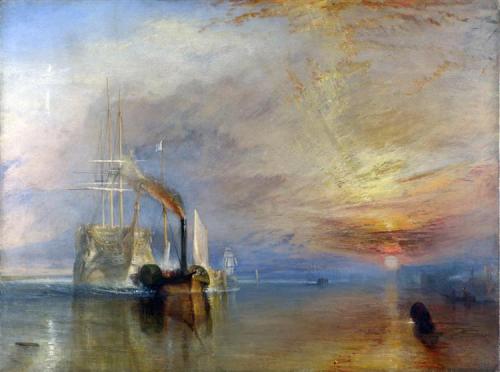
the-fighting-temeraire-tugged-to-her-last-berth-to-be-broken-up-1839.jpg!Large

  The Fighting Temeraire tugged to her last berth to be broken up (1839) 

          William Turner

                _______

while I’m on the subject of threnodies
which is to say “song[s] of lamentation
for the dead”, as I earlier statedlet me 
bring your attention to this extraordinary 
piece, an homage to the victims of the
Titanic
 
it doesn’t even have a title, much as 
Mozart and Haydn didn’t before music 
went mainstream, into public forums 
rather than merely aristocratic salons, 
and when an identifying moniker 
instead of a number became manifestly 
more practical, especially when the 
emerging Middle Classes were 
becoming the ones who were paying 
the composer’s bills, at the opera 
houses and the other sprouting 
concert venues, when some composers 
had even up to 32 sets of piano sonatas 
to remember, three and four often to 
a single set, opus number, as many as 
there are movements in a very sonata

and that’s not counting the numbered 

symphonies and string quartets of 
theirs, left to similarly calculate, 
decipher, extricate

it doesn’t have a title, I think, because
to my knowledge, it is the first of its
kind, a composition created by 
computer, for computer, an entirely 
self-contained digital work of, 
manifestly, art – I’d been waiting, 
diligently, for one – and like Beethoven, 
after the work was done, the artist(s)
just felt the title best left to the 
wordsmiths, thus – you’re welcome –  
Threnody for the Victims of the 
Titanic

sure, computers have done practical
things before, admirably, but never 
told a story, and certainly never one 
as profound as this one

these are the last moments of the 
Titanic, digitally reproduced, in real 
time, 2 hours and 40 minutes, they
are mesmerizing, you don’t want 
to miss a thing

there are no voices, apart from a 
few radio transmissions at the 
start, spotting the iceberg, calling 
out commands to beware, stop 
the engines

afterwards only silence, and the 
sound of the waves, the churning
of the engines, which have been 
restarted, sounding as rhythmic, 
incidentally, and numbing, as the 
wheels on the railroad tracks of
Steve Reich‘s Different Trains“,
another powerful threnody 

later the flash and crack of flares,
the crunch of the ship sinking  

the pervasive, however disrupted, 
silence and the inexorable passage 
of ever ticking time combine to be, 
thereafter, transfixing, meditative, 
ultimately transcendent, a fitting 
setting for a threnody 

I know of only another work to take
you to that venerable place,
Beethoven’s opus 111

and often enough Pink Floyd, for 
that matter, and the visionary 
Alan Parsons Project, of course, 
discoursing on inexorable Time 

and, now that I think of it, Elgar‘s
The Dream of Gerontius, whose 
character goes from his deathbed 
in the first act, to his afterlife in 
the second, effecting transcendence
for us by, yes, ingenious 
metaphorical proxy

but I digress

what I call Threnody for the Victims 
of the Titanic is a narrative with 
sound, not a movie, not a television
program, it has more commonality 
with a musical production than 
anything else but painting in art 
history, though its means are 
intuitively literary, ship stories go
back to The Odyssey through
Gulliver’s TravelsTreasure 
Island and to one of my very 
favourites, Ship of Fools“,
relatively recently

I could add Mutiny on the Bounty“,
Moby Dick“, “The Caine Mutiny 

in art, a precedent would’ve been set
in our collective consciousness by 
William Turner‘s celebratedThe 
Fighting Temeraire …, but I would 
mention as well Caspar David 
Friedrich‘s The Wanderer above 
the Sea of Fog for its existential
pertinence

a few literary points I’d like to stress
to back up my overt adulation, I find  
it impressive that the Classical rules
of tragedy have been maintained, 
unity of action, time, and place, 
prescriptions going back to 
Aristotle‘s Poetics in our cultural 
history, to profoundly express 
tragedy, iconic, epic, misfortune

not to mention the Classical musical
imperatives of tempo, tonality and 
repetition, none of which can be 
faulted here in this consummate 
composition

there is a no greater leveller of tempo 
than time, larghissimo here*, in the 
largest sense of that word, the 
cosmic, the inexorable pace of 
temporality in our brief heavens

a greater leveller of tonality neither  
is there than the rigorously impartial 
hum of the imperturbable Cosmos 

nor is there greater repetition than 
uniformity, however disrupted by  
however fervent ever human 
intervention, see Sisyphus, or 
Martha in “Who’s Afraid of Virginia
Woolf for iconic disrupters

R ! chard

*   Shostakovich had asked the 
     Beethoven Quartet to play the first 
     movement of his 15th String Quartet,
     “Elegy: Adagio“, so that flies 
     drop dead in mid-air, and the 
     audience start leaving the hall from 
     sheer boredom  

     well this inspired elucidation is even  
     slower than that

threnodies: to the victims of Hiroshima, of the Holocaust, and to the Canadian North

The Scream, 1893 - Edvard Munch

       The Scream (1893) 

             Edvard Munch

                    ____________

before we leave too far behind the 
anniversary of the annihilation of
Hiroshima, August 6, 1945, let me 
introduce you to a piece that 
purports to pay it homage

if I didn’t bring it up before, it’s 
because the date was wrong, but
especially because the work 
offends me, the only thing I like
about it is the title, a thing of 
beauty, poetry – Threnody to the
Victims of Hiroshima – a threnody
is a song of lamentation for the 
dead, which worked for me, this 
one, no further than its title

there is nothing remotely 
reminiscent of the tragedy
throughout the piece, it is a 
collection of academic exercises,
pretensions, I think, without a 
heartbeat 

let me compare Steve Reich’s 
threnody to the victims of the 
Holocaust, the other signature 
Twentieth Century atrocity, his 
Different Trains“, a work in three 
movements, America – Before the 
War”, “Europe – During the War”, 
and After the War”, for string 
quartet and tape, upon which 
Reich has recorded interviews 
with people relating impressions 
from before the warduring, and 
after, according to the movements

the quartet, you’ll note, must keep 
time with the tape, and in this 
production visuals have been 
effectively added 

Glenn Gould had done something 
like this several years earlier,
incidentally, in his The Idea of 
North“, a threnody itself to that 
very idea, a masterpiece, a
groundbreaking transcendental
work of the imagination, with 
overlapping voices, which is to 
say human counterpointthough 
without string quartet

you’ll note that distressing tonalities
affect throughout this other, much 
more successful however, tribute
but the different rhythms of the 
recurrent, which is to say minimalist, 
rails keep you emotionally, as it were, 
on track

Different Trains is appropriately,
and profoundly, commemorative, 
not to mention unforgettable 

Richard