Just another WordPress.com weblog
Tag: Diana / Artemis – Goddess of the Hunt / of the Moon
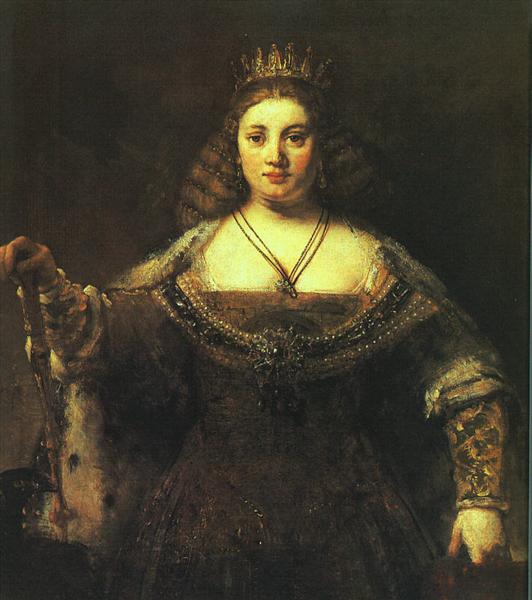
“Juno” (c.1662 – c.1665)
______
Actaeon’s suff’rings, and Diana’s rage,
Did all the thoughts of men and Gods engage;
Some call’d the evils which Diana wrought,
Too great, and disproportion’d to the fault:
Others again, esteem’d Actaeon’s woes
Fit for a virgin Goddess to impose.
The hearers into diff’rent parts divide,
And reasons are produc’d on either side.
remember, not all the gods were
on side
Juno alone, of all that heard the news,
Nor would condemn the Goddess, nor excuse:
queen, therefore, of the gods
She heeded not the justice of the deed,
But joy’d to see the race of Cadmus bleed;
For still she kept Europa in her mind,
And, for her sake, detested all her kind.
Europa had been whisked away
husband, and borne him several
children, to the enduring enmity
of the queen of the deities
Besides, to aggravate her hate, she heard
How Semele, to Jove’s embrace preferr’d,
Was now grown big with an immortal load,
And carry’d in her womb a future God.
philanderer apparently, had now
impregnated Semele, youngest
daughter of Cadmus, to Juno’s
utter disgust and dismay
Thus terribly incens’d, the Goddess broke
To sudden fury, and abruptly spoke.
let me reiterate here that the original
gods and goddesses of Olympus had
migrated with the Greeks to other
areas of the Mediterranean, but
became known, in the lands that
they’d settled, by other names
according to the languages and
customs that evolved in these new
territories, thus the Greek goddess
Hera was in Rome and its outlying
areas known as Juno, the Greek
though their home remained for
“Are my reproaches of so small a force?
‘Tis time I then pursue another course:
about his inveterate philandering,
her reproaches were not enough
to stop the god from his
determined activities
she therefore ordains
It is decreed the guilty wretch shall die,
If I’m indeed the mistress of the sky,
If rightly styl’d among the Pow’rs above
The wife and sister of the thund’ring Jove
(And none can sure a sister’s right deny);
It is decreed the guilty wretch shall die.
Juno / Hera is not only the wife of
sister, both children of Cronos /
were themselves children of the
earth goddess Gaia and the sky
She boasts an honour I can hardly claim,
Pregnant she rises to a mother’s name;
While proud and vain she triumphs in her Jove,
And shows the glorious tokens of his love:
though Juno / Hera did indeed have
she is probably no longer here
bearing him any, I am supposing,
while Semele, proud and vain, is
now show[ing] the glorious tokens
of his love
But if I’m still the mistress of the skies,
By her own lover the fond beauty dies.”
/ Zeus the cause of Semele’s
demise
This said, descending in a yellow cloud,
Before the gates of Semele she stood.
/ Zeus, would’ve been officiating at
the Cadmeia, the equivalent of the
Athenian Acropolis, at Thebes, the
city named after her father, its
sparks will surely fly
stay tuned
R ! chard
_____
In a fair chace a shady mountain stood,
chace, chase
a fair chace, not far away
Well stor’d with game, and mark’d with trails of blood;
Here did the huntsmen, ’till the heat of day,
Pursue the stag, and load themselves with rey:
rey, probably prey, cause rey is not
a word, and ray instead of rey would
lead to inanities, improbabilities, lead
to hunters, huntsmen, bearing branches,
or stalks, of flowers at best, at worst,
bolts of light
When thus Actaeon calling to the rest:
“My friends,” said he, “our sport is at the best,
The sun is high advanc’d, and downward sheds
His burning beams directly on our heads;
let’s take a break, Actaeon says, it’s
midday, too hot, it’s scorching
Then by consent abstain from further spoils,
Call off the dogs, and gather up the toils,
And ere to-morrow’s sun begins his race,
Take the cool morning to renew the chace.”
we’ve gathered sufficient quarry, he
continues, let’s wait until to-morrow,
for the cool[er] morning, in order to
renew the chace
They all consent, and in a chearful train
The jolly huntsmen, loaden with the slain,
Return in triumph from the sultry plain.
loaden, laden
the slain, the spoils from the hunt
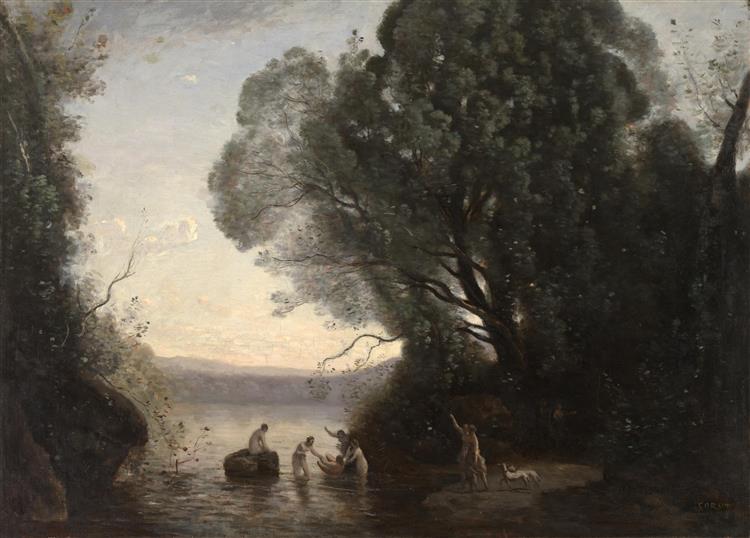
Down in a vale with pine and cypress clad,
Refresh’d with gentle winds, and brown with shade,
The chaste Diana’s private haunt, there stood
Diana / Artemis, goddess of the Hunt,
and of the Moon
Full in the centre of the darksome wood
A spacious grotto, all around o’er-grown
With hoary moss, and arch’d with pumice-stone.
From out its rocky clefts the waters flow,
And trickling swell into a lake below.
Nature had ev’ry where so plaid her part,
That ev’ry where she seem’d to vie with art.
to vie, to contend, to curry for
position, favour
Here the bright Goddess, toil’d and chaf’d with heat,
Was wont to bathe her in the cool retreat.
Here did she now with all her train resort,
Panting with heat, and breathless from the sport;
Her armour-bearer laid her bow aside,
Some loos’d her sandals, some her veil unty’d;
Each busy nymph her proper part undrest;
While Crocale, more handy than the rest,
Gather’d her flowing hair, and in a noose
Bound it together, whilst her own hung loose.
Five of the more ignoble sort by turns
Fetch up the water, and unlade the urns.
ignoble, not noble, lacking authority,
pedigree, courtly experience
unlade, empty
an idyll about to unravel
stay tuned
R ! chard

 Richibi's Weblog