Richibi’s Weblog

Just another WordPress.com weblog

Tag: Diana / Artemis – Goddess of the Hunt

“The Transformation of Actaeon into a Stag” (ll) – Ovid

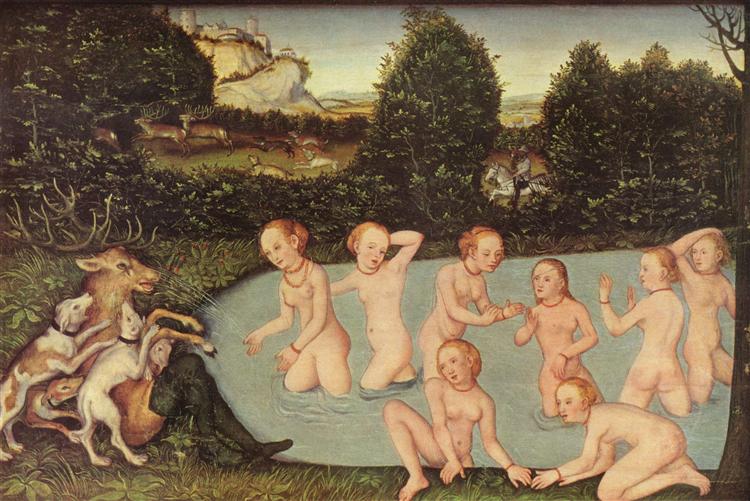
Diana and Actaeon, c.1518 - Lucas Cranach the Elder

          Diana and Actaeon

                 Lucas Cranach the Elder

                                   ____________


               Now all undrest the shining Goddess stood,
               When young Actaeon, wilder’d in the wood,


wilder’d in the wood, wandered

in the wild, in the forest


               To the cool grott by his hard fate betray’d,


grott, grotto


betray’d, treacherously confronted,

his hard fate would not be on his

side for this one


               The fountains fill’d with naked nymphs survey’d.


survey’d, observed, espied,

considered, contemplated


               The frighted virgins shriek’d at the surprize

               (The forest echo’d with their piercing cries).


listen, you can hear it


               Then in a huddle round their Goddess prest:
               She, proudly eminent above the rest,
               With blushes glow’d; such blushes as adorn
               The ruddy welkin, or the purple morn;


ruddy welkin, red sky, as at sunset


               And tho’ the crowding nymphs her body hide,
               Half backward shrunk, and view’d him from a side.
               Surpriz’d, at first she would have snatch’d her bow,
               But sees the circling waters round her flow;
               These in the hollow of her hand she took,
               And dash’d ’em in his face, while thus she spoke:


These, ’em, the circling waters


               “Tell, if thou can’st, the wond’rous sight disclos’d,
               A Goddess naked to thy view expos’d.”


not a warning here, but a curse, if thou

can’st being the operative expression,

for Actaeon, now in the process of

transformation, will no longer be able

to utter words


               This said, the man begun to disappear
               By slow degrees, and ended in a deer.


begun, began


               A rising horn on either brow he wears,
               And stretches out his neck, and pricks his ears;
               Rough is his skin, with sudden hairs o’er-grown,
               His bosom pants with fears before unknown:


the skittishness of a deer


               Transform’d at length, he flies away in haste,
               And wonders why he flies away so fast.


how did I do that, Actaeon wonders


               But as by chance, within a neighb’ring brook,
               He saw his branching horns and alter’d look.


his reflection, however by chance,

however inadvertently, in the water, 

the neighb’ring brook, reveals to him

his transformation, his metamorphosis


               Wretched Actaeon! in a doleful tone
               He try’d to speak, but only gave a groan;
               And as he wept, within the watry glass


the watry glass, the mirroring rivulet,

rill, waterway, brook


               He saw the big round drops, with silent pace,
               Run trickling down a savage hairy face.


the association with Bambi here for

me is inescapable, however grim

might be later Actaeon’s own fate


               What should he do? Or seek his old abodes,
               Or herd among the deer, and sculk in woods!
               Here shame dissuades him, there his fear prevails,
               And each by turns his aking heart assails.


something like the onset of puberty,

I think, that frightful fundamental

biological transformation, the fear,

the shame, remember


compare Calisto pregnant before the

very same goddess, Diana / Artemis

incidentally, the evidently unforgiving

deity before anything but unsullied

modesty, before uncompromised

chastity, who’s presently, consider,

condemning Actaeon


               As he thus ponders, he behind him spies
               His op’ning hounds, and now he hears their cries:


op’ning, advancing


               A gen’rous pack, or to maintain the chace,

               Or snuff the vapour from the scented grass.


or to … Or, either to … Or


maintain the chace … snuff the vapour,

dogs doing what dogs do


               He bounded off with fear, and swiftly ran
               O’er craggy mountains, and the flow’ry plain;
               Through brakes and thickets forc’d his way, and flew
               Through many a ring, where once he did pursue.


brakes, bracken, brush


a ring, a territory, a circumscribed

area


where once he did pursue, Actaeon

had earlier been not the hunted, but

the hunter


               In vain he oft endeavour’d to proclaim
               His new misfortune, and to tell his name;
               Nor voice nor words the brutal tongue supplies;


“Tell, if thou can’st, Diana / Artemis

had warned, and now [n]or voice

nor words the brutal tongue supplies,

allows, Actaeon, to speak


               From shouting men, and horns, and dogs he flies,

               Deafen’d and stunn’d with their promiscuous cries.


promiscuous, unleashed,

unconstrained


               When now the fleetest of the pack, that prest
               Close at his heels, and sprung before the rest,
               Had fasten’d on him, straight another pair,
               Hung on his wounded haunch, and held him there,
               ‘Till all the pack came up, and ev’ry hound
               Tore the sad huntsman grov’ling on the ground,
               Who now appear’d but one continu’d wound.


the attack


               With dropping tears his bitter fate he moans,
               And fills the mountain with his dying groans.
               His servants with a piteous look he spies,
               And turns about his supplicating eyes.


His servants, the jolly huntsmen, the

friends he’d advised to [t]ake the cool

morning to renew the chace


               His servants, ignorant of what had chanc’d,


what had chanc’d, the transformation,

the metamorphosis, Actaeon become

a stag


               With eager haste and joyful shouts advanc’d,
               And call’d their lord Actaeon to the game.


Actaeon seemed to them not there,

absent


               He shook his head in answer to the name;


he couldn’t speak, could only [shake]

his head


               He heard, but wish’d he had indeed been gone,


gone, away, in another place, as [h]is

servants thought him to be


               Or only to have stood a looker-on.


a looker-on, observing rather than

having been the centre, the subject

of the situation


               But to his grief he finds himself too near,


too near, indeed present, central,

in the very thick of the fray


               And feels his rav’nous dogs with fury tear
               Their wretched master panting in a deer.


Actaeon doesn’t survive this

transformation, nor is he

transmuted, like so many others

who’d displeased the gods, into 

sets of stars, or constellations


a recurring theme seems to be,

as the poem advances, how

arbitrary the fate of humans is

in the hands of the, apparently

capricious, gods


to follow


R ! chard


“The Story of of Cadmus” (V) – Ovid

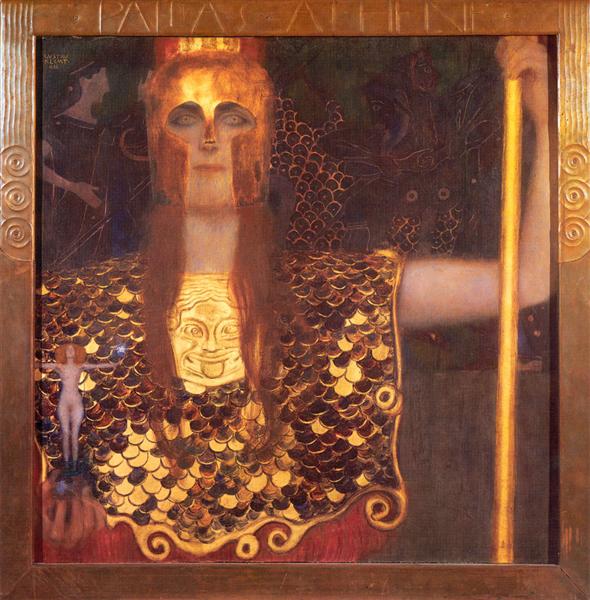
Minerva or Pallas Athena, 1898 - Gustav Klimt

         Minerva or Pallas Athena” (1898)


                Gustav Klimt


                       ______


an interesting thing has happened with

the story of Cadmus, he is not only a

mythical figure, but also a legendary

one, which is to say that Cadmus has

roots in actual history, he’s not just an

imaginary construct like those that

until now have peopled Ovid’s text


Cadmus appears to have actually

founded Thebes, whose origins,

however, are lost in antiquity, going

back to, it appears, the late Bronze

Age, around 2000 BC, goodness


stories evidently grew around

Cadmus, that transformed him into

our first documented hero, indeed

superhero


counterparts exist in other traditions,

consider David, for instance, who

slew his own dragon, Goliath, before

becoming king of the Israelites, 10th

Century BCE, at Jerusalem, where

he consorted, incidentally, later, with

Bathsheba, however illicitly, but

that’s another story


King Arthur, late 5th to early 6th

Centuries CE, stems from British

lore, though his historical actuality

has been contested, is also a hero

with preternatural capabilities based

on some historical accountability


in our day, there’s James Bond,

based on real, living and breathing,

personalities


or, dare I say, even Jesus


the point here is that actual people

are being included in the, however

culturally specific, mythologies,

which, in each, had earlier consisted

of metaphorical constructs merely,

the concept of History, in other words,

was being born, memorable events

were to be remembered, recorded,

documented, if only, originally, orally,

around, say, campfires, however

aggrandized might have been their

recollected heroes


Cadmus, meanwhile, in our story, is

about to establish his own historical,

and archeologically confirmed, note,

credentials


            The dire example ran through all the field,
            ‘Till heaps of brothers were by brothers kill’d;


The dire example, the dragon’s teeth,

grown into men, had begun, if you’ll

remember, to slaughter one another


example, display


            The furrows swam in blood: and only five
            Of all the vast increase were left alive.
            Echion one, at Pallas’s command,
            Let fall the guiltless weapon from his hand,


Echion, one of the five surviving

brothers


Pallas, Pallas Athena, goddess of

Wisdom, also of War


see above


            And with the rest a peaceful treaty makes,
            Whom Cadmus as his friends and partners takes;


the rest, the four other survivors


            So founds a city on the promis’d earth,
            And gives his new Boeotian empire birth.


promis’d earth, the premonition of

the oracles whose counsel Cadmus

had sought at Delphi, if you’ll

remember


            Here Cadmus reign’d; and now one would have guess’d
            The royal founder in his exile blest:


his exile, from Tyre, Cadmus’ original

home, from which his father, Agenor,

had sent him, not to return, he’d

warnedwithout his sister, Europa


            Long did he live within his new abodes,
            Ally’d by marriage to the deathless Gods;


Ally’d by marriage, at the end of a

period of penance for having killed

the dragon, which had been sacred

to Ares, god of War, the gods gave

Cadmus Harmonia, goddess of

Concord, to be his wife


Ares would eventually exact mighty

vengeance, but that’s another story


            And, in a fruitful wife’s embraces old,
            A long increase of children’s children told:
            But no frail man, however great or high,
            Can be concluded blest before he die.


even Cadmus, though he might

enjoy a long life, and many, a long

increase of, children, is not immune

to any of the vicissitudes of life either

until his own time has come, the poet

advises, however ominously


and here Ovid also introduces the

subject of his next metamorphosis,

Actaeon, however early, luring us

thereby, deftly, literarily, towards

his next instalment, Actaeon’s

story, eponymously, there, given

its title


            Actaeon was the first of all his race,

            Who griev’d his grandsire in his borrow’d face;

            Condemn’d by stern Diana to bemoan
            The branching horns, and visage not his own;


his grandsire, his grandfather,

Cadmus was the father of Autonoë,

who was the mother of Actaeon


borrow’d face, Actaeon was

transformed into a stag by the

goddess Diana / Artemis, of the

Hunt, of the Moon, of Chastity,

for having seen her naked as

she was bathing


he now has the face, the visage, of

someone, something, he hadn’t

been before, borrow’d


            To shun his once lov’d dogs, to bound away,
            And from their huntsman to become their prey,


having been transformed into a

stag, or metamorphized, Actaeon

would end up hunted, and worse,

by his own, once lov’d, dogs


            And yet consider why the change was wrought,
            You’ll find it his misfortune, not his fault;
            Or, if a fault, it was the fault of chance:
            For how can guilt proceed from ignorance?


to have been at the wrong place

at the wrong time, yet to suffer,

however unfairly, the consequences,

that, Ovid asks, is the question, the

conundrum


stay tuned


R ! chard

“The Story of Coronis, and Birth of Aesculapius” (IV) – Ovid

adam-elsheimer-apollo-and-coronis-2

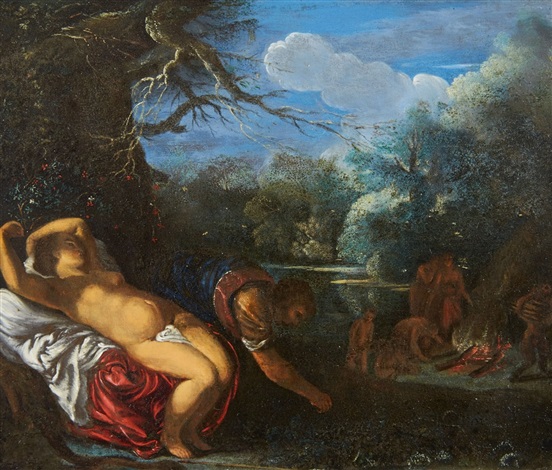
   “Apollo and Coronis (1606 – 1608)


                Adam Elsheimer


                   __________


               On her incestuous life I need not dwell 
               (In Lesbos still the horrid tale they tell), 
               And of her dire amours you must have heard, 
               For which she now does penance in a bird, 
               That conscious of her shame, avoids the light, 
               And loves the gloomy cov’ring of the night; 
               The birds, where-e’er she flutters, scare away 
               The hooting wretch, and drive her from the day.” 


Nyctimene, daughter of Epopeus

king of Lesbos, a Greek Island in

the Aegean Sea, had been defiled 

by her father, Minerva, out of pity,

transformed her into an owl, the

above verses tell the story of

that owl, Nyctimene


               The raven, urg’d by such impertinence, 
               Grew passionate, it seems, and took offence, 
               And curst the harmless daw; the daw withdrew: 
               The raven to her injur’d patron flew, 
               And found him out, and told the fatal truth 
               Of false Coronis and the favour’d youth. 


the raven, Apollo’s own bird, having 

discovered Coronis to be unfaithful 

to their master, its and hers, remained

intentdespite the daw’s warnings,

earlier here reported, on informing

the god of the Sun 


               The God was wroth, the colour left his look, 


wroth, angry


               The wreath his head, the harp his hand forsook: 


[t]he wreath, … the harp, Apollo’s

usual attributes, symbols of his

harmony, concord


               His silver bow and feather’d shafts he took, 
               And lodg’d an arrow in the tender breast, 
               That had so often to his own been prest. 


though Apollo is not usually 

associated with bows and arrows,

his twin sister Diana, goddess of

the Hunt, always is, it would not 

be unusual to conflate the two 

deities for poetic, or indeed

mythological, purposes


               Down fell the wounded nymph, and sadly groan’d, 
               And pull’d his arrow reeking from the wound; 
               And weltring in her blood, thus faintly cry’d, 
               “Ah cruel God! tho’ I have justly dy’d, 
               What has, alas! my unborn infant done, 
               That he should fall, and two expire in one?” 
               This said, in agonies she fetch’d her breath. 


it is supposed here that the unborn

infant is indeed Apollo’s


               The God dissolves in pity at her death;

               He hates the bird that made her falshood known, 
               And hates himself for what himself had done; 
               The feather’d shaft, that sent her to the Fates, 
               And his own hand, that sent the shaft, he hates.


Apollo is suffused with regret, anger,

self-recrimination


               Fain would he heal the wound, and ease her pain, 


Fain, with pleasure, gladly


               And tries the compass of his art in vain. 


the compass of his art, the range 

of his ability, in this case vain, 

faulty, ineffective


               Soon as he saw the lovely nymph expire, 
               The pile made ready, and the kindling fire. 


pile, pyre


the sentence lacks a verb here, it 

should read The pile was made 

ready, just saying


               With sighs and groans her obsequies he kept, 


obsequies, funeral rites


               And, if a God could weep, the God had wept. 


I’ll have to watch out for gods

weeping, I suspect some have, 

some can


               Her corps he kiss’d, and heav’nly incense brought, 
               And solemniz’d the death himself had wrought. 


corps, body, corpse


wrought, brought about, made

happen


               But lest his offspring should her fate partake, 
               Spight of th’ immortal mixture in his make, 


Spight, in spite 


               He ript her womb, and set the child at large, 
               And gave him to the centaur Chiron’s charge: 
 

Chiron, first among the centaurs,  

half man, half horse, was highly 

revered as a teacher, having 

been raised by the twins, Apollo 

and Diana / Artemis, supremely

accomplished deities


               Then in his fury black’d the raven o’er, 
               And bid him prate in his white plumes no more. 


black’d, Apollo turned the snowy 

plume[d], [w]hite as the whitest 

dove’s unsully’d breast raven 

black


prate, babble, talk incoherently


R ! chard