Richibi’s Weblog

Just another WordPress.com weblog

Tag: Debussy

Debussy, “L’isle joyeuse”‏ (“The Joyous Island”)

here’s Daphne doing Debussy, his L’isle joyeuse, from 1904,
a long way from Beethoven, 1798 
 
had it not been for Beethoven though, making music into a
language, instead of merely a Mozartean, a Haydnesque
aristocratic entertainment, Debussy wouldn’t have even
been possible, where were their “Moonlight Sonata“s, their
Tempest“s, their “Appassionata“s for that matter, their
Hammerklavier“s, these earlier composers, for a weightier,
more abstract, topic, Mozart and Haydn were having courtly,
though ever so inspired, fun, while Beethoven would proclaim,
pronounce, discover and describe, open up to the imagination,
upon these earlier, nevertheless mighty, Classical shoulders,
a whole new, transfigured, world
 
 
L’isle joyeuse is not a sonata, it only has one movement,
I would call it a soundscape, were I to define it, Monet,
1840-1926, is written all over it, the same shimmer,
ephemerality, must’ve been the light, not to mention of
course, at his most ethereal, Beethoven
 
 
Richard      


Beethoven: piano concerto no 5, in E flat major, opus 73‏

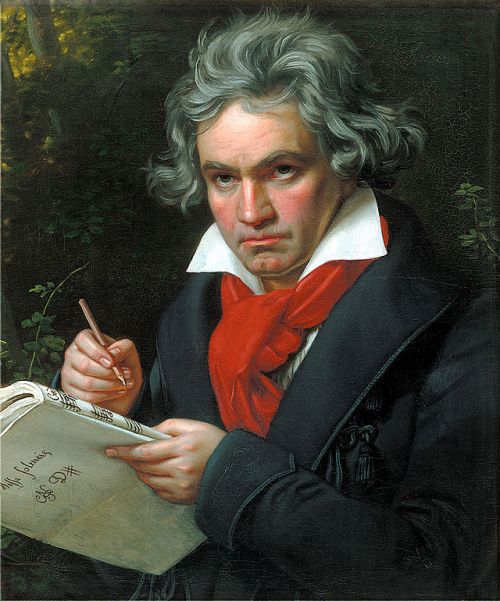
"Beethoven" - Joseph Karl Stieler

A portrait of Ludwig van Beethoven (1820)

Joseph Karl Stieler

_____________

you might say a triumvirate of piano concertos dominate
our Western musical culture, a veritable trinity of pianistic
masterworks that tower over, and have ruled, our musical
consciousness throughout the modern epoch, the
Rachmaninoff 3 has been one of them, but the 5th of
Beethove
n is surely the granddaddy, the “Guppa” as a
favourite grandchild I know would say, the Olympian
Zeus, the Christian God the Father, of them all, in majesty
and authority, others quake in its overwhelming aura, it is
the sun to all the other stars

Glenn Gould is the standard still by which it should be
played, none yet, to my mind, has surpassed him

Karel Ancerl conducts the Toronto Symphony Orchestra,
a competent orchestration, overshadowed inevitably by
this prodigy, who nevertheless doesn’t ever flaunt his
finger play but remains faithful throughout to the
dictates, the tonal balances, of the music, it is 1972

I had mentioned “variations in volume, tempo, tonality,
the play of harmonization and discords” in Rachmaninoff
,
note the strict adherence to tempo here, even the fastest
runs of notes are grounded in beat, more solid, less elusive
than the iridescent Rachmaninoffian allusions to Debussy,
you could set a metronome to the appropriate tempo of
each individual movement in Beethoven, it would remain
constant, apart from a few restrained ritardandos near
the end of some musical elaborations, until its very final
apotheosis, beat was ever an anchor for the fulgurating
Beethoven, an article of faith from which he strayed only
with great circumspection

note the language is not emotional, passionate and ardent,
but philosophical, metaphysical, Beethoven is confronting
cosmological considerations, existential realities, not the
more emotional concerns that confound us every day, it’s
God he’s talking to, eternity, not the incarnate tendrils
of the moment, not the poignant stuff even of soon
through Schubert a Chopin, Beethoven was at the start
of that Romantic Movement, indeed its very first
proponent, but not quite ready to wear his heart itself
on his sleeve, but a more spiritual, probing reason, whose
ardent metaphysical ratiocinations would set all the others
on fire, setting the stage for all the other stars

later, if you haven’t guessed what it’ll be already, I’ll
supply you with the third concerto, the Holy Ghost, of
the trinity, the Apollo, god of music and the sun, among
our concert greats

Richard
Rachmaninoff: Piano Concerto no 3, in D minor, opus 30

fully 150 years after Mozart the concerto was still a thriving
musical form though it had undergone some modifications,
you’ll hear a more passionate account in Rachmaninoff than
the more lyrical, less emotionally overt compositions of
Mozart, the variations in volume, tempo, tonality, the play
of harmonization and discords, all incidentally within a single
movement, show the passage of time, of Beethoven, of Chopin,
of Debussy between Mozart and the more Romantic, Impressionistic
Rachmaninoff, note the sweeping ritardandos, where the beat is
drawn out, stretched for pathos, a Chopinesque insinuation into
music not found in earlier stuff, one imagines torrid expressions
of fervent sentiment, note the evanescent flurry of notes passing
by like the fleeting glitter of stars, the ephemerality of an
incorporeal idea that Debussy originated and brought to music,
and of course note the irrepressibility, the authority, the masculinity
of a volcanic Beethoven underpinning the lot, you can hear them all

the Vladimir Horowitz Piano Concerto no 3 of Rachmaninoff at
Carnegie Hall, January 8, 1978, with Eugene Ormandy leading the
New York Philharmonic Orchestra is, after Van Cliburn’s historic
1950s account, May 19, 1958, again at Carnegie Hall but under Kiril
Kondrashin this time, and the now defunct Symphony of the Air,
don’t ask, the one I then grew up with, it was riveting even without
the pictures

with pictures here he is again a few months later at Avery Fisher
Hall in New York, September 24, 1978, under Zubin Mehta with
again the New York Philharmonic, so good you’ll even forgive
Mehta his usual sentimental excesses

incidentally Horowitz was 74 at this concert, he is astounding

Vladimir Horowitz, colossus and legend, 1903 -1989

enjoy, be transported, be transfixed, you have been warned

Richard