Richibi’s Weblog

Just another WordPress.com weblog

Tag: Debussy

a veritable Schubertiade, III

Impression, sunrise, 1872 - Claude Monet


     Impression, Sunrise (1872) 


               Claude Monet


                   ________


what struck me most about Schubert’s Piano 

Sonata no. 17 in D major, his D850, was, more

than its emotional impact, its technical

wizardry, from the start Schubert dazzles with 

his prestidigitation, his manual dexterity, the

notes fly


there’s a lot of Beethoven in this composition,

working against the beat, apart from the fourth 

movement, the rondo, Schubert is being 

unequivocally Beethoven


the fourth movement is, incidentally, utter 

Mozart, you can tell from the preponderance

of trills


texture, meanwhile, overcoming melody, 

in, most notably, the third movement, is 

right out of Chopin, his Winter Winds 

for instance, an inspired combination

of both melody and texture, where is

the supremacy of either, listen, you tell 

me, do the Winds conquer the groans, 

the tribulations, of the underlying melody, 

the left hand, the low notes, the chthonic, 

the earth, or does the dexterousness of 

the right hand, the ephemeral, the 

transitory, win the day


texture will overcome melody eventually, 

as the century moves along, Impressionism 

will prioritize perspective over emotion, the 

head over the heart, Debussy, among 

others, Renoir, Monet, Pissaro, will 

dominate, see above,  but that’s another

story


meanwhile Schubert


listen


R ! chard

how to listen to music if you don’t know your Beethoven from your Bach, XVIII – Rachmaninov

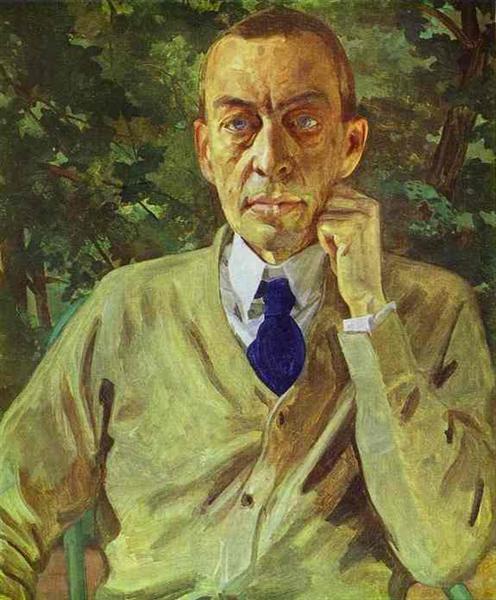
Portrait of the composer Sergei Rachmaninov, 1925 - Konstantin Somov


     Portrait of the composer Sergei Rachmaninov


                   Konstantin Somov


                                ______


though you probably still wouldn’t be able

to tell a prelude from a hole in the wall, 

nor, admittedly, can I, unless indicated,

if you’ve listened to the pieces I’ve

recently presented, you’ve noted, even 

merely sensed, really, that the preludes 

of one composer don’t sound at all like

those of the others, Bach doesn’t sound 

like Chopin, who doesn’t sound at all   

like Debussy, the first step in telling  

your Beethoven from your Bach, as 

promised in my title


you might not even be able to tell which  

is which as you’re listening, but you can

tell they’re different, you do the same 

thing telling your Monet from your 

Renoir


Rachmaninov also wrote, like Chopin, 

and Debussy, 24 preludes, and, like 

Chopin, in every key, major and minor


but spread out through three publications, 

Opus 3, no. 2from 1892, comprising of 

only one prelude, but a scorcher, The 

Bells of Moscow, listen

a second set, Opus 23, consists of ten, 

mostly iconic, pieces, you’ve heard 

them somewhere before, therefore 

iconic


the final set comes out in 1910, 

Opus 32with thirteen preludes,

for a total of 24


you’ll marvel, even Marilyn Monroe 

famously did


enjoy 


R ! chard 

how to listen to music if you don’t know your Beethoven from your Bach, Vl

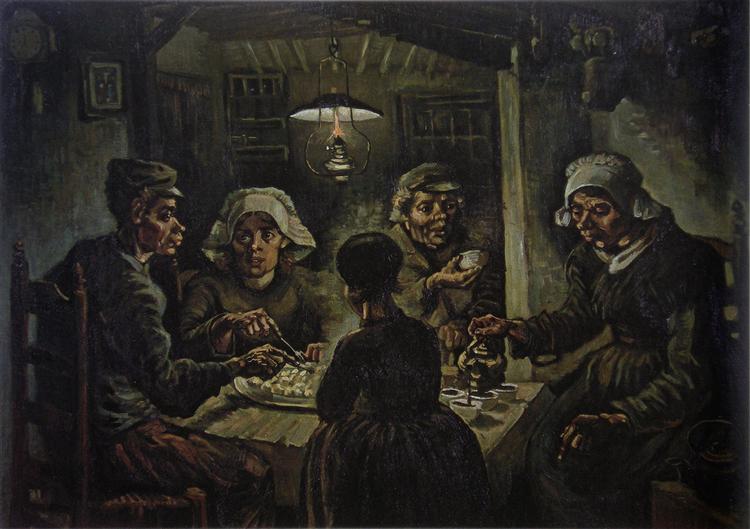
The Potato Eaters, 1885 - Vincent van Gogh

            The Potato Eaters” (1885)


                   Vincent van Gogh


                        ___________


where do you start with Chopin, he is

in our Western cultural bloodstream,

as identifiable in music as, say, van

Gogh is in painting, you don’t need 

to be interested in any kind of art to

have not been given even only a

whiff of these iconic artists


nearly anything I might present here

of Chopin you’ve probably already

heard somewhere before, if only in

bits


of van Gogh, well, he goes back in

the public imagination to at least

Vincent1971, the song, no one

doesn’t know about him, when I

heard it playing in Amsterdam at

the museum, with the first piece I

saw, The Potato Eatersdominating

the first wall, insisting on van Gogh’s

vision, his prophecy, his profound

compassion, I cried, I understood

what art is, see above


Chopin exerts a different kind of,

however equally potent, magic


Mozart might sound like Haydn,

Beethoven might sound like

Schubert, all of the Impressionists

sound like all of the Impressionists,

be they Ravel, Debussy, Satie, or

Saint-Saëns, to the untrained ear


but no one sounds like Chopin,

he’s, culturally, a North Star


here’s one of his nocturnes, the

moonlit one, in E flat major  


here’s a polonaisehere’s an étude,  

in English, a study, a finger exercise,

an iconic, here, prestidigitation


here’s an impromptu, his very,

indeed, Fantaisie-Impromptu, just

to get your categories going


consider its construction, having

some information already about

fantasias, a work of the imagination,

open to any experimentation within

the confines of one movement, with

an impromptu, something purported

to have been created on the spot,

also in one movement


the answer requires you to sharpen

your aesthetic pencil, always a

delight – an impromptu, a

spontaneous invention, a fantaisie,

a work of the imagination, how do

they differ, which part is a fantaisie,

which an impromptu, how do they

nevertheless coalesce


this exercise is the first step in

listening


enjoy


R ! chard

Piano Concerto no 2 in G major, opus 44 -Tchaikovsky

beech-grove-i.jpg!Large

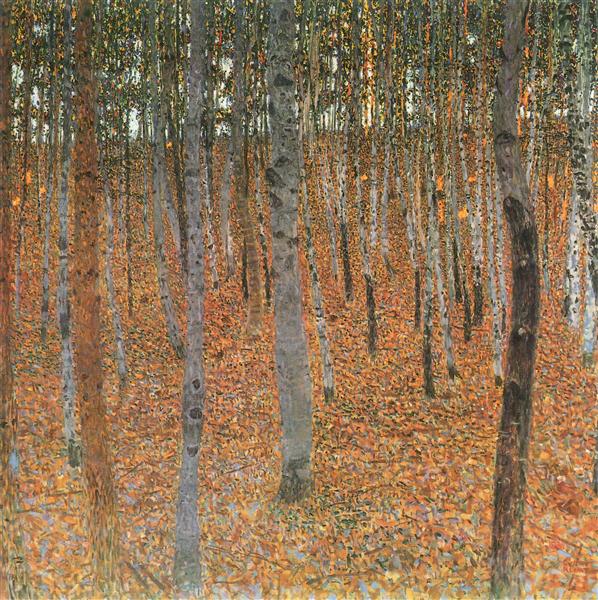
    Beech Grove I (1902) 

           Gustav Klimt

                 ________

if a sonata, or any composition for one 
instrument, is a meditation, a rumination,
an introspection, a concerto is its entire
opposite, it’s a declamation, a very 
harangue, the performer is not only 
before an audience, but before an
orchestra, before the conductor of that 
orchestra, that soloist had better be, 
therefore, something

Tchaikovsky’s 2nd Piano Concerto 
hasn’t cut the cultural mustard, you’ve
probably never heard of it, never mind 
heard it, not even in the miasma of our 
collective unconscious 

why

who knows, it’s magnificent

I suspect that Moscow’s distance, 
St Petersburg’s, might’ve had something 
to do with it, Russia would still have been 
a backwater to Europe, regardless of what
Catherine the Great might’ve done for its
intellectual edification, indeed a veritable 
Elizabeth the First, Queen of England
she, in her sponsorship of the arts

something like that happened, but in 
reverse, to Gustav Klimt, Egon Schiele 
in art, SchoenbergBerg, Webern, the 
Second Viennese School in music, in 
literature, Robert Musil, his The Man
Without Qualities very rival to 
Proust‘s epic trip down memory lane, 
Remembrance …“, when the centre 
of gravity for the arts moved from 
Vienna to Paris in the late 19th 
Century with the advent of 
Impressionism

France had entered its Fourth
Republic by then, was to finally 
entrench its democracy, and we got 
MonetDebussy, and indeed Proust 
instead, not to mention all of that 
city’s celebrated others

leaving creative Vienna, meanwhile,
the undisputed engine of the Zeitgeist
the spirit of the times, for over three 
quarters of an earlier century, thereby,  
in the dust

New York would take over in the 
1950s, similarly, for a time, Andy
Warhol and The Factory, eclipsing 
any other town

in other words, location, location, 
location, in tandem with historical 
events


R ! chard

miracles‏

when I started looking for miracles,
I found out that there indeed were
some, as a matter of fact, many

here’s another, in case you missed
the last one

Richard

a Chopin Fantasia‏, opus 61

 
to be specific, opus 61, you’ll more easily notice 
already the more abstract peregrinations of his
disciple, Debussyand even the first stirrings of
improvisation incidentally, which is to say the
free-wheeling of idiosyncratic jazz, the very 
inversion of Classical order, personal expression
was trumping even ecclesiastical dictates, those 
very earlier immutable fundamentals of the long
unimpeachable Ten Commandments  
 
Oh Moses, Moses you stubborn, splendid, adorable 
fool, as Anne Baxter, Nefertiri, pagan, therefore 
insidious seductress, would admonish in the film
pronouncementsa film which of course fashioned 
the Biblical iconography of my entire generation,
a veritable Divine Comedy” for our still recent
enough times, nothing has come up to displace it
meanwhile, though a progressively alternative
cultural morality seems steadily to harken
 
was Moses then a fool, a Prometheus in Christian
clothing 
 
time alone tells, and time is an inveterately
temperamental arbiter
 
 
it would appear now that faith equals
unconditional conformity, when I thought
that faith could not, by definition, be
constrained, faith had been meticulously
a considered personal conviction, an
individual emancipation rather than a
conformist, and nefarious ultimately, it
would appear, code 
 
I count on thoughtful efflorescence then,
and a garden of societal consideration, 
a pantheistic and cooperative accord
 
not excluding, let it be noted, the indeed
worthiest, by thoughtful process, of those
very Ten Commandments 
 
without my own children, for instance, I
still recommend honouring one’s parents,
this will bring, I knowlegeably warrant, 
untold benefits, indeed grace, peace and
profound satisfaction, plenary solace to
the very reaches of each our indeterminate
soul
 
take it right here from an appropriately  
distinctive Chopin, unparalleled poet to
the panoply of possible gods   
 
 
Richard


Debussy Preludes, Books 1 & 2‏

if Debussy composed not only Études, in the manner 
of Chopin but Préludes” as well, Book 1 and Book 2,
with only twelve preludes apiece however, but for an
equal number of 24, to cover likewise all the keys, it
might be that his piano teacher, Mme de Fleurville, a
student of Chopin, she claimed, would have had him
duly practice her master’s musical methods, manner 
and propositions, accounting for the similar textures,
colours and even templates the diligent acolyte uses,
devout responses in effect to his mentor’s mentor
 
but time and temperament get in the way of an exact
of course replication 
 
Chopin follows the narrative line of melody, whereas
Debussy evokes a more nebulous mood, the line of
Romantic heroism has given way to the more abstract
investigation of the amorphous psyche or, if you like,
the suprarational soul, after Freud’s most recent
uncovering and elaboration of consciousness  
 
listening to Debussy therefore is more like looking at
a painting than reading a book, you are moved by the
evocative aspects of the composition, colour, texture,
tone, rather than by the chronological tale it no longer
tells  
 
unbending truth has given way to perspective, stream of
consciousness has superseded the narrator’s traditional
linear omnipresence, for better or for worse 
 
 
Richard
 
psst: Europe, as I was informed by a friend of mine, is
         celebrating Debussy‘s 150th birthday this year,
         he was born August 22, 1862
 
         may he live forever 
 
 
         thanks, Lajla


Chopin “Études”, opus 25‏

if the Debussy, was a bit too fast a move from Chopin’s
Romanticism, his enchanting melodies wrought with
pressing and intent emotion to tug at your most
unresisting aural senses, into a 20th Century of
cynicism and machinery, speed, neurosis, world war,
it was probably too fast for those who actually lived
it as well, just as we think of our own world as out of
control, ultimately the swoons of Chopin would no
longer cut it alone as mileposts towards so unmoored
a future, a heretofore beyond mere private emotions,
other voices would come up responding to further
calamities, inconsistencies in the cultural argument,
where the poet no longer could stand prophetically
alone, there were others also to tend to, and nations
and even new ideologies burgeoning, social, sometimes
sinister even, experiments, Romanticism would have no
choice but to cede to the imperatives of a new, often
inclement, order

but that nevertheless choice still imprint is nowhere
near as definitive as Chopin before all that happened,
as people were still all celebrating and expressing
their newfound personal validity, freedom, worth,
fruit of the revolution not only of the political world
but of the cultural one as well

Elizabeth Barrett Browning is to my mind his only
literary equivalent, compare their equal ardour
and the likeness of their compelling muse

Daniil Trifonov, playing Chopin’s other set of
“Études”, opus 25, not only lives them, he’s
utterly possessed, he’s in Tel Aviv, it’s May, 2011

Richard

psst: the first Étude is called the “Aeolian Harp”,
the ninth the “Butterfly”, the second to last,
or eleventh, the “Winter Winds”, all of which
you might try to make out in passing, they are
not that difficult to identify, all the others are
named for their key

Debussy’s “Études”

 Man with a Guitar - Georges Braque
 
                    Man with a Guitar (1914)
 
                               Georges Braque 
 
                                       ______
 
 
while we’re on the subject of études, listening to 
hundred years later, 1830s to 1915, would prove
instructive, I deemed 
 
picture me deeming, August 3, 2012, my brow
just slightly pensively constricting 
 
 
if the basis of music as defined by the Classical
period depended on beat, tonality, and the repetition
of the tune, usually of both musical statements, these
apparently essential components of course would be
the first places to bear the scrutiny of probing musical
minds, seeking to find, seeking to set more expansive,
more profound dimensions to the areas of their quest,
that’s what artists do 
 
and this of course is exactly what happened starting
with Beethoven, by the time of Chopin music had
relaxed its stricter Classical rhythmic precision,
allowing great expansive gestures in the more
malleable tempi, tempos, producing the effect of
more compassion and soulful examination than
the earlier less indulgent, more disciplined code
 
the fact of having musical tapestries, sound patches,
take the place of melody, narrative, in the musical
presentation of Chopin also suggests a more
diversified, dare I say prismatic, telling, than the 
linear account of for instance Mozart‘s solitary
tuneful wanderer
 
it also evokes incidentally the vagaries of the
inconstant heart rather than its unflinching
condemnation, a repudiation of atavistic
Christian ecclesiastical intolerance 
 
 
by the time the old order was about to be extinguished,
in 1915, at the onset of the First World War, Debussy’s
Études, like Chopin 12 of them per set, had seen
social injustice – see Charles Dickens, see Émile Zola,
see Karl Marx – the improbable discoveries of science –
Darwin, Freud, Einstein – the car, the airplane,
photography were changing everything, the old
paradigms no longer applied, were irrelevant, even
harmful, in this new context, the First World War 
would prove all that 
 
in the language of music, tempo, melody, repetition
would be inevitably subverted
 
Debussy produces erratic tempi, foregoes melody for
harmonic exploration, combining incidentally the
musical patches of Chopin with the intellectually
driven investigations of Beethoven for a more
cerebral understanding of music, a music for the
head, with expert displays of pianistic skill, indeed
prestidigitation, for, along with the intellectual
rigour, spectacle  
 
is this then still music 
 
is Post-Impressionist painting still art  
 
what would 1915 have said
 
 
above is Georges Braque‘s nearly contemporary, 1914,  
 
man with a guitar, who’d a thunk it
 
 
Richard


Chopin: “Études”, opus 10

if I haven’t brought up Chopin much in this series
it’s that I think of him more as a decorator than
as an innovator, he was developing a sensibility
that had been defined by the earlier Beethoven,
adding texture and style, form instead of function,
the wheel had been invented, now it remained to
be artfully applied
 
some break new ground, others decorate it, make
it enchanting, Chopin makes things enchanting 
 
he is also the first composer we think of when we
think of Romanticism, which says quite a lot about
the quality, the universality, of his gift 
 
 
here are his opus 10, “Études”, or “Studies”, 12 of
them, they are not sonatas, for not having more
than one movement, they are “études” , “studies”,
called by that name for being what they are, then
given numbers to differentiate them, also their
key, the convenience of universally attributing
titles not having quite caught on yet though a
couple of these do have them, the 5th, the
“Black Keys”, for obvious reasons, and the last,
the “Revolutionary”, again for reasons you’ll find
obvious once you’ve heard it 
 
tonality however remains, no apparent discords,
that’ll come later  
 
 
note that in comparison to Mozart the notes are
a shimmer, the same alphabet is used, the one
set up by Bach, but where Mozart made these
into narratives to follow, and even sing along to,
with Chopin the same flurry of notes becomes
a wash of sound you could never vocally keep
up with, a texture rather, an enveloping caress,
prefiguring incidentally the Impressionists, the
lush soundscapes of for instance Debussy 
 
 
though you’ll find the same prerequisite opening
musical statement as in Mozart, followed by the  
contrasting one, often these will be in altogether
constrasting rhythms as well, tempi, compared
to the single strict beat throughout of the 
foundational Classical model    
 
the tempo itself is also much more lax, some
passages surrendering formal rhythmic strictures
to greater emotional content, more self-expression,
less attention to rules, in accord with the newly
installed ideal of individual human rights 
 
hence Romanticism, the fruit of the Revolution 
 
 
note also that the musical argument is no longer
in the Mozartean playground but of a more mature
understanding, Chopin has known love 
 
 
Richard