on the origins of the waltz
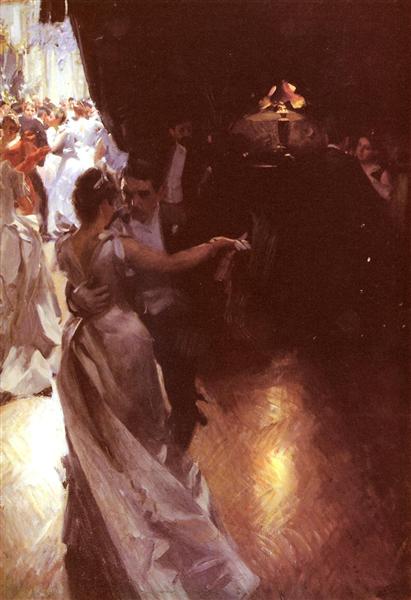
“Waltz“ (1891)
____________
had the waltz been confided to any
other but the Johann Strausses,
father and inveterate son, we may
never have distinguished it from
the polka
at the start, this amorphous new
dance was deemed shameless,
even shocking, by a scandalized,
apparently, aristocracy, used to
the more discreet, less conjugal,
minuet
some nobles, sowing wild,
irresistible oats, however, at the
festivities of their more irreverent
servants, brought the new dance
back home to their more informal,
less stuffy, entertainments, avidly,
though surely under their hats
to Belvedere, Schönbrunn, even
Schloss Esterházy, Haydn‘s
stately old stomping haunt
thus was the waltz born, whirling
indiscriminately like a polka at first,
with indefinite still, however, timing
which then was reduced to only ever
3/4 time, by the Strausses, the metre
in which this comment, coincidentally,
is written
read it aloud, you’ll want to wrap
your arms around the nearest
partner, I assure you, and whirl,
twirl, deliriously surrender
had we not had the Strausses, neither
had we had Fred Astaire, Ginger Rogers,
“Shall We Dance” from the glorious
“The King and I”, nor the irrepressible
“So You Think You Can Dance“ either
nor me, for that matter, writing in 3/4
verse, essentially, dactylic poetic metre,
about these celebrated accomplishments,
something I deem eminently worthy of
reporting
such is the impact of veritable art, I
warrant, the waltz was not inevitable
listen to Strauss Jr’s’ “Wiener Blut”,
“Viennese Blood“, or “… Spirit“
in English, for instance, for
corroborating confirmation, and
corresponding, however inadvertent,
even, inspiration
ever
R ! chard

