Richibi’s Weblog

Just another WordPress.com weblog

Tag: “Cyrano de Bergerac” – Edmond Rostand

at the movies – “Phaedra”

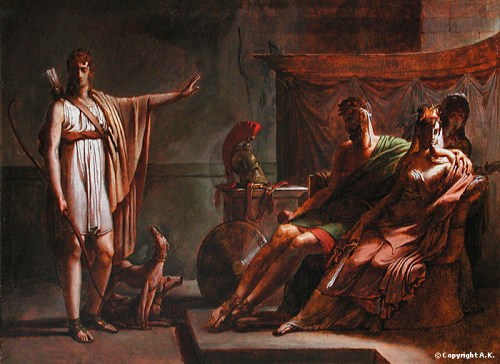
phaedra-and-hippolytus-1802.jpg

     “Phaedra and Hippolytus (1802) 

            Pierre-Narcisse Guérin

                   _____________

Phaedra, according to Greek myth, fell
in love with her stepson, and, of course,
ruined, for everyone, everything 

she’s been represented in music by
composers from, at least, Rameau,
1733, to, here, now, Benjamin Britten,  
1976by way of even Tangerine
Dream, 1973, however peripherally, 
and the hits just keep on coming

in literature, the story goes back to 
Euripides, 480 – 406 BCE, through
Jean Racine, 1639 – 1699, poet at 
the court of Louis XlV, the version 
that I studied in French Literature,
along with, in English, Shakespeare,
who was doing courtiers, rather, 
and royalty there, then, incidentally, 
instead of the Continent’s iconic 
Mediterranean figures – it remains 
my favourite play in my mother 
tongue, next to, for me, its only 
other equal, Cyrano de Bergerac

but I’d never seen a production of 
Phaedra until this searing, 
modern, rendition, set in, relatively 
contemporary, Greece, London, 
and Paris, with the irrepressible, 
the irresistible, Melina Mercouri
torrid temptress, the very goddess 
Herahereand Anthony Perkins
perfect as her suitor, a youth still, 
pulsing with a young man’s 
unbridled intentions

sparks fly, from moment to 
incendiary moment – I had often 
to pause to catch my breath – 
portents of an inescapable, and 
eventually epic, indeed mythic, 
apocalypse

watch, if you dare


R ! chard

“When You Come” – Daniel Goodwin

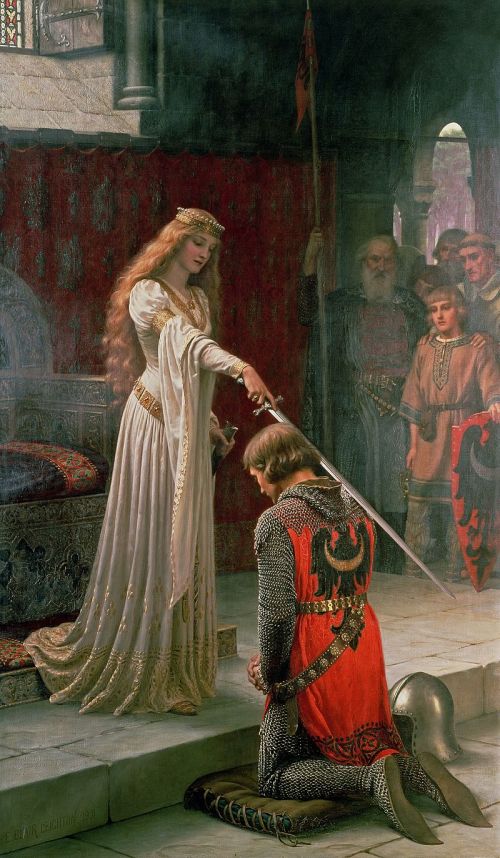
800px-Accolade_by_Edmund_Blair_Leighton.jpg

            “The Accolade (1901) 

           Edmund Blair Leighton

                     ___________

When You Come

When you come to greet me, shyly, 
wearing nothing but your love for me
I will come to meet you halfway
like a falcon returning to your wrist.

And when you raise your arm,
trembling ever so slightly,
I will alight and let you pull
the velvet shroud over my eyes. 

 Daniel Goodwin

                  —————–

courtly love, an idea of love that took 
shape in the 12th Century in what would
become France eventually, though its 
development soon touched all the 
countries, or kingdoms then, of Europe,
became the primary subject of poetry
and literature especially through the 
influence  of Eleanor of Acquitaine
without a doubt the most powerful
woman in Europe during her reign as 
Queen of France after her marriage to 
Louis Vll, which was annulled after a 
time for her having not borne Louis  
any sons, then with Henry, Duke of 
Normandy, who then became Henry ll
of England, with whom she had 
Richard l, the Lionheart, as well as the 
later King John – the wonderful film, 
The Lion in Winter” with Katherine
Hepburn as Eleanor is a brilliant 
account of her later life with Henry 
and their fractious sons, featuring 
as well Peter O’Toole as Henry, and a
young Anthony Hopkins as Richard

her patronage of the arts in general 
then, from her position of power, 
allowed, much as it would today any
potentate, the dissemination of 
courtly love as a cultural ideal that
ultimately led to some of the greatest 
works of our Western cultures, notably
Dante‘s The Divine Comedy“, where 
Dante courts chastely the married 
Beatrice, who becomes indeed even 
an intermediary for him during his 
passage through Paradise

the idea, through the interpolation of
the Catholic Church, was that courtly 
love should be pure, unconsummated,
a noble admiration and reverence of 
an object of adulation within the strict 
constraints of an impossible physical 
conjunction, the model being, of course, 
the emulation of the worship of the 
Virgin Mary

Cervantes‘ Don Quixote is a later 
example of this same disposition,
though by this time, 1605 to 1615,
the practice of courtly love had 
been sullied by too many evidently 
corrupt practitioners, and a more 
cynical therefore culture, so that 
Don Quixote despite his blameless
pursuit of Dulcinea, his unwitting
muse, is made out to be a fool 
given the context of his more 
contentious times, albeit a benign, 
and somewhat heroic, fool

but my very favourite such story is
that of Edmond Rostand‘s “Cyrano
de Bergerac“, whose long nose 
makes him disparage his own 
chances of ever achieving the love 
of his beloved, Roxane

José Ferrer got an Oscar for his 
superb performance of Cyrano in 
1950, but my ideal remains that of
Gérard Dépardieu, a complete 
wonder, in 1990, both very much, 
however, worth your time

all this as a preface to the poem 
above, When You Come, which 
seems to me of that tradition,
despite having been written in 
2014 according to its inclusion 
then in the Literary Review of 
Canada, perhaps because of the 
introduction of the falcon, not at 
all a contemporary image, but 
fraught with the impression of a
love that is all devotion instead 
of conquest, a kind of love that
in my particular circumstances 
I’ve come to reach for rather 
than anything less refined

true love, in other words, can  
never not love, as I’ve said earlier 

Richard

Aristotle on poetry

aristotle-jpglarge

      Aristotle” (1653)

        Luca Giordano

          ___________

so what’s a poem

in an attempt to get a clearer picture 
of what a poem should be, rather 
than trust only my own, however 
informed perhaps, opinion – though 
it must be added that we all bring 
something to that word’s definition, 
mine no less worthy than yours, 
yours no less worthy than mine – 
thought I’d go back to authoritative 
sources to see what they might 
have said

and it doesn’t get any earlier and 
authoritative than Aristotlewriting 
in 350 B.C.E., at the height of 
Ancient Greek preeminence, 
dissecting the term in his 
penetrating and perspicacious, 
ahem, Poetics” 

I propose to treat of Poetry in itself and of its various kinds,
noting the essential quality of each, to inquire into the
structure of the plot as requisite to a good poem; into the
number and nature of the parts of which a poem is
composed; and similarly into whatever else falls within
the same inquiry.“, he says in Part 1 of his 
magisterial treatise

and proceeds to declare the parameters 
of “Poetry” for the ages  

Poetry in general seems to have sprung from two causes“, 
he proceeds, imitation and rhythm 

by imitation I think it best to think of 
representation, which is another way, 
anyway, of saying imitation, but 
much more evocative in this instance,
more attuned to our sense of his word 

a poem is a representation then, a 
reproduction of something other than 
itself 

while its rhythm is what George
Gershwin‘s got, and by extension, as  
you can see from this videoGene Kelly

and yes, that means that “Epic poetry and Tragedy, Comedy also
and Dithyrambic poetry, and the music of the flute and of the lyre in
most of their forms, are all in their general conception modes of
imitation.” 

so, according to Aristotle, is dance 

all, therefore, poems

an interesting elaboration about “Tragedy” 
states that it should have the three unities 
that I grew up with during my French 
Canadian upbringing, the unity of time, of
space, and of action the famous French 
Classical dramatists, Racine and Corneille,
applied under the aegis of Louis XlV

not to mention Tragedy’s use of iambic 
pentameter, Shakespeare’s ubiquitous 
beat, a beat that persevered into the very 
Nineteenth Century, in France with 
Rostand‘s Cyrano de Bergerac“, for 
instance, and into the Twentieth Century 
with Eliot‘s Murder in the Cathedral“, 
about the assassination of Archbishop
Thomas Becket at Canterbury in 1170 
under Henry the Second‘s own aegis,
all written as poetry 

the most famous play to follow the 
three unities in the modern era is 
Who’s Afraid of Virginia Woolf?“,
the play which I think defines the 
Twentieth Century, which takes 
place overnight somewhere in 
New England college town, mid-
century, at George and Martha’s 

though followed closely by O’Neill‘s 
Long Day’s Journey int Night“, 
which transpires from morning, one 
day in August, 1912, till midnight, at 
the home ofunity of space, note, 
the dysfunctional Tyrones

so it appears not much has changed
about poetry, Aristotle got a lot of 
mileage out of his early definition, 
nearly 2500 years 

makes you wonder  why so much 
attention was paid instead to 
Platohis contemporary, the 
mystic, who would’ve banned
poetry, he thought it was 
subversive
 
Richard

psst: for a modern day application
          of the three unities, watch 
          In Treatment“, a television
          series, which takes place 
          in a psychotherapist’s office,
          each episode a session,