Richibi’s Weblog
Just another WordPress.com weblog
Tag: Classicism
April 23, 2024
a veritable Schubertiade, VI
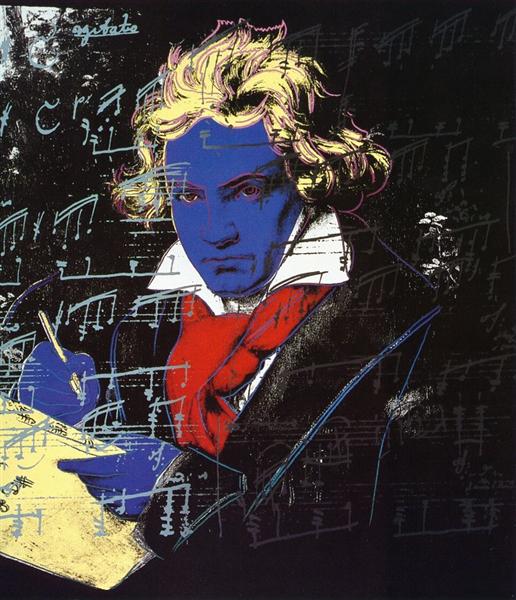
by this time, in his Piano Sonata in A minor,
D 845, Schubert has accumulated so much
Beethoven that his Beethoven is beginning
to shine through in his own compositions,
Beethoven was a forefather, still present,
it’s often difficult to tell one, indeed, from
the other, even here
Beethoven, see above, punched through
Classicism – Mozart, Haydn – its artificiality,
delivering emotion, instinctively, from the
very start, from which he nearly
single-handedly delivered to the world no
less than Romanticism, like delivering the
recalibration of time and space after
Einstein essentially, so profound a
cultural metaphysical reorganization
Schubert remains ever more courteous,
more beholden to the upper crust that
supports him, and that he ever wants to
court, you can hear it, listen, there is no
confrontation here, just, dare I say,
entertainment
Schubert was not a revolutionary
R ! chard
June 5, 2018
twice upon a dirge – Beethoven / Chopin
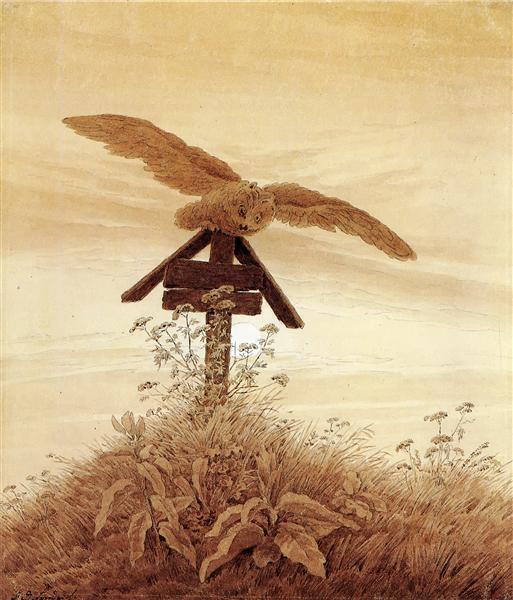
“Owl on a Grave” / “Eule am Grab“ (c.1836 – c.1837)
_______
following my nose rather than
my intellect in my exploration
of musical treasures, like a very
Aladdin uncovering at the click
of my password a cave full of
priceless wonders, I might find
stuff out of sequence, but gems
nevertheless, and I can’t just
whisk by without acknowledging
them, however peripheral to my
main task
it’s like heading towards the Eiffel
Tower in Paris, and not stopping
at the Arche de Triomphe
though I’d debated so soon
presenting these two pieces,
not because of their chronology
especially, though also that, but
mostly because of their dour
content, I’ll point out that the
move from Classicism to
Romanticism is the transition
from dance music, delightful
music, to drama, passion,
powerful emotions, dirges,
therefore, are not out of place,
however mournful
thus the two most famous
funeral marches, Beethoven’s,
Chopin’s, the third movement
in either of their home sonatas
the clincher for me was the
immaculate performance of
the Chopin here, a revelatory
moment, though the Beethoven,
significantly earlier, the tune,
1801, 1837, is nevertheless
unimpeachable, however still
underdeveloped – four variations
only in the first movement, for
instance, and all of them
elementary – the caterpillar had
not yet become the butterfly, the
apple blossom the apple
note that each movement in the
Chopin, apart from the last, has
two distinct tempi, executed
effortlessly and nearly
imperceptibly, a total of six, you
can’t see, you can’t hear, the
seams as you listen, which, with
its virtual therefore episodes,
conflicting and tortuous
emotions, constitute collectively
a drama, a narrative, music has
become literature
the last movement of the Chopin
moves beyond even tempo –
Beethoven’s also, incidentally,
nearly – creating therefore a
very challenge to it, both trying
to transcend tempi, an area to
closely watch
Beethoven’s Piano Sonata no 12
take your pick
both are supremely, mark,
instructive
R ! chard
March 4, 2018
String Quartet, opus 77, no 1 – Joseph Haydn
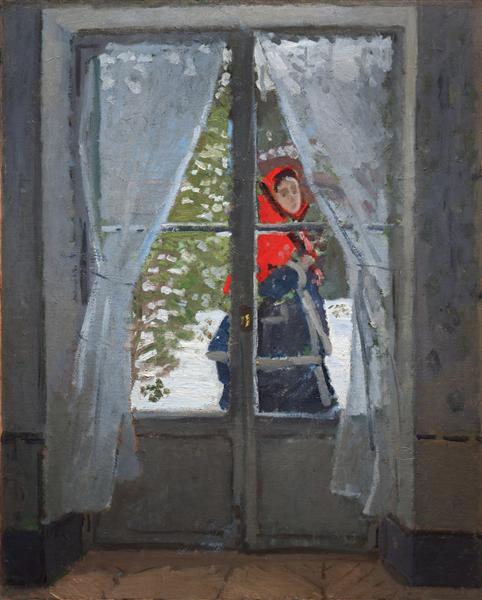
“The Red Cape (Madame Monet)“ (c.1870)
_______
for my mom
that’s a lot of Haydn, I said to my mom,
when I saw the list of my transmittals in
her hotmail, hm, I wondered, maybe it’s
too much
then I said, but it’s like when we’ve
toured, for instance, our European
art galleries, me propounding on
the paintings, as I am wont, however
incorrigibly, to do, but now, note, you
can tell the difference between your
Monets and your Klimts, however
similar their perspectives
or like your tour guide taking you
recently through Argentina,
highlighting spots, in the space of
a month only, the same amount of
time I’ve spent for the music of
Haydn
pronounced, incidentally, I specified,
like “hidin'” in English, not “maiden”,
just sayin’
I gathered that she’d ‘ve sensed by
now, if she’d been listening, which she
said she had, mornings over her
coffee, what a string quartet is, four
movements, different tempos, fast
at first, a joyful introduction,
followed by a lament, then a spirited
third movement, for countereffect,
then a big fourth movement finish
also, the internal structure of each
movement would’ve been internalized,
a theme, a counter theme, a
recapitulation of both, or either, all of
it, probably unconsciously, which is
how art fundamentally works till you
meticulously deconstruct it
the string quartet is the work of Haydn,
the house that Haydn built, from
peripheral aristocratic entertainment,
like modern day artists sporting their
wares in noisy restaurants, to the
glamour of taking on, in concert halls,
Europe, Brunelleschi did a similar,
sleight-of-hand thing with his dome
in Florence for its oracular Cathedral
remember that the string quartet lives
on as a form, where no longer does
the minuet, for instance, nor the
polonaise, nor even the waltz, not to
mention that concertos, and
symphonies have become now
significantly subservient to movies,
secondary players
watch the instrumentalists here live
out, in Haydn’s Opus 77, no 1, their
appropriately Romantic ardour,
something not at all promoted in
Haydn’s earlier Esterházy phase, to
raise their bow in triumph, as they
do at the end of most movements
is already an indication, not at all
appropriate for the earlier princely
salons, that times have changed
Haydn was a prophet, but also an
elder, with an instrument to connect
the oncoming, and turbulent, century
to the impregnable bond of his
period’s systems, the legitimacy of
the autocratic, clockwork, world,
Classicism, the Age of Reason, the
Enlightenment, for better or for
worse
we are left with its, however ever
ebullient, consequences
R ! chard
February 20, 2017
“First Piano Concerto” – Pyotr Ilyich Tchaikovsky
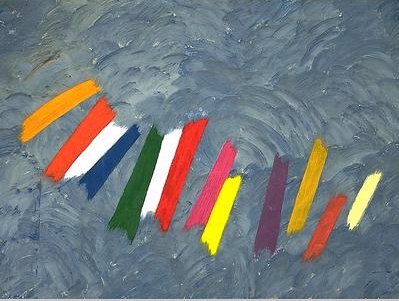
“Concerto“ (1975)
_____
if there’s a piece that defines Classical music
for most people, encapsulates it, even for
those who aren’t especially interested in
Classical music, that piece would be, I think,
Tchaikovsky‘s “First Piano Concerto“
strictly speaking Tchaikovsky isn’t a Classical
composer, but a Romantic one, the Classical
period in music having been transformed
some years earlier into the Romantic period
by none other than Beethoven, 1770 – 1827,
perhaps the most transformative composer
of all time – Tchaikovsky‘s “First Piano Concerto“
was written in the winter of 1874 – 1875, pretty
well at the end of the Romantic Period, which
then ceded to the Impressionists, just to get
our periods right
what the Romantic Period added to the
Classical Era was emotion, sentiment – note
the use of tenuto, for instance, beats being
drawn out, languidly, longingly, for pathos –
what it maintained was the structure, the
trinity of Classical conditions, rhythm, tonality,
and repetition, which is why even the most
uninformed listener will usually be able to
sing along throughout the entire performance,
the blueprint is in our collective blood, in the
DNA of our culture
to remain present a piece must remain
relevant to the promoter, an interpreter must
have reason to play it, substance surely plays
a big part, but technical considerations play
perhaps an even greater role towards a great
work’s longevity, “Chopsticks“, for instance,
is good but it won’t fill a concert hall
unless, of course, it’s with Liberace
the “First Piano Concerto” of Tchaikovsky is
the Everest of compositions, emotionally
complex and technically forbidding, nearly
impossible, it would seem, were it not for
those few who’ve mastered its treacherous
challenges, conquered its nearly indomitable
spirit
Van Cliburn put it on the map for my
generation, with a ticker tape parade in
New York to confirm it
Martha Argerich later on kept the ball rolling
and now Behzod Abduraimov, a mere youth,
born in 1990 in Uzbekistan, Tashkent, delivers
by far the best performance I’ve seen since,
giving it new life for the new millenium
behold, be moved, be dazzled, be bewitched
Richard
April 17, 2015
septet / schleptet – Beethoven / Schikele
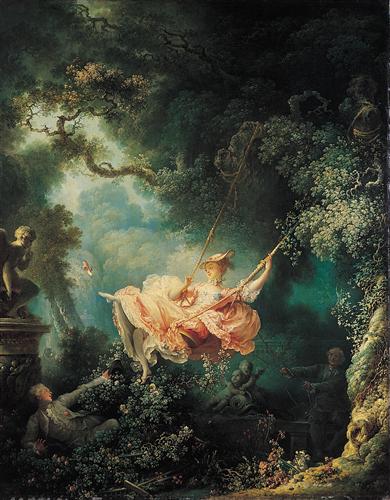
“The Swing“ (“Les hasards heureux de l’escarpolette“) 1767
_____
though I’ve spent the last forty years
exploring Beethoven, I still haven’t
heard, much less seen performed
all of his music, unexpected gems
pop up still to prick up even my
weathered ears
but a septet this time, who’d ‘a’
thunk it
the opus 20, not unexpectedly, sounds
like Mozart, formal, musically inventive,
but not prompted by Beethoven’s later
transcendental passions, it was 1800,
he was still showing off his Classical
shoes, spinning andante cantabiles
out of minuets, for no less than Maria
Theresa in this instance, the Empress,
its august dedicatee, not yet having
profoundly outgrown them, the tiara,
the shoes, though you’ll find
expressions of his surpassing majesty
already throughout this masterpiece
six movements, for instance, uppity,
impudent, bold, an impertinence
towards imperial time and its
exigencies, unless it’s worth it, of
course, even in the case of my own
more relaxed schedule
but a precursor to his seven-part
C# minor String Quartet, opus 131,
for its breadth, for its ambition, for
the prefiguring of a monument, a
cultural institution, for its
proclamation of the advent of a
veritable sonic Parthenon
you’ll note a peculiarity, he uses
in the Septet‘s third movement
the same air that served him well
in his 20th piano sonata, opus 49,
no 2, second movement – why not,
it’s his – an earlier composition
despite the later opus number
don’t ask
opus 49, no 2 has only two
movements, incidentally, like his
earlier opus 5, no 1, or his later
incandescent no 111, to shed light
on the chronology of his musical
evolution, his eventual historical
apotheosis
find the movement with variations
in the Septet, your body will tell
you, much like it does slow tempi
from fast ones, you merely listen
with your senses, not just your
ears, your unconsciousness, while,
distractedly, you’re, say, washing
dishes, you’ll say, hey, I’ve just
heard this before, but different,
only this minute
hence the term variation
compare this Schleptet in Eb major,
from Peter Schikele for fun, from
the year 2000, a spoof on Beethoven’s
Septet in the identical key the
better to roast him, but in five
movements this one, in the Classical
style, but where the mood is neither
Classical, nor even Romantic, it’s
ironic, satirical, wry, even cynical,
note the slapstick tempo markings
I. Molto Larghissimo – Allegro Boffo
II. Menuetto con brio ma senza Trio
III. Adagio Saccharino
IV. Yehudi Menuetto
V. Presto Hey Nonny Nonnio
the voice, for better or worse, of our
time
Richard
May 26, 2014
“Music”
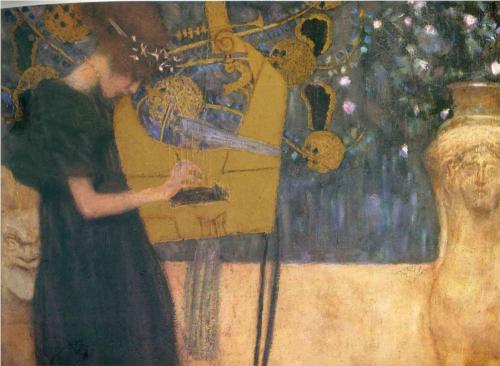
“Music“ (1895)
______
not for lack of imagination, lately, but for,
rather, lack of confidence, the complaint
of any would-be poet, the complaint of
any proponent of oneself, one’s persona,
one’s own, however benign, however even
benevolent, ideas, I retreated into myself,
surrendering to forthright inspiration for
any, elusive enough, courage
inspiration, through its usual unsuspected
channels, and as ever categorically, gave
me, reliably, “Music“, Klimt‘s ineluctable
masterpiece, not even for its iconic image,
but for its transcendental comment on
art’s interpretive counterpart, music
world’s meld
a “magical mystical miracle” happens, as
Katharine Hepburn, in her utterly
enchanting movie, “Summertime“,
would have it, irrepressible as ever
I had to share
Richard
psst: note the juxtaposition of contrasting
colours, patterns, impressions, note
the Baroque presentation of Classical
imperatives, touched with Romantic
sensibilities, kicking off, not
incidentally, Modernism
March 21, 2014
Beethoven – piano sonata no 7, in D major, opus 10, no 3
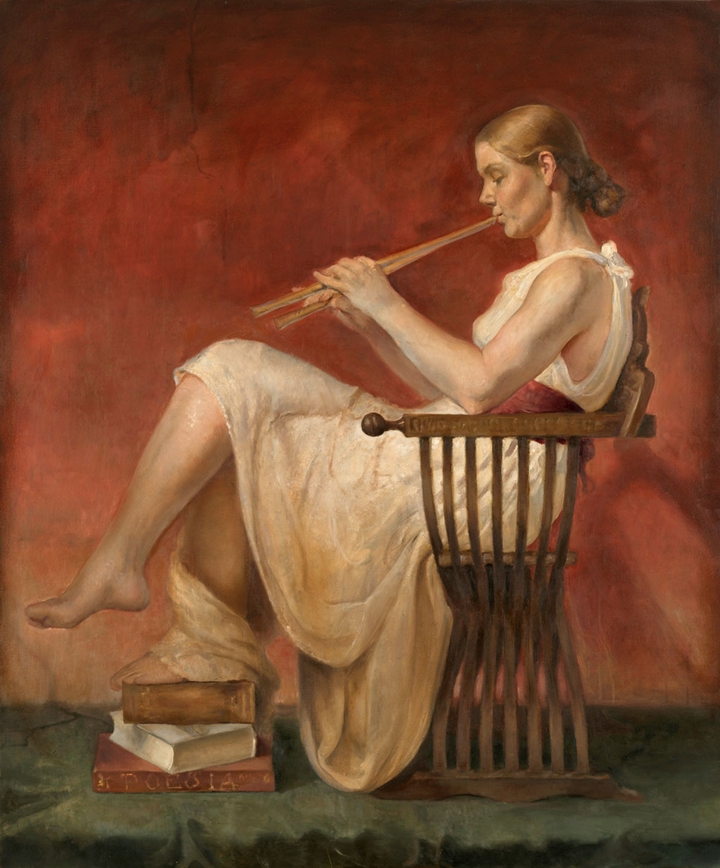
“Euterpe – Apollo and the Muses“ (2008 – 9)
________
if the piano sonata no 4 of Beethoven,
in E flat, opus 7, was academic, an
exercise, a display of technical
dexterity and some, admittedly,
even mighty, compositional verve,
it lacked, in my estimation, a centre,
a convincing motivating factor, a muse,
though ever ardent, ever entertaining,
it is ultimately arid, I think, trite, I’m
not, one is not, keen on returning to it
but in the piano sonata no 7, in D major,
opus 10, no 3, Beethoven hits, I submit,
his stride, this sonata is enchanting
note the similarities of structure
between the two, the order of the
movements with identical, essentially,
tempo patterns, notably the middle
slow movement, in the first a largo,
con gran expressione, slow with
great expression, in the latter, a
largo e mesta, slow with sadness,
where Beethoven plumbs, evidently,
the limits of pacing, the time lapse
between two notes, the capacity for
silence of this new instrument, the
pianoforte, of which he’ll look into
also, and even vigorously, its
capacity for volume, the crashing
introduction to his celebrated 8th,
for instance, to establish the
instrument’s new perimeters
you’ll note you can listen to the later
largo, the opus 10, no 3, forever, you
can get lost in its aural world, I can’t
think of anywhere else right now a
more profound largo
the other movements are dazzling
in their thrilling prestidigitation, all
organically sound, and, crucially,
motivationally centred, I think, this
is indeed music, magisterial music,
Beethoven’s not just kidding
anymore, he’s hitched onto his
proper inspirational deity, his own
private Euterpe, music’s muse, and
we’re in for something, from here
on, of a ride
note the cool riff closing off the last
movement, Beethoven in the guise
of Gene Kelly stepping in for a
breezy good-bye, prefiguring, of
course, XXth-Century music, and
the serendipitous extrapolations
of jazz
Richard
psst: incidentally, the headings, largo,
con gran expressione, largo e
mesta, are entirely Romantic
musical notions, notations,
Classical composers would’ve
been too sedate, formal, courtly,
for such flagrant sentiment
June 18, 2013
Liszt – piano concerto no 2 in A major
since discovering Tamás Érdi, feral hands,
uncommonly hirsute, but uncovering the
soul of a poet, an angel in wolf’s clothing,
a satyr, without a flute but, at the piano,
I’ve been hooked, combined with Liszt he
is again irresistible, not to mention totally
transcendental
you’ll find Liszt quite a bit like Beethoven,
but more bombastic than philosophical,
style trumps substance, Liszt was a
show-off, a pianistic Paganini
stylistic flourishes abound in the hands
of a deft, however uninformed might he
or she be, technical wizard, it doesn’t
take an Einstein, in other words, to be
a Puccini
and Liszt is a Puccini, who delivers
likewise, and for the very ages
note the same intensity as Beethoven
in Liszt, much of the same musical
idiosyncrasies, but with more dramatic,
late Romantic, alterations of tempo, he’ll
milk a phrase before returning to a more
Classical, which is to say, less elastic
beat
his extemporisations are also less
ruminative, more serendipitously
motivated, like jazz, Liszt wants
primarily to dazzle, kick around,
not instruct
and he does, masterfully, just that
here’s Alfred Brendel doing an alternate,
wholly incandescent version I couldn’t
at all leave out
here’s Julie Andrews giving her take on
the history of jazz
Richard
April 26, 2013
Beethoven Strinq Quartet no 14, opus 131
if Beethoven had written merely one transcendental
work we would still have been beholden, but that he
wrote neither two, nor three, but several immutable
pieces is extraordinary, super-, apparently, human,
though, of course, manifestly not, unless you want
to bring Jesus into the picture as such a dual being,
then we’ll talk, but Beethoven is a staunchly secular
voice, devoid of the spiritual considerations of a
Bach, for instance, Beethoven speaks for humanity,
its longings, consternations, aspirations, its essence,
no longer the discredited primacy of the Cross and
Its imperial derivatives, Human Rights have trumped
God
what Beethoven maintains however is the reverence,
his later pieces – you’ve heard the “Hammerklavier“,
already, the 32nd piano sonata – are manifestly
spiritual experiences, as opposed to religious
the 14th String Quartet will do the same
if the “Hammerklavier“ is akin to Moses delivering
his peremptory tablets, the 14th String Quartet is
the Sermon on the Mount, in the history of music
they have so great an impact
briefly, as briefly as I can, I’ll say a few introductory
words, then let your soul and the music do the rest,
see what happens to your karma
there are seven movements in the 14th, uninterrupted,
no pauses between the movements, though each is
easily identifiable, tempo therefore becomes incidental
instead of Classically ordered, the first movement, for
instance, is an adagio, a Classically improbable spot
the sections therefore play much as chapters in a
novel, advancing according to the logic and emotions
of the moment, always, as in all of Beethoven, moving
inexorably forward despite the intricacies of the, not at
all predictable, plot, as had been the case in the more
regimented Classical model, Beethoven takes you,
instead of around the corner, into the clouds, into a
spiritualized heaven, a place of profound existential
introspection
try listening to the 14th String Quartet attentively
without thinking about your soul, its existence,
its mission, in the very face of its ineradicable,
and fateful, actuality, the human conundrum,
Beethoven lets us know we’re not alone
some mountaintop Sermon indeed, watch what
happens to your sensibility, your very sacred
self, or maybe I should say, listen
may your path be decked meanwhile with laurels,
and your days be blessed with grace, be it ever
so merely, maybe, human
who knows
sincerely
Richard
psst: if you’ll allow me to pursue my series of
similarities you’ll imagine piano sonata
no 32 as Beethoven’s “Last Supper”,
this one in particular five luminous stars
 Richibi's Weblog