“Metamorphoses” – Ovid, 103

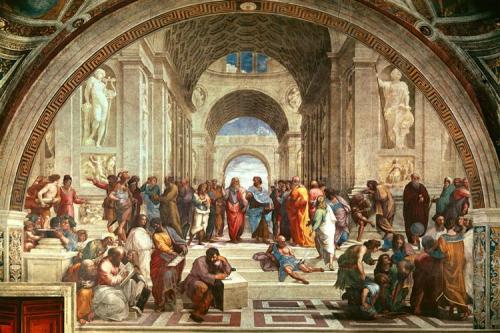
“The School Of Athens“ (1510 – 1511)
_______
upon reviewing my Socrates, Plato, and
Aristotle from a series of university
lectures I’ve been following, I came upon
a discovery so egregious, I couldn’t
believe I hadn’t seen it before, the old
story of the forest and the trees, I guess
upon hearing that the Oracle at Delphi
had replied that it was Socrates to those
who’d wondered who the wisest man
was, Socrates, abashed, began to seek
out wise men to disprove the Oracle,
but whenever Socrates asked of them
what is virtue, what is justice, what is
knowledge, for instance, the answers
were always inconclusive, they always
seemed to depend on perspective –
virtue, justice, knowledge were in the
eye of the beholder – though Plato
later putting in his own definitions
called them Ideals, a chair partook,
for instance, of an overarching
chairness somewhere, as did indeed
virtue, knowledge and justice, which
inferred another ideal universe
contiguously, of which our own
universe supplied only imperfect
renditions
you can hear the seeds of Heaven and
God already in all of that, way before
Christianity, not to mention Original
Sin
it also suggests an implacable order
Socrates wouldn’t’ve liked that
but Aristotle, with a much more critical
mind than Plato’s, less speculative, more
akin to Socrates’, less autocratic, more
inquisitive, begins to try to define,
nevertheless, abstractions, virtue,
knowledge, justice, as though they
indeed existed as ideals
this is putting the cart before the horse,
I thought, in the form of a revelation
an instance exists in the act of creation,
a physical transformation produces a
flower, the flower doesn’t happen
because of the word
a human example
for surviving an aneurysm once, someone,
to my astonishment, had called me
courageous, I’d been, I thought, only
surviving, not an inch of courage, not
even a millimetre
courage, I surmised, is in the eye of the
beholder, it is not at all a template, an
absolute, in my experience
Aristotle goes on to define a host of
Virtues, indeed 11, which come out as
essentially his Eleven Commandments,
on, in fact, courage, among others, all
essentially, and appropriately, moral,
thereby creating the moral realm of
our Western world
Jesus followed
and of course God and Heaven
which, of course, still prevail despite
sound, sober objections
as though we could know
why is this important
because, I think, we must remember
that our assumptions are only that,
and often they’re based on only what
we’ve been told, which is already a
step away from incorrect
interpretation
in the world of false news, check
your references, check your very
words, our lives, it isn’t too much
to say, I believe, depend on it
not to mention our own personal
moral code, our soul, our purpose
for being, which every wo/man
must oversee for hirself
if one has the courage
Richard
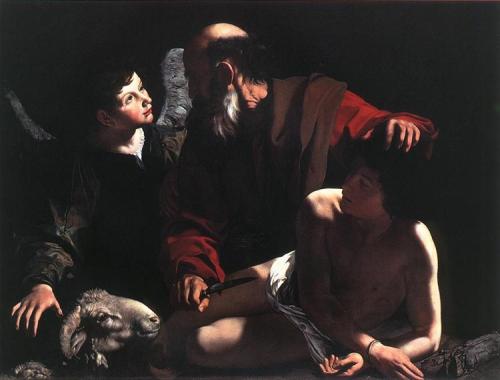
“The Sacrifice of Isaac“ (1598)
________
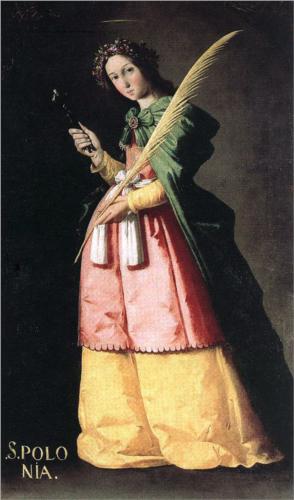
“Saint Apollonia“ (1636)
___________
who ‘s Saint Apollonia, I asked my dentist
when he suggested I call on her to intercede
in this present mortification, I was sitting in
his chair undergoing treatment for a painful
abscess for which he’d aligned already
several instruments along my lower lip
the patron saint of toothaches, he replied,
as though she were a fairy
who knew, I marvelled, I’d only ever heard
of Saint Jude otherwise, patron saint of
lost causes, memorably
you must’ve been raised Catholic, I
interjected, Protestants don’t have
saints
yes, he stated, suggesting the shared
impact of an, however privately
relinquished, or distant, religion,
upbringing
he didn’t know about her time or place,
and counseled I should look into it
who wouldn’t
principally she lived in Alexandria, her
name alone could have given that away,
if Greeks had become Christian anywhere
it would’ve been in Alexandria then, 250,
a city close to the Christian source,
Palestine, and teeming with international
attention, though ruled long by Greeks,
you’ll remember Cleopatra had been of
Greek origin
in a wave of atrocities perpetrated by
Alexandrian mobs, unleashed during
commemorative festivities – see, for
instance, the Vancouver hockey game
riots to compare – roused by prophecies
of ill winds towards their city, set upon
Christians to appease their more raucous
gods, among them Apollonia
in Vancouver she was London Drugs
and the Bay
they pulled out her teeth, one by one,
which is why she’s represented with
pincers, that done they threatened to
burn her alive should she not repeat
their profanities
she jumped, instead, herself, onto the
pyre
Jesus, Mary, Joseph, I exclaimed, quite,
quite uncharacteristically, but only other
too objectionable imprecations could’ve
reflected the extent of my consternation,
after that, I thought, what’s an abscess
later I brought him gratefully a bottle of
fine wine, to the fortified gate, however,
of his impervious secretary, though
serenely be she ever smiling, for having
tended with speed and alacrity to my
distress, however unworthy it may
have been of beatification
a French wine or a Marilyn Merlot, Napa
Valley, I had to ponder, bought both,
couldn’t resist, kept for myself, however,
not to render the choice to the intermediate
secretary, the Marilyn, my more familiar, and
headier, saint
cheers
Richard
“If thou workest at that which is before thee, following right reason seriously, vigorously, calmly, without allowing anything else to distract thee, but keeping thy divine part pure, as if thou shouldst be bound to give it back immediately; if thou holdest to this, expecting nothing, fearing nothing, but satisfied with thy present activity according to nature, and with heroic truth in every word and sound which thou utterest, thou wilt live happy. And there is no man who is able to prevent this.”
“Meditations“, Book 3, 12
_________
the idea of the virtuous man, or the
interpretation of Marcus Aurelius of
such a person, goes back of course to
Socrates by way of Plato, 427 – 347
B.C., who’s ideal was primarily
political, what to achieve within a
political order, rather than a private
meditation, an advice rather than
a contemplation as in Marcus
Aurelius, 121 – 180 A.D., 550,
not inconsequential, years later
other moral perspectives meanwhile
applied, Epicureanism, for instance,
notably, after which the stranglehold
of Christianity produced not philosophy
but dogma, for a subservient and,
biblically labeled, fallen people,
nearly fifteen hundred years spent
trying to figure out how many angels
fit through the eye of a needle,
essentially, how many irrationalities
could prove the existence, and
authority, of a mandated God
René Descartes inadvertently in this
very quest, but not before 1637, put
an end to that, introduced a new, and
revolutionary, perspective, “I think,
therefore I am“, which put the individual
instead of the Church in the driver’s seat,
this, if it didn’t bring on the Renaissance,
at least gave it a significant push
but because of his famous scientific
method, studies afterwards in what
we now know as the humanities
became more empirical than
specifically moral, how do we
perceive rather than how do we live
according to what is right or wrong,
Nietzsche‘s “Beyond Good and Evil“,
1886, reoriented that investigation,
as it happened, ominously, in an age
where any kind of god had become
irrelevant, Beethoven would be
transformed into a Hitler, an
uncomfortably fateful Übermensch,
Superman
now philosophy is concerned with
language, what do we mean when
we say what do we mean, and can
anybody understand that
our closest moralist, our modern day
Marcus Aurelius, is at present Miss
Manners, whom I wholeheartedly
recommend
as well as, of course, Marcus Aurelius
Richard
psst: Miss Manners‘ question and answer
format, incidentally, is not at all unlike
what Plato does in his Socratic dialogues,
she just has a larger, more flip audience

“Madonna and Child with Canon Joris van der Paele”
(1436)
_______
Have you thought of writing or already written memoirs? I think I’d enjoy reading them.
Your second story reminded me of the Confessions by St. Augustine,
in which he grieved over the death of his beloved friend.
Descartes might say this about your “This is the census” moment: “I lisp, therefore I exist”.
But how would you interpret the “parable”?
What caused you to stop ministering at the palliative care unit after ten years?
 Richibi's Weblog