Richibi’s Weblog

Just another WordPress.com weblog

Tag: Chopin

Debussy Preludes, Books 1 & 2‏

if Debussy composed not only Études, in the manner 
of Chopin but Préludes” as well, Book 1 and Book 2,
with only twelve preludes apiece however, but for an
equal number of 24, to cover likewise all the keys, it
might be that his piano teacher, Mme de Fleurville, a
student of Chopin, she claimed, would have had him
duly practice her master’s musical methods, manner 
and propositions, accounting for the similar textures,
colours and even templates the diligent acolyte uses,
devout responses in effect to his mentor’s mentor
 
but time and temperament get in the way of an exact
of course replication 
 
Chopin follows the narrative line of melody, whereas
Debussy evokes a more nebulous mood, the line of
Romantic heroism has given way to the more abstract
investigation of the amorphous psyche or, if you like,
the suprarational soul, after Freud’s most recent
uncovering and elaboration of consciousness  
 
listening to Debussy therefore is more like looking at
a painting than reading a book, you are moved by the
evocative aspects of the composition, colour, texture,
tone, rather than by the chronological tale it no longer
tells  
 
unbending truth has given way to perspective, stream of
consciousness has superseded the narrator’s traditional
linear omnipresence, for better or for worse 
 
 
Richard
 
psst: Europe, as I was informed by a friend of mine, is
         celebrating Debussy‘s 150th birthday this year,
         he was born August 22, 1862
 
         may he live forever 
 
 
         thanks, Lajla


Chopin “Études”, opus 25‏

if the Debussy, was a bit too fast a move from Chopin’s
Romanticism, his enchanting melodies wrought with
pressing and intent emotion to tug at your most
unresisting aural senses, into a 20th Century of
cynicism and machinery, speed, neurosis, world war,
it was probably too fast for those who actually lived
it as well, just as we think of our own world as out of
control, ultimately the swoons of Chopin would no
longer cut it alone as mileposts towards so unmoored
a future, a heretofore beyond mere private emotions,
other voices would come up responding to further
calamities, inconsistencies in the cultural argument,
where the poet no longer could stand prophetically
alone, there were others also to tend to, and nations
and even new ideologies burgeoning, social, sometimes
sinister even, experiments, Romanticism would have no
choice but to cede to the imperatives of a new, often
inclement, order

but that nevertheless choice still imprint is nowhere
near as definitive as Chopin before all that happened,
as people were still all celebrating and expressing
their newfound personal validity, freedom, worth,
fruit of the revolution not only of the political world
but of the cultural one as well

Elizabeth Barrett Browning is to my mind his only
literary equivalent, compare their equal ardour
and the likeness of their compelling muse

Daniil Trifonov, playing Chopin’s other set of
“Études”, opus 25, not only lives them, he’s
utterly possessed, he’s in Tel Aviv, it’s May, 2011

Richard

psst: the first Étude is called the “Aeolian Harp”,
the ninth the “Butterfly”, the second to last,
or eleventh, the “Winter Winds”, all of which
you might try to make out in passing, they are
not that difficult to identify, all the others are
named for their key

Debussy’s “Études”

 Man with a Guitar - Georges Braque
 
                    Man with a Guitar (1914)
 
                               Georges Braque 
 
                                       ______
 
 
while we’re on the subject of études, listening to 
hundred years later, 1830s to 1915, would prove
instructive, I deemed 
 
picture me deeming, August 3, 2012, my brow
just slightly pensively constricting 
 
 
if the basis of music as defined by the Classical
period depended on beat, tonality, and the repetition
of the tune, usually of both musical statements, these
apparently essential components of course would be
the first places to bear the scrutiny of probing musical
minds, seeking to find, seeking to set more expansive,
more profound dimensions to the areas of their quest,
that’s what artists do 
 
and this of course is exactly what happened starting
with Beethoven, by the time of Chopin music had
relaxed its stricter Classical rhythmic precision,
allowing great expansive gestures in the more
malleable tempi, tempos, producing the effect of
more compassion and soulful examination than
the earlier less indulgent, more disciplined code
 
the fact of having musical tapestries, sound patches,
take the place of melody, narrative, in the musical
presentation of Chopin also suggests a more
diversified, dare I say prismatic, telling, than the 
linear account of for instance Mozart‘s solitary
tuneful wanderer
 
it also evokes incidentally the vagaries of the
inconstant heart rather than its unflinching
condemnation, a repudiation of atavistic
Christian ecclesiastical intolerance 
 
 
by the time the old order was about to be extinguished,
in 1915, at the onset of the First World War, Debussy’s
Études, like Chopin 12 of them per set, had seen
social injustice – see Charles Dickens, see Émile Zola,
see Karl Marx – the improbable discoveries of science –
Darwin, Freud, Einstein – the car, the airplane,
photography were changing everything, the old
paradigms no longer applied, were irrelevant, even
harmful, in this new context, the First World War 
would prove all that 
 
in the language of music, tempo, melody, repetition
would be inevitably subverted
 
Debussy produces erratic tempi, foregoes melody for
harmonic exploration, combining incidentally the
musical patches of Chopin with the intellectually
driven investigations of Beethoven for a more
cerebral understanding of music, a music for the
head, with expert displays of pianistic skill, indeed
prestidigitation, for, along with the intellectual
rigour, spectacle  
 
is this then still music 
 
is Post-Impressionist painting still art  
 
what would 1915 have said
 
 
above is Georges Braque‘s nearly contemporary, 1914,  
 
man with a guitar, who’d a thunk it
 
 
Richard


Chopin: “Études”, opus 10

if I haven’t brought up Chopin much in this series
it’s that I think of him more as a decorator than
as an innovator, he was developing a sensibility
that had been defined by the earlier Beethoven,
adding texture and style, form instead of function,
the wheel had been invented, now it remained to
be artfully applied
 
some break new ground, others decorate it, make
it enchanting, Chopin makes things enchanting 
 
he is also the first composer we think of when we
think of Romanticism, which says quite a lot about
the quality, the universality, of his gift 
 
 
here are his opus 10, “Études”, or “Studies”, 12 of
them, they are not sonatas, for not having more
than one movement, they are “études” , “studies”,
called by that name for being what they are, then
given numbers to differentiate them, also their
key, the convenience of universally attributing
titles not having quite caught on yet though a
couple of these do have them, the 5th, the
“Black Keys”, for obvious reasons, and the last,
the “Revolutionary”, again for reasons you’ll find
obvious once you’ve heard it 
 
tonality however remains, no apparent discords,
that’ll come later  
 
 
note that in comparison to Mozart the notes are
a shimmer, the same alphabet is used, the one
set up by Bach, but where Mozart made these
into narratives to follow, and even sing along to,
with Chopin the same flurry of notes becomes
a wash of sound you could never vocally keep
up with, a texture rather, an enveloping caress,
prefiguring incidentally the Impressionists, the
lush soundscapes of for instance Debussy 
 
 
though you’ll find the same prerequisite opening
musical statement as in Mozart, followed by the  
contrasting one, often these will be in altogether
constrasting rhythms as well, tempi, compared
to the single strict beat throughout of the 
foundational Classical model    
 
the tempo itself is also much more lax, some
passages surrendering formal rhythmic strictures
to greater emotional content, more self-expression,
less attention to rules, in accord with the newly
installed ideal of individual human rights 
 
hence Romanticism, the fruit of the Revolution 
 
 
note also that the musical argument is no longer
in the Mozartean playground but of a more mature
understanding, Chopin has known love 
 
 
Richard


a cello concerto‏

Portrait of Marquise de Pompadour, 1759 by Fran?ois Boucher

               “Portrait of Marquise de Pompadour

                                 François Boucher  
 
                                     __________
 
 
Joseph Haydn, 1732 to 1809, who preceded and outlived
Mozart, 1756 to 1791, was also an older contemporary of
the more imperious Beethoven, 1770 to 1827 
 
of the three Haydn is the most pleasant, polite, courtly,
witty, elegant, congenial, the musical equivalent of, say, 
the painters Boucher or Fragonard, though with a perhaps
more restrained sensuality 
 
his audience, and indeed his sponsors, were aristocrats,
his music makes no political, emotional, ideological
demands, it is meant merely to delight, which it does
in spades 
 
one of his symphonies, the number 45, for instance, loses
instrumentalists one at a time in its final movement until
two only remain, Haydn himself and the concertmaster,
the orchestra had been wanting to go home but had been
retained by the count at his summer palace, Esterhazy,
longer than anyone expected, each one, according to
instructions in the score, was to put out the candle on
his music stand, in Vienna, incidentally, not one of
them of course was a woman, then was to leave the
shrinking stage, the not inconsiderate count let them
scurry the very next day
 
 
Mozart is more spontaneous, less academic than Haydn,
playful, unaffected, less inhibited, younger, by very
definition therefore less refined, more maybe, as a
consequence, unintentionally magical
 
Beethoven meanwhile is a quantum leap from their
Classicism, which is to say the musical groundwork
for our epoch set down by both those other
foundational pillars, into Romanticism, unleashing
upon his forebears’ firm structural, Classical, base 
his more humanist, less formalized, view of the
emotions, paving the way, for instance, blazing a
very trail for, among others, its later towering
figure, Chopin 
 
 
in 1761, Eve-Marie Caravassilis plays the cello, Patrick
Botti conducts the Concilium Musicum de Paris in the
Church of St-Catherine of Hungary in Paris, all of these
to me unknown, August 10, 2011, just last year  
 
I was not unimpressed
 
 
note the consistency throughout of the pace, and the
courtly discretion ever, in even the nimble, never 
boisterous or brash, concluding, for instance, presto
pithy, pert, but always peremptorily polite, it would
never come crashing down 
 
what Revolution, it assumes, what 1789, let’s party


Brahms violin concerto in D major, Op.77

though I’d’ve preferred to consider violin concertos for a while
after the Tchaikowsky, the Beethoven, a break from the usual,
though always eminently magisterial, piano, I was unable to
quickly find a performance of the work I had in mind that would
suit my needs, nothing primarily that was complete, that had all 
its unabridged movements
 
and what’s a concerto without its movements, a meal without
an appetizer, without its main course maybe, without even 
dessert, that’s making do, that’s subsisting, that’s got nothing
to do with appreciating a meal, not to mention our pending
Thanksgiving
 
then the Chopin struck, a very revelation, and I couldn’t, even
temporarily, put it aside 
 
I hope you enjoyed it   
 
 
because the Brahms in D major, opus 77, is after the first
two violin concertos I listed the third most revered and 
respected major string work, it cannot but be duly and
with great honour represented in any Classical music 
survey
 
the first movement, the allegro non troppo, or, jauntily but
not too much, in English, is played by David Oistrakh and 
conducted by the legendary Kirill Kondrashin, who conducted
Van Cliburn, famously, in both his Tchaikowsky One and
Rachmaninoff Three concertos in Moscow, 1958, when Cliburn 
won first prize, is he the best, Khrushchev asked when
nervous judges questioned awarding an American, give it
to him then, he most judiciously replied, in the very face
of Cold War bile and cynicism 
 
Kondrashin defected to the West in 1978 
 
David Oistrakh never left his homeland, Russia, though he
toured extensively enough in the West, surely dazzling
everywhere rapt audiences
 
 
the next two movements, the adagio, slow, the allegro 
but not too lively – little by little go faster, have the
glorious Leonard Bernstein jumping up and down even 
with exhilaration at the thrilling sounds they are making,
while the equally glorious Gidon Kremer struts inimitable,
incendiary stuff, a Tchaikowsky competition winner also
he, in 1970, who ‘s since dominated and championed an
impressively extensive and eclectic, even modern, 
repertoire  
 
note in passing that their accompanying Vienna Philharmonic
doesn’t have a single woman, which nevertheless doesn’t 
of course disqualify a superior sound, it is merely an archaic,
intransigeant, aristocratic institution, it would appear, with
counterintuitively melodious and undeniably winning soul
 
 
one course at one restaurant then, the next two at another,
you’ll need to adjust to atmosphere, menu variations,
service, but expect in either case only the very best, you
will not be disappointed 
 
 
Brahms violin concerto in D major, opus 77
 
              1 – allegro non troppo, Oistrakh, Kondrashin,
                                                          the Moscow Philharmonic Orchestra
              2 – adagio, Gidon Kremer, Leonard Bernstein, the Vienna Philharmonic
                                                              Kremer, Bernstein,  
                                                    the Vienna Philharmonic again
 
 
Richard 
 
psst: here is an alternate third movement by to me unknowns,
         an exquisite partial repast, perhaps the most impressive
         morsel here    


Chopin piano concerto no 1, opus 11‏

Chopin doesn’t take you on a philosophical journey, he
just makes you fly    
 
 
Richard 
 
psst: goes well with wine


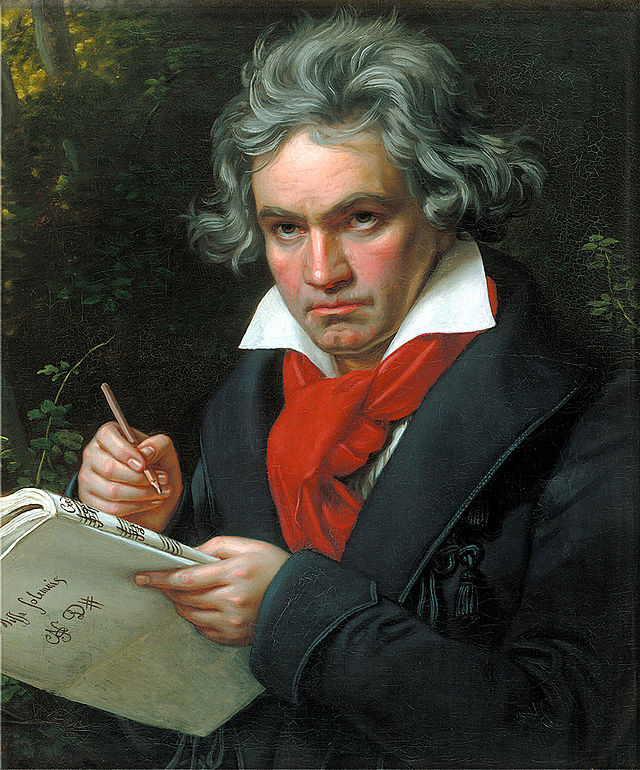
Beethoven: piano concerto no 5, in E flat major, opus 73‏

"Beethoven" - Joseph Karl Stieler

A portrait of Ludwig van Beethoven (1820)

Joseph Karl Stieler

_____________

you might say a triumvirate of piano concertos dominate
our Western musical culture, a veritable trinity of pianistic
masterworks that tower over, and have ruled, our musical
consciousness throughout the modern epoch, the
Rachmaninoff 3 has been one of them, but the 5th of
Beethove
n is surely the granddaddy, the “Guppa” as a
favourite grandchild I know would say, the Olympian
Zeus, the Christian God the Father, of them all, in majesty
and authority, others quake in its overwhelming aura, it is
the sun to all the other stars

Glenn Gould is the standard still by which it should be
played, none yet, to my mind, has surpassed him

Karel Ancerl conducts the Toronto Symphony Orchestra,
a competent orchestration, overshadowed inevitably by
this prodigy, who nevertheless doesn’t ever flaunt his
finger play but remains faithful throughout to the
dictates, the tonal balances, of the music, it is 1972

I had mentioned “variations in volume, tempo, tonality,
the play of harmonization and discords” in Rachmaninoff
,
note the strict adherence to tempo here, even the fastest
runs of notes are grounded in beat, more solid, less elusive
than the iridescent Rachmaninoffian allusions to Debussy,
you could set a metronome to the appropriate tempo of
each individual movement in Beethoven, it would remain
constant, apart from a few restrained ritardandos near
the end of some musical elaborations, until its very final
apotheosis, beat was ever an anchor for the fulgurating
Beethoven, an article of faith from which he strayed only
with great circumspection

note the language is not emotional, passionate and ardent,
but philosophical, metaphysical, Beethoven is confronting
cosmological considerations, existential realities, not the
more emotional concerns that confound us every day, it’s
God he’s talking to, eternity, not the incarnate tendrils
of the moment, not the poignant stuff even of soon
through Schubert a Chopin, Beethoven was at the start
of that Romantic Movement, indeed its very first
proponent, but not quite ready to wear his heart itself
on his sleeve, but a more spiritual, probing reason, whose
ardent metaphysical ratiocinations would set all the others
on fire, setting the stage for all the other stars

later, if you haven’t guessed what it’ll be already, I’ll
supply you with the third concerto, the Holy Ghost, of
the trinity, the Apollo, god of music and the sun, among
our concert greats

Richard

Rachmaninoff: Piano Concerto no 3, in D minor, opus 30

fully 150 years after Mozart the concerto was still a thriving
musical form though it had undergone some modifications,
you’ll hear a more passionate account in Rachmaninoff than
the more lyrical, less emotionally overt compositions of
Mozart, the variations in volume, tempo, tonality, the play
of harmonization and discords, all incidentally within a single
movement, show the passage of time, of Beethoven, of Chopin,
of Debussy between Mozart and the more Romantic, Impressionistic
Rachmaninoff, note the sweeping ritardandos, where the beat is
drawn out, stretched for pathos, a Chopinesque insinuation into
music not found in earlier stuff, one imagines torrid expressions
of fervent sentiment, note the evanescent flurry of notes passing
by like the fleeting glitter of stars, the ephemerality of an
incorporeal idea that Debussy originated and brought to music,
and of course note the irrepressibility, the authority, the masculinity
of a volcanic Beethoven underpinning the lot, you can hear them all

the Vladimir Horowitz Piano Concerto no 3 of Rachmaninoff at
Carnegie Hall, January 8, 1978, with Eugene Ormandy leading the
New York Philharmonic Orchestra is, after Van Cliburn’s historic
1950s account, May 19, 1958, again at Carnegie Hall but under Kiril
Kondrashin this time, and the now defunct Symphony of the Air,
don’t ask, the one I then grew up with, it was riveting even without
the pictures

with pictures here he is again a few months later at Avery Fisher
Hall in New York, September 24, 1978, under Zubin Mehta with
again the New York Philharmonic, so good you’ll even forgive
Mehta his usual sentimental excesses

incidentally Horowitz was 74 at this concert, he is astounding

Vladimir Horowitz, colossus and legend, 1903 -1989

enjoy, be transported, be transfixed, you have been warned

Richard