Richibi’s Weblog

Just another WordPress.com weblog

Tag: Chopin

at the XVth International Tchaikovsky Competition – Daniel Kharitonov‏

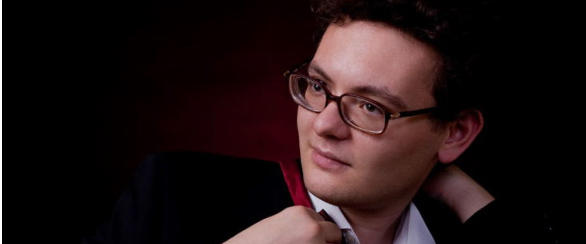
Daniel Kharitonov

Daniel Kharitonov

__________

Daniel Kharitonov will be 17 in
December, I think he could win

after the usual misconceived, to
my mind, Bach, which he ends,
however, with lengthened notes
that evoke the organ instead of
the more skittish, less ceremonial
harpsichord, giving credence to
some, at least, rubato in Bach,
for Bach wrote exceedingly for
the organ, he then not only
recaptures your confidence with
an unexpectedly sparkling
“Appassionata”, not easy after
so many, then polishes off his
laurels with virtuosic Liszt,
Chopin and Rachmaninov after
having played a lovely, aptly
contemplative, “Méditation” of
Tchaikovsky

Daniel Kharitonov is going places,
indeed has gone, Carnegie Hall, for
instance, in 2013, he would’ve been
14

watch

Richard

at the XVth International Tchaikovsky Competition – Bach‏

"J.S. Bach, Wohltemp. Klav. Bd. I, No. IV. (Extrait) / (Duo de Tristesse)" -  Robert Strûbin

“J.S. Bach, Wohltemp. Klav. Bd. I, No. IV. (Extrait) / (Duo de Tristesse)” (1957)

Robert Strûbin

________

if I’ve been getting on their backs
about their Bachs at the Tchaikovsky
Competition
, it’s that they’re playing
Bach as though he were mediocre
Beethoven, it’s like asking Duke
Ellington to be Pink Floyd, it’s just
a completely different generation,
era

Bach wrote for the harpsichord, a
precursor to the piano, it could not
control the volume, nor the length
of a note, the pianoforte came
along to resolve both issues

therefore before Beethoven, who
made full use of the new invention
and worked hard the pianissimos
and the fortissimos, to degrees that
often became either inappropriate
or too authoritative, indelicate or
obnoxious if you’re not in the mood
– I remember wanting to play his so
solemn 111 at my father’s funeral,
but realized late that the first
movement was not especially in
that situation warranted, nor even
parts of the transcendental, but not
always not obstreperous, adagio –
and thumbed thus his nose at the
aristocracy, who earlier, before
the citoyens had demanded their
rights and when the world had
been considered to be of a
rational, logical order, a clock,
and as regular, would never have
tolerated such impudence

Bach and Mozart do not sway
much from strict rhythm, neither
do they alter volume much at all

so that the constant display of
heartfelt Bach and passionate
Mozart becomes cloying, and
not at all what these Classical
and Baroque masters would
have approved of

nor Beethoven, nor Chopin, for
that matter, whose strict tempo
markings didn’t include much
rubato, ritardandos, which you
could think of as milking a note,
putting velvet on your canvas,
it doesn’t work, the composition
itself unaided by bathos, pathos,
delivers, check out, of course,
Glenn Gould

Andrei Korobeinikov sat me right
down the other night with his
arresting BWV868, thrilling,
followed by more dazzling
pyrotechnics, though he fizzled,
and fractured his Beethoven, the
very 111 I care so much for, I
couldn’t even finish, you don’t
need a velvet canvas behind the
111, neither cloying ritardandos,
just skill, nor tangles of notes,
for that matter

Richard

at the XVth International Tchaikovsky Competition – the program‏‏

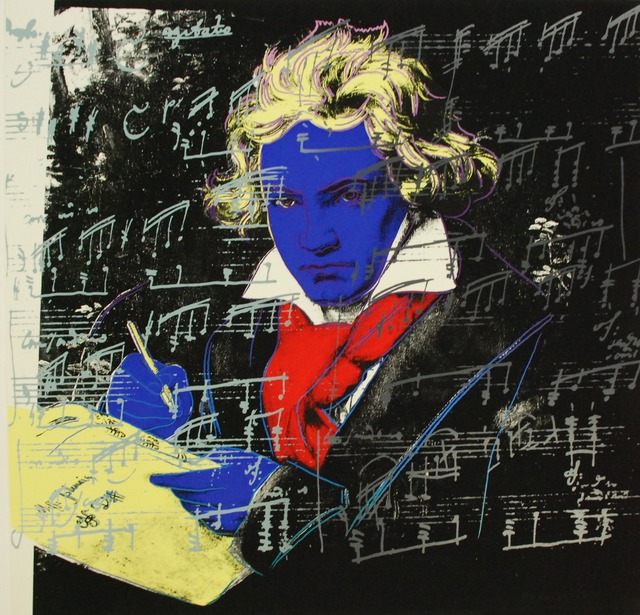
"Beethoven, 1987" -  Andy Warhol

Beethoven, 1987 (1987)

Andy Warhol

______

you’ll probably have noted, if you’ve
been following the Tchaikovsky
Competition
, that, unlike the
Rubinstein, the selection of works
is much more constrained, though
the mighties nevertheless
predominate

after the third day and into the
fourth, only one contestant has
started with anything other than
Bach, a Tchaikovsky

but unfortunately none of them but
one had given us a Bach worthy of
his name, then followed through
with, not surprisingly, a quite
competent Mozart, the cultural
conditions being not yet all that
different, aristocrats were looking
for their own music instead of the
church’s, secular instead of
ecclesiastical, therefore a tune
rather than an oratorio, Beethoven
and the Revolution would change
all that

afterwards a sonata of Mozart,
Haydn or Beethoven, the Classical
triumvirate, after which Tchaikovsky,
appropriately at this competition,
then études, either “-tableaux”,
“transcendentales”, or plain and
simple, by Rachmaninov, Liszt, or
Chopin, that’s it, you get to hear
the “Appassionata” or the “Grandes
études de Paganini”
several times
that way, sharpening discernibly
your musical ear

one was riveting, Andrey Dubov‘s

another, Lukas Geniušas transfixed
me with his opus 2, no 3, of
Beethoven, a work I usually only
ever tolerate, sending it soaring
into the bard’s later mature, and
revelatory, period

others have been competent, even
admirable, several, however, not
ready for this trial, they’ve come
without adequate preparation for
the ball

though I’ve been watching it in
my pajamas, I should talk

Richard

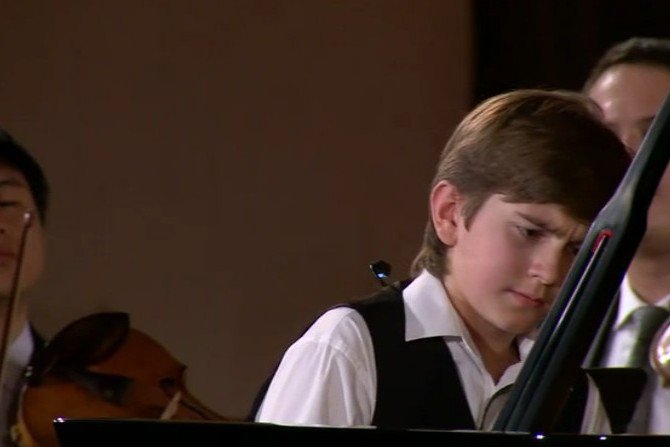
at the XVth International Tchaikovsky Competition‏ – Yuri Favorin


Yuri Favorin

Yuri Favorin

_______

if it doesn’t make you shiver, quiver,
throb even, after the first two numbers,
as far as I’m concerned, forget it, and
that’s being generous

Yuri Favorin flubs his introductory
Bach, losing too often the strict
Baroque tempo markings, notably
in the overlapping fugal* play of
both hands, required of Bach, for
consistency, world view, the clock
being the image of a fundamental
and prophetic order

but once the Romantic Era takes off,
he is transcendent, he made me
hear the Beethoven opus 22 all over
again, Beethoven’s 11th Sonata, and
that’s something, Beethoven can be
pleasant early on, decidedly
entertaining, even inspiring, but not
as profound as he later became, I
like profundity

his Tchaikovsky, his Chopin, are
melting, revelatory, who knew about
Tchaikovsky and “Nocturne’s, or ‘d
even thunk about it, or ‘d heard so
wrenchingly recently the dramatic
change of dynamics from
tempestuous to nearly stopped,
vulnerable and innocent, then
back again, in Chopin, as a device
in his music, in stark and
representative contrast, incidentally,
to Bach’s rigid Baroque framework

Liszt dots the “i” of transcendentalism,
something I refer to often, but which is
formally even expressed in his title,
“Études transcendentales”, an age in
which music aspired to be formally
much more than just music, attempted
to touch beyond the stars, define, even,
God

so when I say things are transcendent,
I’m not kidding, some things let you in
on the voice of deities, divinities, the
ineffable, the wonder, the miraculous

this guy, Yuri Favorin, is transcendent,
and he hasn’t even won yet

Richard

* fugal is the superimposition of
the same musical line alongside
the original one, but at a different
place along that line, we used to
call it singing in canon when it
applied to song

Paganini’s First Violin Concerto – Akiko Suwanai‏

Jean Auguste Dominique Ingres - "Niccolo Paganini" (c.1819)

Niccolo Paganini (c.1819)

Jean Auguste Dominique Ingres

_____________

for Apollo, who alerted me to my error

having egregiously misspelled “Akiko”
in my recent commentaries about Ms
Suwanai, since, however, corrected, I
can only heap upon her greater praise
now for again an immaculate
performance of, this time, Paganini’s
First Violin Concerto
, itself an event,
as atonement

not only does she play this thrilling
masterpiece
with precision and
consummate artistry, this is the
performance with which she wins
the Tchaikovsky Competition, the
one Van Cliburn had secured so
illustriously back in the late Fifties,
at the height of Soviet Communism,
she in 1990, moments only after its
fall, a full, now, 25 years ago

it astounds me that such a talent
would’ve taken so long to reach my
ears, which have been attuned to
Classical music and its
peregrinations for as long as I can
remember

then again there was no ticker tape
parade for Ms Suwanai when she
triumphed
, the world has changed,
it seems such excellence is no longer
so universally paraded, not even
much advertised

the Paganini Violin Concerto was
composed around 1818, late
Beethoven, early Chopin, Paganini
defines for the violin the Romantic
Period, what Chopin did for the piano,
Beethoven had given them the push

if you can get past your astonishment
you’ll note that the foundation of the
piece
is Classical, tight tempi, tonality,
no discordant notes, and repetition
always of the themes, still the triple
pillars of our understanding of music,
its Trinity, despite some strong forays
into their deconstructions, see, for
instance, the haunting George Crumb

what Paganini adds to Classicism is
personality, Romanticism, same as
Beethoven did, and at about the
same time

aristocratic formality was giving way
to the voices of the crowd, some highly
articulate, representative, formidable,
as the shackles of servitude fell with
the French Revolution and human
rights became central, and
indomitable

Richard

Études, opus 10 and 25 – Frédéric Chopin

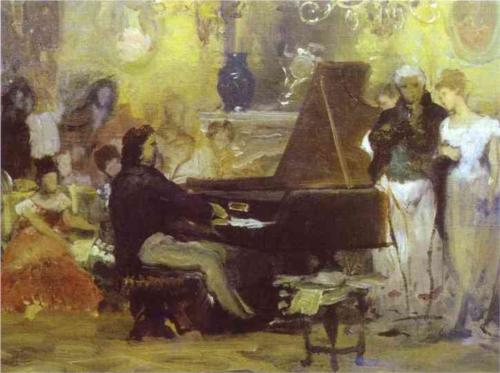
 Henryk Siemiradzki - "Chopin Performing in the Guest Hall- of Anton Radziville in Berlin In 1829" (1887)

Chopin Performing in the Guest Hall- of Anton Radziville in Berlin In 1829” (1887)

Henryk Siemiradzki

__________

no sooner does one inveigh against an
attitude than that attitude turns around
and slaps you in the face, my, however
brief, enrolments at art school, musical
conservatories, and creative writing
classes, were not, I think, without some
merit, some would even say much merit,
despite my short disparagement of them
in my last blog, there are tools for every
art, schools have the machinery to
channel inspiration

Hans Hofman must’ve believed he was
painting a Poème d’amour when he
painted it, why otherwise would he
have painted it, despite myriad
objections, and general
incomprehension, could he have
known that no one would get it, did
he care, who called it art

did Chopin know when he wrote his
first set of “Études”, opus 10, a
theoretical set if there ever was one,
a set of fiendishly challenging
technical exercises, that they would
define the Romantic Period, an era
given over to the very heart, he was
23, having fun

what is art, art is what works, art is a
consensus, sometimes you’ll get it,
sometimes you won’t, sometimes I
get it, sometimes I don’t, art is in the
eye of the beholder, just like beauty
and love

Chopin, the theoretician, produces a
resounding argument for the technical
side of composition, the cerebral, this
is perhaps why they are my favourites
of his compositions

but he hasn’t left out the very centre
of music, how it connects, how it can
carry you along, even to enchantment,
he hasn’t left out the enchantment,
these to me are poems of love

he calls them études, opus 10 and 25

who’d ‘a’ thunk it

enjoy

Richard

my reply to BookInhabiter, a.k.a. Brain

a reader writes

“Hello Richard,
Recently I’ve been watching up on many dance competitions. I knew of the existence of piano competitions but never thought that they would be filmed. I must listen to the top contenders. How did you hear about this competition?”

here is my, admittedly extended, answer, with pertinent links

Richard

_____________


I haven’t missed So You Think You
Can Dance
“,
Brain, for 11 years, so
we’ve probably been watching the
same “many dance competitions”

“piano competitions” aren’t much
different, just another art, judged
here by professionals throughout,
rather than entire publics

the competitions are fierce, to a
person the competitors are world
class

the music is often sublime, utterly
transcendent, though more rigorously
intellectual than popcorn – pace
Mozart – this puts some people off

much as you probably find covers of
songs you like, I go out looking for
sonatas, string quartets, concerti I
already know of and admire, I check
out the big names, Chopin, Beethoven,
Rachmaninov, see what might be up

the Internet abounds with nearly
anything you might want to find, the
only obstacle is the quality

the Van Cliburn competition, from
Houston, was dreadful, enough to
put me off it, but looking for musical
counterparts to pieces of interest, I
found the Rubinstein one in Tel
Aviv
offering sterling performances

I quickly flew across the globe,
virtually, of course, speaking

the experience has been well worth
it, I heard miracles of music, haven’t
had so much fun since reading Proust,
in French of course, but you must
understand I’m an inveterate egghead,
totally chronic

this week I started Edward Gibbon’s
The Decline and Fall of the Roman
Empire”
, text and, to my delight,
audiotape, its reader is extraordinary

check out the Chopin Competition
for, up to this point anyway in my
investigation, only Chopin, but he’ll
do for a significant while, his music
is consistently breathtaking

I’ll also check out the Russian
Tchaikovsky Competition, which Van
Cliburn made famous for us in the late
50’s
, by winning it, despite the rancours
of the Cold War, with a still paramount
rendition of Tchaikovsky’s own
monumental First Concerto

wow, I’ve been hooked ever since

thanks for stopping by my blog, Brain,
you’ll find, incidentally, a lot of excellent
performances highlighted there, several
of the best, in fact, from the most recent
Rubinstein Competition
, none of which,
to my utter consternation, managed to
win

other recommendations follow, check
it out

I think your blog is wonderful, keep
it up

Richard
Ran Dank

Mount  Everest

Mount Everest

_________

though I’d only just listened to a full
recital at the Rubinstein Piano
Competition
, a peek at the next
performer’s program, left me unable
to not watch another, Ran Dank would
be playing, along with four pieces of
Chopin, three mazurkas and his A flat
major Polonaise, itself a towering
musical monument, Beethoven’s
“Hammerklavier”, the very pinnacle
of piano music, nothing surpasses in
majesty and stature the
“Hammerklavier”, the Mt. Everest of
music, a competent reading will
change your life, it is that good

Ran Dank doesn’t disappoint, I left
the planet

Richard

Natalia Sokolovskaya


though there have been gems among
the performances presented during
Stage l of the 14th Arthur Rubinstein
International Piano Master Competition
,
in Stage ll each contestant has been for
me outstanding, I’ve now seen six of
the 16 remaining contenders out of the
original 36, 20 are gone, cast away by
the 7 judges

Natalia Sokolovskaya had mightily
impressed me at Stage l with,
especially, her own 8 Variations
on a Theme of Paganini
” (at 15:00
minutes on the tape)
, you’ll remember

Rachmaninov’s Rhapsody on the
same theme, but for entire orchestra,
Sokolovskaya writes hers for piano
alone, the original theme, from
Paganini’s 24th Caprice, had been
of course for violin

at Stage ll her Rachmaninov First
Sonata (at 20:00 minutes)
is

transcendent, surely definitive, this
is the one I’m going to remember

her Spanish pieces (at 10:00), a
couple of compositions by Albéniz
,

are a wonderful break from the often
very abstract other works on offer,
with their immediately captivating,
beguiling, indeed seductive, rhythms

she even makes the very trite
“Reflections on Love” (at 00:00)
, a

condition of the competition, credible,
by spacing its interchangeable
movements, pausing between them,
letting them breathe, in order to
separate the varied “Reflections”,
instead of stringing them all together
as a continuous, rather than discrete
elements of a, considered whole, as
all the other performers have to date
reflexively done

no one has written anything pertinent
about love, musically, since Chopin,
with the exception of often enough
Rachmaninov, to presume to
significantly comment on love is, to
my mind, pretentious, calling for a
fall, this composer is no exception,
her thoughts are to be expected, love
is atonal, arhytmic, loud, soft, tender,
tempestuous, strident, placating

but everyone already knew that

Sokolovskaya gives the “Reflections”
dignity nevertheless despite their
overt pretensions

a recital to write home about

Richard

the 14th Arthur Rubinstein International Piano Master Competition

Thomas Gainsborough - "The Blue Boy (Portrait of Jonathan Buttall" (1770)

The Blue Boy (Portrait of Jonathan Buttall) (1770)

Thomas Gainsborough

____________


if you’ve missed me lately, it’s because I’ve been
in Tel Aviv for the past week, virtually of course,
taking in the 14th Arthur Rubinstein International
Piano Master Competition
, and they’re not kidding,
every challenger to date has been at the very least
astonishingly dextrous, sparkling even, though
some have been hampered by their own dire
program, with the unfortunate added condition
that, for all, they must integrate one of two
commissioned works that, to my mind, are
completely uninspired

other performers have been astounding, lots
of Beethoven of course, Chopin, Liszt, the
technically utterly daunting

among the moderns Ravel takes centre stage
as an option, with too many, to my mind, of his
tedious pieces,“Gaspard de la nuit”, yawn,
“La [, yawn again] valse”

but Bartok pops up, and Prokofiev, a great set
of variations by Szymanowski, unexpectedly,
and, at one point, a completely irresistible
Ligeti, more of which later

Nikolay Khozyainov starts with the only Ravel
I’ve been able to sit through without getting
impatient, “Gaspard de la nuit” to my mind
should stay there, “La valse” should
immediately stop, but Khozyainov‘s “Pavane
pour une infante défunte”
, or “Procession for
a Deceased Princess” was everything you
would want in a dirge, solemn, transcendental,
transfixing

he follows up with a Liszt to knock your socks
off, “Feux follets”, “Fireflies”, fleet as the night
air, as mesmerizing

the final Rachmaninov sonata reminds us of
how wonderful Rachmaninov really was

watch, listen

Richard