nocturnes / scherzos, Chopin
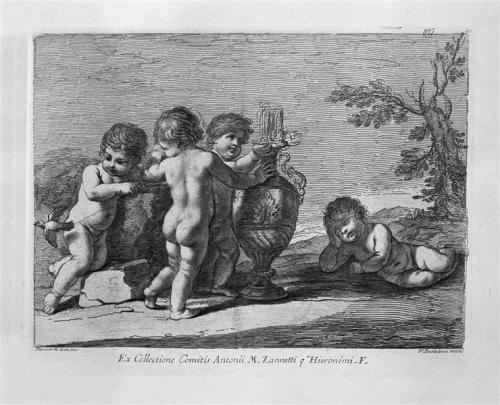
“Scherzo di putti“
Giovanni Battista Piranesi
______________
two, a scherzo
you tell me
both by Chopin
two, a scherzo
you tell me
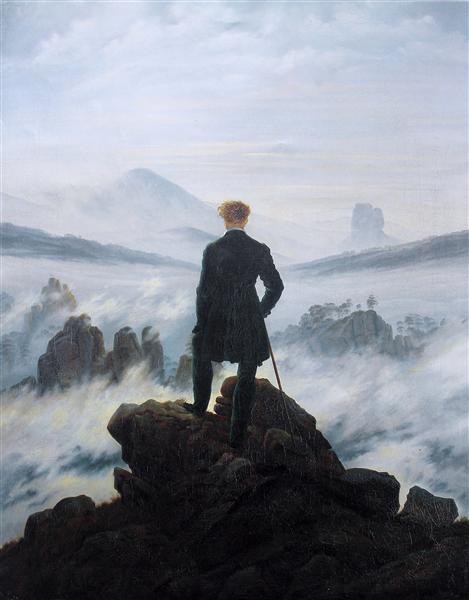
“The Wanderer above the Sea of Fog“ (1818)
_____________
if Beethoven built the Church, along
with Goethe maybe, of Romanticism,
and be assured Romanticism is an
ideology, a moral outlook, a
motivational perspective, much like
the economy is nowadays,
supplanting any more humanistic
imperatives, Brahms put up one of its
Cathedrals, just listen, the First Piano
Concerto is a monument, as mighty
as the Cologne Cathedral musically,
right next to Bonn, incidentally,
Brahms‘ birthplace
with the disintegration of the
supremacy of the Catholic deity
at the onset of the Protestant
Reformation, Luther, Calvin,
Henry Vlll and all that, bolstered
by new discoveries in scientific
speculation, that the earth wasn’t
flat, for instance, that it revolved
around the sun rather than the
other way around, contradictory,
though convincing, voices began
to abound, excite question
in the 18th Century, the Age of
Reason, the Christian Deity fell,
never effectively to be put back
together again, see for Its final
sundering, Nietzsche
in France, after the Revolution,
the Church was officially removed
from political consideration,
countermanding its centuries of
morally heinous depredations,
the United States had already at
its own Revolution separated it
from State
Romanticism was an answer to
a world wherein there might not
be a God, a world with, however,
a spiritual dimension, to respond
to the clockwork universe
envisioned by the earlier epoch,
the Enlightenment, a world where
everything could be categorized,
analyzed, predicted
Romanticism called for the
inclusion of inspiration in the mix,
there are more things in heaven
and earth, Horatio, than are
dreamt of in your philosophy,
as Shakespeare would, for
instance, have it – “Hamlet”,
1.5.167-8
poets became prophets thereby,
if they could manage it, very
oracles, the world was blessed
with, at that very moment,
Beethoven, far outstripping the
likes of, later, for example, Billy
Graham, or other such, however
galvanizing, proselytizers,
whose messages would’ve been
too, to my mind, literal
for music cannot lie, obfuscate,
prevaricate, music cannot be
fake
and then there was Schubert,
and Chopin, Tolstoy, Dickens,
Elizabeth Barrett Browning,
Robert, her husband,
Tchaikovsky, Caspar David
Friedrich, the Johann Strausses,
Byron, Shelley, Keats, whose
artworks, all, are as profoundly
in our blood, our cultural system,
as, if not more so than, our
present information about the
details of our Christian myths,
despite a superfluity of them
even, throughout the long
indeed Middle Ages, and right
up to, and including, the still
fervent then Renaissance, for
better or for worse still, for us
what Romanticism did, and
specifically through the work
of these seminal artists, was
give each of us a chance,
show us how to come
through trial and tribulation,
what a faith does, any faith
it said, here, this is my dilemma,
and this is how I deal with it
for me, Beethoven’s 32nd
Piano Sonata is, soundly, the
epitome of that, but listen to
Brahms put a stamp on it
with undaunted authority
we might be ultimately of no
consequence in an indifferent
universe, they say, but, hey,
this is what we can do, and
do gloriously, while we are
at it
Woody Allen picks up the
purpose in our own recent
20th Century, following in
the earnest footsteps of his
Existential mentor, the much
too dour, I think, Ingmar
Bergman
but that’s another story
entirely
meanwhile, listen
also watch, the conductor here,
a complete delight, is right out
of “Alice in Wonderland“, I
promise you’ll love it
R ! chard

“The Birth of Venus” (1485)
___________
if there’s a piano concerto that dominates
the 19th Century, it’s Tchaikovsky’s First
Piano Concerto, not even Beethoven’s
Fifth, to my mind, matches its celebrity,
one thinks Romantic Period, one thinks
this iconic masterpiece
Tchaikovsky had the advantage of
absorbing not only Beethoven by this
point in history, but also Chopin, the
narrative power of the former, with
the mesmerizing textures of the latter,
what could go wrong but insufficient
genius
of which Tchaikovsky manifestly had
more than plenty, enough to verily
stop your breath
many towering performers have
challenged this concerto‘s peaks,
some even historically, you’ve
heard them, I won’t reiterate
but listen to what Yuja Wang does with
this challenge, and you tell me if she
doesn’t conquer its tribulations,
despite, or abetted by, her
controversial dress
she is a vixen, manifestly, at least in,
admittedly, her attire, but should a
vixen play as brilliantly, what does
one have to counter her provocative
presentation but her innate femininity,
her, too often castigated, female pulse,
something the world could do with a
lot more of
Venus, with all her allure, was goddess
for centuries before women were
obliterated from the dominant Christian
pantheon, the Father, the Son, the Holy,
I ask you, Ghost, with no equal female
foundational representative
Yuja Wang, a modern day Venus abetted
by her evident attendant muses, the
symbolic, here, orchestra, see above,
could play nude, as far as I’m concerned,
she’d still be transcendent, and I’m not
even heterosexual
girlfriend, I say, however proper, modest,
blushing, get a grip
not to mention that Tchaikovsky is also,
in this outing, once again, astounding
R ! chard
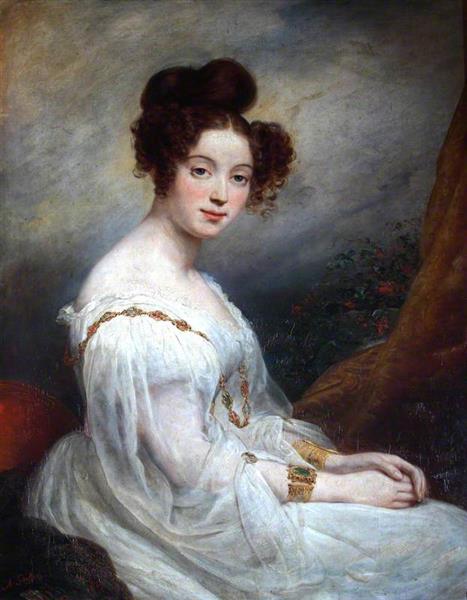
“Charlotte Rothsch, Baroness Anselm De Rothschild“ (1828)
_______
since Beethoven wrote nothing of any
great consequence for four-hand piano,
I thought at first I’d head towards another
kind of pairing, but upon listening to the
complete recital here of the two Jussen
brothers, where Beethoven’s “Variations
on a Theme by Count von Waldstein”,
1792, a trifle, and his later “Waldstein”
Sonata, 1804, for piano solo, an infinitely
more accomplished work of his Middle
Period, both dedicated to the same good
friend and patron, bookend a flurry of
enchanting Schubert compositions,
the contrast between the two composers,
if not starkly evident, is at least
discernable if you listen with some
degree of attention
the difference is in the tone, the intention,
Beethoven is brash, assertive, Schubert
remains ever respectful, even often
courtly
you’ll note that after the fall of Napoleon,
the monarchy was restored in France,
therefore throughout the whole of
Europe, which had resumed its more
genteel pretensions, as had, for instance,
even Chopin himself, you’ll remember, in
very Paris, where he’d relocated from
Poland because of its political unrest
I’ve often said that a distinct characteristic
of Beethoven is that he writes against the
beat, rather than stressing the first note
of the air he is developing, he accentuates
the second, or third, the next still, or the
very last
don’t go, I wish you’d stay here, he, for
example, beseeches, if you transpose
his notes in the last movement of the
Waldstein, the one after the lugubrious
adagio, into words, don’t go, he strikes,
I wish you’d stay, don’t go, I wish you’d
stay here, don’t go, I wish you’d stay, I
wish you’d stay, I wish you’d stay,
accent each time on the stay
in Schubert’s “Fantasie“ for four-hand
piano, written a generation later, in 1828,
and admittedly powerfully influenced by
Beethoven, though no more derivatively
than Mozart would’ve been of Haydn, try,
I hear a bird sing, I hear it sing, I hear it
sing, it sounds so lovely, to the lovely
melody at its very beginning, one
composer is peremptory, the other is
more subservient, confessional
this is what I mean by intention, and the
difference between these two towering
geniuses, who shaped together the
music of their era, however might they
have been otherwise total strangers
they are both musical giants upon
whose shoulders our Western culture
still stands, and swoons, before such
an utterly transcendent legacy
R ! chard
“Suite Fibonacci“ (2003)
________
before I say much more about his Cello
Suites, let me point out that Bach has
some French Suites, some English
Suites, on top of similarly structured
Partitas and Toccatas, the French have
their tout de suites, and hotels have,
nowadays, their so named luxury
apartments
musical suites are sets of dance pieces,
by the early 18th Century much stylized,
with an introductory prélude, an allemande,
followed by a courante, which is to say, folk
dances, the first German, the next French,
then a sarabande, Spanish, followed by a
couple of galanteries, court dances,
minuets, gavottes, bourrées, then a final
English gigue
all of the markings are in French, which
leads me to believe that all of these
dances must’ve originated at the court
of Louis XlVth, the Sun King, 1638 to
1715
but the suggestion is that Europe was
becoming an integrated community
all of these dances were eclipsed by
the Classical Period, of Haydn and
Mozart, apart from the minuet, which
more or less defined, nevertheless,
that new era
the minuet will die out by the time of
Beethoven, you’ll note, to be replaced
by the waltz, which had been
considered much too racy until
transformed by Chopin into a work
of ethereal art
the Strausses, father and son, gave it,
only a little later, celebratory potency,
but that’s another story
here’s Bach’s English Suite, the 3rd,
for context, the French ones are a
little too salty, as it were, they do not
quite conform to prescribed suite
notions, however might their
propositions have been, ahem,
sweet
meanwhile, enjoy this one
R ! chard
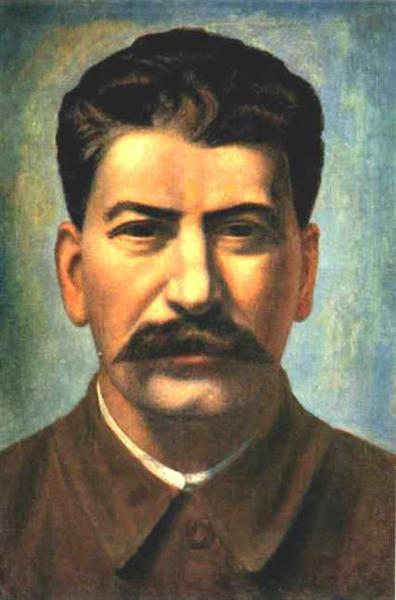
“Portrait of Joseph Stalin (Iosif Vissarionovich Dzhugashvili)“ (1936)
_________
if you’ve been waiting for a Shostakovich
to write home about among his early
symphonies, here’s the one, his
Symphony no 4 in C minor, opus 43 will
knock your socks off from its very
opening gambit, have a seat, settle in,
and get ready for an explosive hour
the Fourth was written in 1936, some
years after the death of Lenin, and the
instalment of Stalin as the supreme,
and ruthless, authority, after several
years throughout the Twenties of
maneuvering himself, cold-bloodedly,
into that position
from Stalin, “Death is the solution to
all problems. No man – no problem.“
fearing retribution after Stalin had
criticized his recent opera, “Lady
Macbeth of Mtsensk“, Shostakovich
cancelled the first performance of
this new work, due to take place in
December, ’36, others had already
suffered internal exile or execution
who had displeased the tyrant, a
prelude to the infamous Great Terror
the Symphony was eventually played
in 1961, 25 years later, conducted by
no less than Kirill Kondrashin, who’d
partnered Van Cliburn a few years
earlier in Cliburn’s conquest of Russia,
but along with this time however the
long-lived Leningrad Philharmonic
Orchestra
to a friend, I said, this is the biggest
thing since verily Beethoven, no one
has so blown me away symphonically
since then
he looked forward, he replied, to
hearing it
the Fourth Symphony has three distinct
movements, to fit thus appropriately the
definition of symphony, though the first
and third have more than one section,
something Shostakovich would have
learned from already Beethoven, it gives
the opportunity of experiencing a variety
of emotions within one uninterrupted
context, add several movements and
you have a poignant, peripatetic musical
journey, more intricate, psychologically
complex, than many other even eminent
composers, Schubert, Chopin,
Mendelssohn, even Brahms, for instance
it’s helpful to think of film scores, and
their multiple narrative incidents,
brimming with impassioned moments,
however disparate, Shostakovich had
already written several of them
let me point out that Shostakovich’s
rhythms are entirely Classical, even
folkloric in their essential aspects,
everywhere sounds like a march,
proud and bombastic, if not a
veritable dance, peasants carousing,
courtiers waltzing, and repetition is
sufficiently present to not not
recognize the essential music
according to our most elementary
preconceptions
but the dissonances clash, as though
somewhere the tune, despite its rigid
rhythms, falls apart in execution, as
though the participants had, I think,
broken limbs, despite the indomitable
Russian spirit
this is what Shostakovich is all about,
you’ll hear him as we move along
objecting, however surreptitiously,
cautiously, to the Soviet system, like
Pasternak, like Solzhenitsyn, without
ever, like them, leaving his country
despite its manifest oppression, and
despite the lure of Western accolades,
Nobel prizes, for instance, it was their
home
and there is so much more to tell, but
first of all, listen
R ! chard
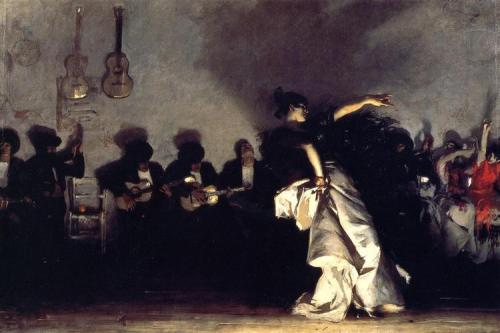
not much is heard from Spain during
Western music’s Golden Ages, Baroque,
Classical, Romantic, Impressionist,
now even Pop’s, Rock’s, Punk’s, Rap’s,
Post-, in all their incarnations, Modern’s

“The Musical Contest“ (1754-5)
______
with only four contestants to go,
I already crown Shino Hidaka the
winner of the XVth Tchaikovsky
Competition, this kind of affinity
only comes around once in a
lifetime, her Bach was not only
perfect but inspired, probing,
her ensuing Chopin,
mesmerizing, the Beethoven
that followed aptly, though ever
unexpectedly, transcendental,
transcendence not ever
happening without absolute
mystical concentration, her
Tchaikovsky, an evocation
rather than a mere description
of a Russian village, her
Rachmaninov, on utter fire
Dmitry Shishkin, before her,
neither was un-brilliant, a
consummate technician,
however, rather than an outright
revelation, his spirited Bach was
a turning point for me, finally
someone who got it, his Mozart,
as frivolous and delightful as
Mozart would’ve wanted it to be,
the rest appropriately everywhere
dazzling, second, therefore, ever
so illustrious, nevertheless,
prize, bravo
neither, incidentally, milked any
of their notes, just played what
was written
Richard
psst: compare Fragonard, above, to
Mozart, a synaesthetic match,
where sight and sound are
interwoven, giving you social
intimations of the mid-18th
Century
 Richibi's Weblog