Just another WordPress.com weblog
Tag: Chiron / centaur
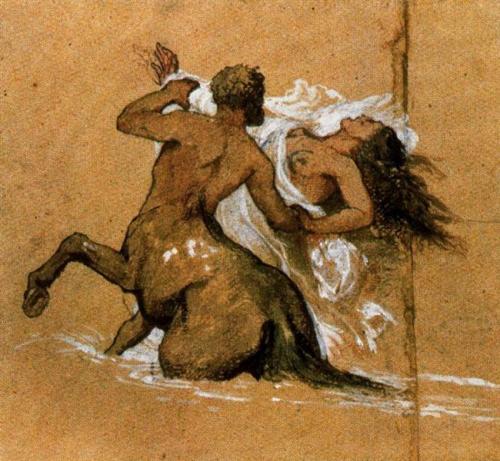
______ Thus entring into destiny, the maid The secrets of offended Jove betray’d: especially Hades , Jove’s brother, had prophesied that Apollo ‘s child with Coronis would be an acclaimedhealer, thus defraud[ing] the tomb, thereby saving people from the clutches of Hades , the especially aggrieved god More had she still to say; but now appears Oppress’d with sobs and sighs, and drown’d in tears. Occhyroe would have had more to prophesy, but was impeded byinvoluntary physical spasms “My voice,” says she, “is gone, my language fails; Through ev’ry limb my kindred shape prevails: kindred shape, the bodilycharacteristics of her father, her kin, the centaur Chiron Why did the God this fatal gift impart, And with prophetick raptures swell my heart! prophetick raptures, Occhyroe , whohad inherited through her father, Chiron , who had himself receivedit from Apollo , his own father, the gift of divination, for better, for either, we’ll learn, or for worse What new desires are these? I long to pace O’er flow’ry meadows, and to feed on grass; I hasten to a brute, a maid no more; what’s happening, What new desires are these?, Occhyroe cries, or nearly neighs, rather, at this point, I’m becoming a brute, she groans, an animal, a maid, no more, she objects But why, alas! am I transform’d all o’er? My sire does half a human shape retain, And in his upper parts preserve the man.” why, Occhyroe asks, since my father, Chiron , is partially a man, am I transform’d all o’er? , whyis there nothing left of me that is human Her tongue no more distinct complaints affords, distinct, clear, easy to decipher affords, allows, permits But in shrill accents and mis-shapen words Pours forth such hideous wailings, as declare The human form confounded in the mare: Occhyroe has become a horse,the proof is in her braying ‘Till by degrees accomplish’d in the beast, She neigh’d outright, and all the steed exprest. all the steed exprest, was everywhere the very picture of a horse born, borne, carried Her hands are turn’d to hoofs, and shod in horn, Her yellow tresses ruffle in a mane, And in a flowing tail she frisks her train, The mare was finish’d in her voice and look, And a new name from the new figure took. Occhyroe can no longer be called Occhyroe , she is no longer she,but a new figure, needing to be identified as something else R ! chard
________ Old Chiron took the babe with secret joy, Proud of the charge of the celestial boy. His daughter too, whom on the sandy shore The nymph Charicle to the centaur bore, With hair dishevel’d on her shoulders, came To see the child, Ocyrrhoe was her name; nymph Charicle , c[o]me …[t] o see the child With hair dishevel’d on her shoulders, there’s a suggestion here, regarding Charicle , of madness, or possession the child, the babe, the celestial boy, the infant, ript, by its very father, Apollo , from his unfaithful lover,its, or his, care She knew her father’s arts, and could rehearse The depths of prophecy in sounding verse. it appears that Ocyrrhoe , daughter of a poetess , was possessed, on her father’s side, of poetry, could reveal, decipher, or rehearse / The depths of prophecy, in sounding verse , was able, as wordmongers sometimes do, to tell truth, deliver, in rhyme, incisive evaluations Once, as the sacred infant she survey’d, the sacred infant, the child born of The God was kindled in the raving maid, The God, the child, the sacred infant, by virtue of being half, if only half, divine, having been fathered by the kindled, inspired the raving maid, Ocyrrhoe , beset byneurotic, irrational, though prophetic, it is proposed, powers And thus she utter’d her prophetick tale: “Hail, great physician of the world, all-hail; great physician of the world, become a healer of legend Hail, mighty infant, who in years to come Shalt heal the nations, and defraud the tomb; defraud the tomb, recall from thehereafter, resuscitate, revive, return to life Swift be thy growth! thy triumphs unconfin’d! Make kingdoms thicker, and increase mankind. thicker, more populated Thy daring art shall animate the dead, Thy daring art, medicine, the mighty infant will eventually be recognizedas a celebrated man of healing And draw the thunder on thy guilty head: guilty head, when Hades , king of the brother, that the mighty infant was stealing his subjects, the departed, Zeus shot the great physician down,acknowledging the healer’s guilt, of his defraud[ing] the tomb, condemningthe culprit with a punishing, an annihilating, thunderbolt Then shalt thou dye, but from the dark abode Rise up victorious, and be twice a God. Apollo , aggrieved, had had his son,the child, the sacred infant, reinstated,after tortuous ministrations, as animmortal god, an entirely, however, other story And thou, my sire, not destin’d by thy birth To turn to dust, and mix with common earth, How wilt thou toss, and rave, and long to dye, And quit thy claim to immortality; When thou shalt feel, enrag’d with inward pains, The Hydra’s venom rankling in thy veins? the child, the sire, not destin’d by [its] birth / T o turn to dust, which is to say, to be nolonger mortal but immortal, how will it, not wanting particularly to survive, quit [its] claim to immortality, deal with theimpossibility of dying, [w]hen [it] shal[l] f eel, enrag’d with inward pains, agonies, that compel it to seek personal annihilation Hydra , a snakelike monster with manyheads, whose venom and very breath were poisonous, stationed at one of The Gods, in pity, shall contract thy date, And give thee over to the pow’r of Fate.” contract thy date, make mortal,subject once again to Fate R ! chard
__________ On her incestuous life I need not dwell king of Lesbos , a Greek Island in the Aegean Sea , had been defiled by her father, Minerva , out of pity, transformed her into an owl , the above verses tell the story of
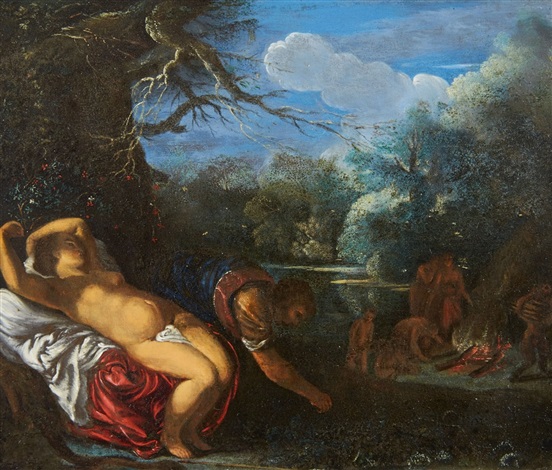
The raven, urg’d by such impertinence, the raven, Apollo’s own bird , having discovered Coronis to be unfaithful to their master, its and hers, remained intent, despite the daw’s warnings, earlier here reported, on informing the god of the Sun The God was wroth, the colour left his look, wroth, angry The wreath his head, the harp his hand forsook: [t]he wreath, … the harp, Apollo’s usual attributes, symbols of his harmony, concord His silver bow and feather’d shafts he took, though Apollo is not usually associated with bows and arrows, his twin sister Diana , goddess of the Hunt, always is, it would not be unusual to conflate the two deities for poetic, or indeed mythological, purposes Down fell the wounded nymph, and sadly groan’d, it is supposed here that the unborn infant is indeed Apollo’s The God dissolves in pity at her death; He hates the bird that made her falshood known, Apollo is suffused with regret, anger, self-recrimination Fain would he heal the wound, and ease her pain, Fain, with pleasure, gladly And tries the compass of his art in vain. the compass of his art, the range of his ability, in this case vain, faulty, ineffective Soon as he saw the lovely nymph expire, pile, pyre the sentence lacks a verb here, it should read The pile was made ready, just saying With sighs and groans her obsequies he kept, obsequies, funeral rites And, if a God could weep, the God had wept. I’ll have to watch out for gods weeping, I suspect some have, some can Her corps he kiss’d, and heav’nly incense brought, corps , body, corpse wrought, brought about, madehappen
But lest his offspring should her fate partake, Spight, in spite He ript her womb, and set the child at large, Chiron , first among the centaurs, half man, half horse, was highly revered as a teacher, having been raised by the twins, Apollo accomplished deities Then in his fury black’d the raven o’er, black’d, Apollo turned the snowy plume[d], [w]hite as the whitest dove’s unsully’d breast raven black prate, babble, talk incoherently R ! chard
 Richibi's Weblog